
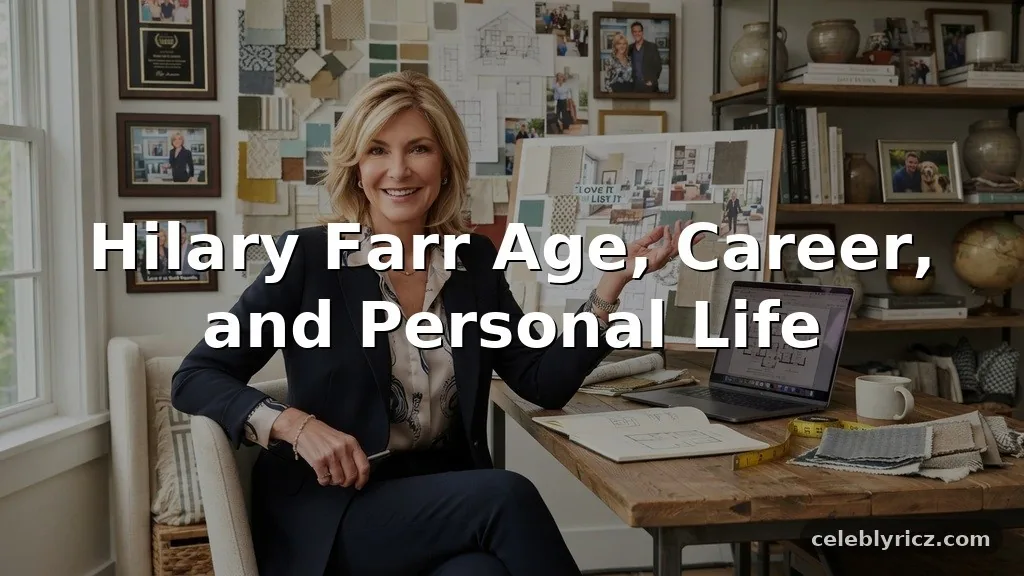

Hilary Farr spent fifteen years convincing homeowners not to move. As the design half of HGTV’s “Love It or List It,” she became one of the most recognizable faces in home television — the quick-witted designer sparring with realtor David Visentin over whether a family should renovate or relocate. But her career started decades before HGTV, in London ballet studios, Los Angeles film sets, and a surprising detour through 1970s cult cinema.
This Hilary Farr profile covers her age, her Toronto birth and London upbringing, the Royal Ballet School years, her acting roles including “The Rocky Horror Picture Show,” the design career that made her famous, the “Love It or List It” phenomenon, her solo series “Tough Love,” her marriages and son, and her estimated net worth.
Born Hilary Elizabeth Labow in 1951, she has been working since the early 1970s — as a renovator, set designer, actress, entrepreneur, and television host. At 75, she remains an active and sought-after authority in the design world, still shaping how North America thinks about home. Here is the full story.
At a Glance
| Fact | Details |
|---|---|
| Full name | Hilary Elizabeth Farr (née Labow) |
| Birth date | August 31, 1951 |
| Age in 2026 | 75 years old |
| Birthplace | Toronto, Ontario, Canada |
| Nationality | British-Canadian |
| Height | 5 ft 9 in (175 cm) |
| Professions | Designer, businesswoman, television host, former actress |
| Years active | 1972–present |
| Signature show | “Love It or List It” (2008–2023, with David Visentin) |
| Company | Hilary Farr Designs (Toronto and New York) |
| Marriage | Gordon Farr (m. 1982; div. 2008) |
| Children | 1 son |
| Net worth | Estimated at around $8–10 million |
How Old Is Hilary Farr?
Hilary Farr was born Hilary Elizabeth Labow on August 31, 1951, in Toronto, Ontario, Canada, which makes her 75 years old in 2026. Some lower-quality sites list 1952 or even 1962, but the 1951 date is the consistently cited one across reputable profiles including Wikipedia’s sourced biography.
Her age is part of her distinction: she became a television star in her late 50s, when “Love It or List It” premiered in 2008, and carried a hit show into her 70s. In an industry obsessed with youth, Farr proved that authority and charisma compound with experience — and that the best time to become a star is whenever you are ready.
Toronto Roots, London Childhood
Farr was born in Toronto to a British mother and a Canadian father — her mother an Anglican in the Church of England tradition, her father Jewish. She was raised celebrating both Jewish and Christian traditions, a dual heritage she has spoken about with pride.
The family moved to London, where Farr spent her formative years immersed in European art and culture. That exposure — museums, theater, architecture — shaped the aesthetic sensibility that would define her design career. She has credited her mother, who encouraged her creativity from childhood, as her earliest design influence.
The Royal Ballet School and an Artist’s Path
As a child, Farr attended London’s prestigious Royal Ballet School until age 11, aspiring to become a professional ballerina. The discipline of dance training — precision, presentation, relentless practice — left its mark even after she left ballet behind.
She pivoted toward theater, attending theater school in London and developing an interest in the visual side of performance: sets, spaces, and how environments tell stories. At sixteen, she was allowed to redesign a family property in London — an experience she describes as the true beginning of her design career.
Los Angeles: Renovations, Film Sets, and Cult Cinema
Farr began her professional career in Los Angeles in the early 1970s, working as a home renovator while also designing sets for film and television. It was a hustle-era education: real clients with real budgets by day, the fantasy world of film sets by night.
During this period she also worked as an actress, appearing in minor roles in cult and genre films: “The Rocky Horror Picture Show” (1975), “City on Fire” (1979), “The Return” (1980), and “Legend of the Werewolf.” The acting roles were small, but the film sets were an invaluable education — she was learning production design from the inside while the cameras rolled.
She eventually retired from acting to focus on design full-time. The decision proved wise: the renovation business she built in those years became the foundation for everything that followed.
The Turning Point: Choosing Design Over Acting
The decision to leave acting was not dramatic — it was practical. The roles were small, the design work was growing, and Farr recognized where her real talent lay. But the acting years were not wasted: performing taught her presence, timing, and how to command a room — skills that would serve her extraordinarily well when television came calling three decades later.
There is a pleasing symmetry to it. The young woman who once acted in front of cameras spent the middle of her career behind the scenes, then returned to the camera as herself — not playing a role but being the expert. The detour through cult cinema turned out to be preparation for stardom, just on a much longer timeline than anyone expected.
Building Hilary Farr Designs
Farr founded Hilary Farr Designs, her interior design firm with operations in Toronto and New York City. Over the decades, she built a reputation for sophisticated, livable luxury — spaces that photograph beautifully but are designed to be lived in, not just looked at.
Her exclusive client list grew to include prestigious celebrity homes — actress Jenna Elfman is among the names associated with her work — and her projects spanned residential and commercial spaces across North America. She became widely known for a particular and rare talent: seeing the hidden potential in a tired, dated space and articulating exactly how to unlock it, a skill that would translate perfectly to television.
Like lifestyle entrepreneur Kim Gravel, who built a business empire on understanding what real customers want, Farr’s success came from designing for actual lives rather than magazine spreads. That practicality became her brand.
“Love It or List It”: The Show That Made Her Famous
In 2008, Farr became co-host of HGTV’s “Love It or List It” alongside realtor David Visentin — and a phenomenon was born. The format was simple and addictive: a couple divided over their home, Hilary renovating to make them “love it,” David showing them listings to make them “list it.” The sparring between designer and realtor gave the show its crackling energy.
The chemistry between Farr and Visentin was the engine. Her dry wit, design authority, and barely concealed exasperation at tight budgets played perfectly against his realtor’s optimism. Fifteen seasons and hundreds of episodes later, the show had aired in both Canada and the United States, making Farr one of the most recognizable and beloved home-design figures in North America.
The show ran from 2008 to 2023, an extraordinary lifespan in reality television. Its success spawned international versions and cemented the “renovate vs. relocate” format as a genre staple. For Farr, it meant fame arriving in her late 50s — and the platform to build everything that came next.
“Tough Love with Hilary Farr” and Solo Projects
In 2021, Farr stepped out on her own with “Tough Love with Hilary Farr,” a solo HGTV series in which she helped families through difficult renovation decisions with her signature blend of candor and compassion. The show let her design philosophy take center stage without the realtor foil.
Beyond television, she launched a home décor line, wrote for lifestyle publications, and became a sought-after keynote speaker at design expos and conferences. She also made guest appearances on shows like “ET Canada,” “The Marilyn Denis Show,” and “Brother vs. Brother,” expanding her footprint across North American lifestyle media.
Hilary Farr Net Worth
Hilary Farr’s net worth is estimated at around $8–10 million as of 2026, with some outlets citing $10 million. The figure reflects five decades of earnings across design fees, television salaries, product lines, and speaking engagements.
The television years were the most lucrative: fifteen seasons as the co-lead of a hit HGTV show, plus her solo series, would have generated substantial per-episode fees. Her design firm, operating in two major markets for decades, provided steady high-end income. The home décor line and brand partnerships added licensing revenue on top.
Like many women who built businesses in male-dominated industries, Farr’s financial success came from ownership and expertise rather than celebrity alone. She was not just the face of a design brand — she was the designer.
Personal Life: Marriage, Son, and Privacy
Farr married Gordon Farr in 1982; the marriage ended in divorce in 2008. She has one son, whose life she has kept almost entirely out of the public eye. Unlike many television personalities, Farr drew a firm line between her on-screen persona and her private world.
That privacy extends to her family background: while she has spoken warmly about her parents’ influence — particularly her mother’s role in sparking her design passion — she has shared little about siblings or extended family. In an era of oversharing, her restraint is notable.
She divides her time between Toronto and New York, the two cities where her design firm operates. Friends describe her as exactly what she appears to be on television: sharp, funny, opinionated, and deeply committed to her craft. Like fitness entrepreneur Nala Fitness, who turned personal expertise into a business brand, Farr’s authenticity is the product — and it has never wavered.
Design Philosophy and Influence
Farr’s design philosophy centers on a simple idea: homes should work for the people who live in them. Her celebrated television renovations were never about imposing a personal style but about solving real human problems — a growing family needing space, an aging couple needing accessibility, a couple divided needing compromise made visible.
She became an advocate for women in business and design leadership, using her platform to encourage the next generation. Her keynote speeches blend practical design advice with career wisdom earned over five decades: trust your eye, know your worth, and never stop learning.
Her influence on the renovation-television genre is structural. The designer-as-problem-solver archetype she perfected — part therapist, part contractor, part truth-teller — is now the template for the entire category.
The Farr-Visentin Dynamic: TV’s Best Odd Couple
No discussion of Hilary Farr is complete without David Visentin, her “Love It or List It” sparring partner for fifteen seasons. Their on-screen relationship — part rivalry, part affectionate bickering, part genuine friendship — was the show’s secret weapon. Viewers tuned in as much for the banter as for the renovations.
The dynamic worked because it was real. Farr’s exasperation at Visentin’s lowball listings and his teasing about her budget overruns played like a long-married couple’s routine. Behind the scenes, the two developed a deep mutual respect; Farr has said that Visentin’s challenges made her a better designer, forcing her to justify every dollar and every decision.
Their partnership is now part of reality-TV history — one of the longest-running and most beloved hosting duos in the genre. When the show ended in 2023, fans mourned the duo as much as the format. It was never just about the houses; it was about Hilary and David.
Signature Style: What Makes a Hilary Farr Renovation
Farr’s design signature is recognizable: clean lines, sophisticated neutrals punctuated by bold accents, open sightlines, and an almost architectural attention to flow. She favors timeless over trendy — the kitchens and living spaces she designed a decade ago still look current, which is the ultimate test of a renovation.
Her television renovations had to satisfy two masters: the homeowners’ needs and the camera’s demands. She became a master of the reveal — the moment when a family sees their transformed space — because she understood that the emotional payoff was the product as much as the renovation itself.
Memorable episodes became legend among fans: the cramped bungalows opened into airy family homes, the dated basements reborn as entertainment spaces, the impossible budgets stretched through sheer design ingenuity. Each one reinforced her core message: good design is not about money, it is about vision.
Life After “Love It or List It” (2023–2026)
Since the flagship show ended in 2023, Farr has remained active across the design world. Her firm, Hilary Farr Designs, continues operating in Toronto and New York, taking on residential and commercial projects. She maintains her home décor line and her writing for lifestyle publications.
Her keynote speaking career has flourished, with appearances at major design expos and conferences where she addresses both craft and career — the business of design as much as its art. She has become a mentor figure for the industry, particularly for women navigating the business side of creative work.
Television has not closed its doors: guest appearances and specials keep her in front of audiences, and at 75 she shows no signs of retiring from public life. The designer who became famous in her late 50s seems determined to keep proving that creative careers have no expiration date.
Farr’s Advice for Homeowners
Across hundreds of episodes and interviews, Farr distilled her philosophy into practical wisdom. Her core advice: renovate for how you actually live, not for resale fantasies or magazine aesthetics. The most common mistake she saw was homeowners prioritizing trends over function — the open-concept kitchen nobody cooks in, the formal dining room nobody uses.
She preached refreshing budget honesty: know exactly what things cost before you fall in love with an ambitious plan, and always keep a contingency for the surprises every renovation hides. And she championed the emotional side of home decisions — acknowledging that houses hold memories, and that “love it or list it” is never just a financial calculation.
That empathy was her superpower. Where other TV designers performed expertise, Farr performed understanding. Homeowners trusted her with their biggest decisions because she treated those decisions as what they were: life choices disguised as design problems.
Awards and Industry Recognition
Across five decades, Farr collected the honors that mark a distinguished career: industry awards for design excellence, television recognition for “Love It or List It,” and keynote invitations that signal peer respect. Her 2021 solo series “Tough Love” earned its own acclaim, proving she could carry a show without the Visentin foil.
But her most meaningful recognition may be the informal kind: the generations of designers who cite her as inspiration, the homeowners whose lives her renovations changed, and the viewers who learned to see their own spaces differently. Awards gather dust; influence compounds.
The Education That Shaped Her
Farr’s formal design education is often summarized as Ryerson University (now Toronto Metropolitan University), but her real schooling was broader: the Royal Ballet School’s discipline, London theater’s visual storytelling, Los Angeles film sets’ practical craft, and decades of clients’ real-world demands. It is a reminder that the best education for a designer is not a single degree but a life spent looking carefully at how spaces work.
Frequently Asked Questions
How old is Hilary Farr?
Hilary Farr was born on August 31, 1951, in Toronto, Canada, which makes her 75 years old in 2026.
What happened to Love It or List It?
The show aired from 2008 to 2023, running fifteen seasons with Farr and David Visentin. Farr later starred in her own HGTV series, “Tough Love with Hilary Farr,” in 2021.
Was Hilary Farr an actress?
Yes. Early in her career she appeared in minor film roles including “The Rocky Horror Picture Show” (1975), “City on Fire” (1979), and “The Return” (1980), before retiring from acting to focus on design.
Is Hilary Farr married?
She was married to Gordon Farr from 1982 until their divorce in 2008. She has one son and keeps her family life private.
What is Hilary Farr’s net worth?
Her net worth is estimated at around $8–10 million as of 2026, earned through her design firm, fifteen seasons of television, product lines, and speaking engagements.
Conclusion
Hilary Farr’s biography is the story of a woman who reinvented herself repeatedly — ballerina, actress, set designer, renovator, entrepreneur, television star — and made every version work. From a London childhood to Los Angeles film sets to fifteen seasons of “Love It or List It,” she built a career on taste, tenacity, and the rare ability to tell people hard truths with a smile.
At 75, with an estimated $8–10 million net worth and a design authority that spans five decades, she remains what she has always been: the expert in the room. The show may have ended, but the influence — on television, on design, and on every woman ever told she was too old to start something new — goes on. Hilary Farr did not just redesign houses. She redesigned what a design career could look like, one fearless reinvention at a time.
Explore more on CelebLyricz.