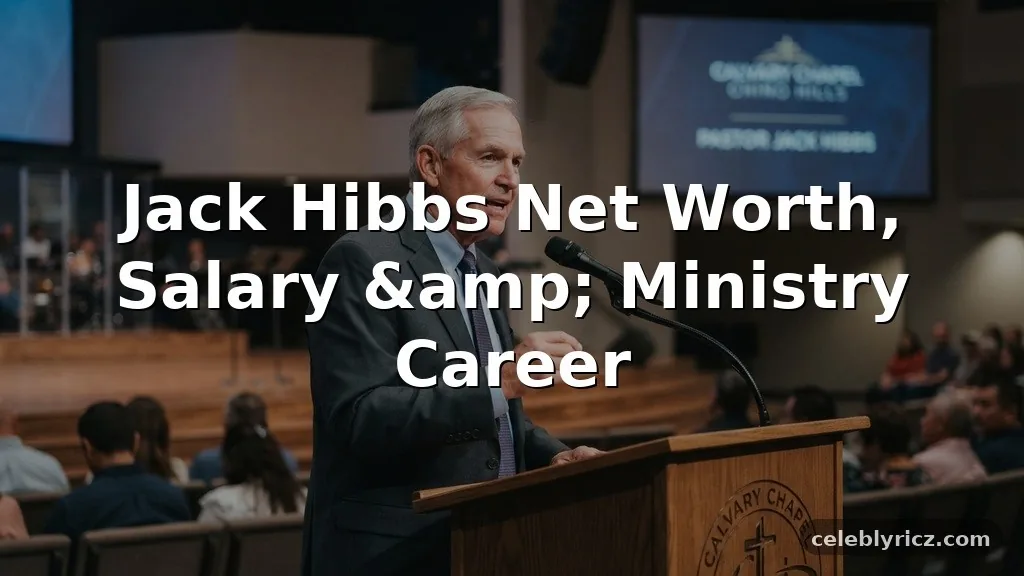

Jack Hibbs has spent nearly five decades building one of America’s most influential evangelical ministries — and naturally, people want to know what that built financially. Jack Hibbs’ net worth is estimated at approximately $5 million as of 2026, with sources ranging from $2 million to $8 million. His salary is not publicly disclosed (estimated in the low-to-mid six figures), and no verified financial record exists for either number. What follows is an honest accounting of what can and can’t be established about his wealth — and the ministry career that produced it.
This companion to our salary-focused profile takes the net-worth angle: where the money comes from, how 48 years of ministry compounds, how his wealth compares to other religious leaders, and the full arc of his ministry career — from a 19-year-old convert in 1977 to the 68-year-old patriarch of Calvary Chapel Chino Hills.
Born January 15, 1958, Hibbs founded his church in 1990 with six people in a living room. Today it draws 10,000+ weekly, his “Real Life” broadcast airs nationally, and his YouTube audience tops a million. The financial story is inseparable from that ministry story — so we tell both.
Jack Hibbs Net Worth: The Full Picture
The consensus estimate — ~$5 million — comes from triangulating multiple income streams over a very long career. Here’s how analysts build the number:
Income Stream 1: Pastoral Compensation (1990–present)
Thirty-five years as senior pastor of a church that grew from 6 to 10,000+ attendees. Early years: modest church-planter pay. Later years: estimated low-to-mid six figures annually, plus the clergy housing allowance. Compounded over decades — even with generous giving factored in — this alone builds a seven-figure foundation.
Income Stream 2: Broadcast Ministry
“Real Life with Jack Hibbs” — nationally syndicated radio and television — generates revenue through the ministry’s media arm. While broadcast income primarily funds the ministry itself, senior leaders of such operations typically draw compensation reflecting the enterprise’s scale.
Income Stream 3: Books and Royalties
Multiple published books, including Turn Around At Home (co-authored with wife Lisa). Book royalties for a pastor with a million-strong digital audience provide steady, long-tail income — modest per year, meaningful over decades.
Income Stream 4: Speaking Fees
Conference and event appearances nationwide. Top-tier evangelical speakers command significant fees; even a dozen engagements a year adds a meaningful line to the ledger.
Income Stream 5: Digital Revenue
YouTube ad revenue (648K–1.13M subscribers), podcast sponsorships, and digital product sales — the newest and fastest-growing slice of the pie.
The through-line: no single windfall, just 48 years of compounding. That’s why the $5 million figure, while unverified, passes the smell test — it’s what a frugal, high-earning professional accumulates over a near-half-century career. For the salary-specific breakdown, see what we know about Jack Hibbs’ salary, and our overview of how much Jack Hibbs is worth.
Jack Hibbs Quick Facts
| Fact | Detail |
|---|---|
| Full name | Jack Hibbs |
| Born | January 15, 1958 (age 68 in 2026) |
| Converted | 1977, age 19, Calvary Chapel Costa Mesa |
| Mentor | Pastor Chuck Smith |
| Church founded | Calvary Chapel Chino Hills, 1990 |
| Weekly attendance | 10,000+ |
| Broadcast | “Real Life with Jack Hibbs” (radio/TV) |
| Wife | Lisa Hibbs |
| Net worth (est.) | ~$5 million |
| Salary | Not disclosed |
Ministry Career Timeline
| Year | Milestone |
|---|---|
| 1958 | Born January 15 in California |
| 1977 | Converts to Christianity at 19 at Calvary Chapel Costa Mesa; mentored by Chuck Smith |
| 1977–1990 | Thirteen years of learning: self-taught theology, Calvary Chapel ministry training |
| 1990 | Founds Calvary Chapel Chino Hills with Lisa — six people in their living room |
| 1990s | Steady growth through expositional Bible teaching; moves to larger facilities |
| 2000s | Church becomes a regional megachurch; media ministry expands |
| 2010s | “Real Life” broadcast goes national; YouTube audience builds; books published |
| 2020s | 10,000+ weekly attendance; million-subscriber digital reach; national evangelical leadership role |
| 2026 | Age 68; still senior pastor, broadcaster, and author |
The Thirteen Years Before the Church
The least-told part of Hibbs’ story is the 1977–1990 apprenticeship — thirteen years between conversion and church planting. Under Chuck Smith’s mentorship at Costa Mesa, Hibbs absorbed the Calvary Chapel DNA: verse-by-verse teaching, plain speech, and the conviction that the Bible, taught clearly, grows churches.
His self-taught theology was forged in those years — not in classrooms but in study, in serving, in watching a master. When he finally planted Chino Hills in 1990, he wasn’t a young visionary improvising; he was a 32-year-old craftsman executing a model he’d internalized for over a decade. That patience is the hidden variable in everything that followed.
Building the Megachurch: How 6 Became 10,000
The growth mechanics are worth studying because they explain the financial base:
- The product: Consistent, expositional Bible teaching — the same sermon DNA every week for 35 years. No gimmicks, no series-driven hype cycles.
- The model: Calvary Chapel’s reproducible structure — simple governance, contemporary worship, strong children’s and youth ministries.
- The compounding: Families stay, invite neighbors, raise kids in the church. Growth is slow, then sudden — the classic compounding curve.
- The location: Chino Hills, in Southern California’s Inland Empire, sat in the path of massive suburban growth through the 1990s and 2000s.
- The media multiplier: As the broadcast grew, it fed the church — visitors who’d watched online showing up in person.
Each new attendee meant new tithes, which funded new facilities and staff, which enabled more growth. The $5 million net worth is, in a real sense, the personal residue of that flywheel — what remained after decades of giving, spending on ministry, and living modestly.
“Real Life”: The Broadcast Empire
The “Real Life with Jack Hibbs” media ministry deserves its own accounting because it’s both his largest platform and a significant economic engine:
- Radio: Nationally syndicated daily teaching broadcast
- Television: Weekly TV program carrying sermons to broadcast audiences
- YouTube: 648K–1.13M subscribers; sermons routinely drawing six-figure views
- Podcast: Audio feeds with sponsorship inventory
- Social: Active presence on Instagram, Facebook, and X
Media ministries of this scale operate as substantial nonprofits-within-the-church — production teams, distribution costs, and the revenue to sustain them. Hibbs’ national profile (and the speaking fees and book sales it drives) is downstream of this broadcast footprint.
Net Worth vs. Ministry Wealth: An Important Distinction
One confusion to clear up: the church’s wealth is not the pastor’s wealth. Calvary Chapel Chino Hills’ campus, budgets, and broadcast infrastructure belong to the ministry, not to Jack Hibbs personally. Conflating the two — as some viral posts do — produces absurd figures.
The honest framework:
- Church assets: Belong to the nonprofit; substantial but not personal
- Ministry revenue: Funds operations, staff, outreach — not a personal account
- Personal net worth (~$5M): 48 years of salary, royalties, fees, and digital income, minus living expenses and (by all accounts) generous giving
This is why the $5 million estimate is more credible than both the lowball ($2M) and the inflated ($25M) figures: it matches the math of a long, well-compensated, modestly-lived career.
How He Compares to Other Christian Leaders
| Leader | Est. net worth | Career length | Profile |
|---|---|---|---|
| Jack Hibbs | ~$5M | 48 years | Megachurch founder; broadcaster |
| Joel Osteen | ~$50M | 25+ years | Televangelist; bestselling author |
| T.D. Jakes | ~$30M | 40+ years | Megachurch; films; conferences |
| John MacArthur | ~$15M (est.) | 50+ years | Expositional preaching; media |
Hibbs sits in the middle of the pack — wealthier than the average pastor by orders of magnitude, but far from the televangelist tier. The comparison that flatters him most is John MacArthur: another long-tenured expositional preacher whose wealth reflects decades of books and broadcasts rather than lifestyle branding.
Family and Personal Life
Lisa Hibbs has been partner in every sense since 1990 — co-founder of the church, co-author of Turn Around At Home, and leader in the church’s family ministries. Their daughters and grandchildren feature constantly in Hibbs’ sermons as illustrations of faith, legacy, and parenting.
The family’s public posture is notably unflashy: no reality shows, no lifestyle brands, no celebrity machinery. For a family adjacent to an estimated $5 million and a 10,000-member church, the modesty is itself a statement — and, to supporters, evidence that the ministry is the point.
What the Future Holds
At 68, the questions are succession and legacy. Who eventually leads Calvary Chapel Chino Hills? Which of Hibbs’ mentees and church plants carry the model forward? The broadcast infrastructure he’s built — studios, audiences, distribution — is designed to outlast any single preacher, which may be the most valuable thing he’s constructed.
Financially, the trajectory is set: the catalog (sermons, books, broadcasts) will generate income for years, the church is institutionally stable, and the personal finances appear secure. The $5 million estimate may well grow — or it may be the plateau of a man who never optimized for money in the first place.
The Giving Side: Where the Money Goes
A net-worth discussion that only counts accumulation misses half the picture. By every available account, Hibbs directs substantial resources back into ministry:
- Church operations: The Chino Hills campus, staff, and programs consume the vast majority of the church’s budget — the machinery that serves 10,000+ people weekly.
- Missions giving: Calvary Chapel’s movement DNA includes aggressive global missions support; Chino Hills is a major contributor.
- Community outreach: Local programs serving the Inland Empire — food, counseling, youth work.
- Broadcast subsidy: Media ministries rarely break even; the “Real Life” operation likely consumes more than it earns, funded by the broader ministry.
- Personal generosity: While private, those close to the ministry describe a pastor who gives significantly beyond the tithe.
This is the context the $5 million figure needs: it’s what’s left after a lifetime of giving, not what’s been hoarded. Whether one shares his theology or not, the financial pattern — earn steadily, live modestly, give substantially — is hard to criticize on its own terms.
Signature Teachings and Series
Over 35 years in the Chino Hills pulpit, certain themes define the Hibbs catalog:
- Verse-by-verse expositions: Complete book studies — Romans, Revelation, Genesis, the Gospels — forming the backbone of the “Real Life” broadcast library.
- Prophecy teaching: Hibbs is known for end-times and prophecy series, a Calvary Chapel staple that draws some of his largest audiences.
- Family and parenting: Drawing on his own experience as a father and grandfather — the material behind Turn Around At Home.
- Cultural engagement: Series addressing contemporary issues from a biblical worldview — the content that built his national profile beyond the church walls.
- Holiday messages: Christmas and Easter services that draw the year’s largest crowds, many of them visitors.
The through-line is consistency: the same text-driven, plainly-spoken, urgently-delivered teaching, year after year. In an era of sermon-as-TED-talk, Hibbs’ refusal to chase trends is itself a distinctive.
The Succession Question
Every founder-pastor faces it, and at 68, Hibbs is no exception: what happens to Calvary Chapel Chino Hills when he steps back? The Calvary Chapel model — built around a strong senior pastor — makes succession particularly delicate. History offers both warnings (churches that collapsed after a founder’s departure) and successes (orderly transitions to trained successors).
What we know: Hibbs has spent decades developing associate pastors and leaders within the church, the broadcast infrastructure can carry his teaching indefinitely, and the church-planting network provides a pipeline of trained leaders. What we don’t know — because he hasn’t said — is the timeline. For now, the question remains theoretical, and the ministry shows no signs of transition planning going public.
Financially, succession matters too: the $5 million personal net worth is independent of the church’s institutional wealth, which is the point — a clean separation that makes transition cleaner whenever it comes.
Criticisms and Defenses
A fair profile notes the criticisms alongside the achievements:
- On wealth: Critics of megachurch economics argue that any multi-million-dollar pastor net worth is incompatible with the Gospel. Defenders note 48 years of work, modest living, and the math of compounding.
- On cultural engagement: Critics say his political outspokenness compromises pastoral neutrality. Supporters say neutrality in the face of cultural decay is the compromise — and that his audience grows precisely because he speaks.
- On theology: Mainline and progressive critics dispute his conservative positions. Within his tradition, he’s regarded as faithful, not extreme.
What’s notable is what’s absent from the criticism: no financial scandals, no moral failures, no lavish lifestyle exposés. In the landscape of megachurch controversies, Hibbs’ record is remarkably clean — which may be the most telling data point of all.
What a Megachurch Pastor Actually Does All Week
The salary estimates make more sense once you see the job description. A senior pastor of a 10,000-member church with a national broadcast isn’t preaching twice on Sunday and golfing the rest of the week. The reality:
- Sermon preparation: 15–25 hours weekly for verse-by-verse exposition — the study behind the “self-taught” reputation is relentless.
- Broadcast production: Recording, reviewing, and approving radio, TV, and digital content.
- Leadership: Directing dozens of staff, meeting with elders, setting vision, handling the crises that inevitably surface in a community of thousands.
- Pastoral care: Counseling, hospital visits, weddings, funerals — the unglamorous core of pastoring that no broadcast captures.
- Writing and speaking: Books, conference messages, and the preparation each demands.
- Public engagement: Interviews, cultural commentary, and the controversy management that comes with it.
It’s a 60–70 hour week, every week, at 68 years old. Whatever one thinks the number should be, the workload behind it is not in doubt — and it’s the strongest argument the estimates have: this is executive-level labor, compensated at something like executive-level rates, over a timespan few executives sustain.
The Verdict: What We Actually Know
After the estimates, the ranges, and the caveats, here’s the honest summary:
- Net worth: ~$5 million (est.), built over 48 years — credible, unverified, and consistent across sources.
- Salary: Undisclosed; plausibly low-to-mid six figures based on comparable roles.
- Lifestyle: Modest by every available account — no scandal, no extravagance on record.
- Career: One of the great church-building runs in modern American Christianity: 6 to 10,000+, plus a national broadcast.
- Family: Married to Lisa since before the church existed; daughters and grandchildren; co-author and ministry partner.
The numbers will keep circulating, and they’ll keep being estimates — because Jack Hibbs, like most pastors, doesn’t publish his finances. What he has published, in the only currency that matters to his calling, is the work: nearly five decades of it, verse by verse, week by week, from a living room to a movement.
Key Takeaways
- Jack Hibbs’ net worth is estimated at ~$5 million — the product of 48 years of ministry income, not a windfall.
- His salary is not publicly disclosed; comparable megachurch roles suggest low-to-mid six figures.
- He founded Calvary Chapel Chino Hills in 1990 with six people; it now draws 10,000+ weekly.
- The “Real Life” broadcast, books, and digital platforms form a national media ministry.
- He lives modestly by all accounts, with no financial scandals on record.
- Married to Lisa Hibbs; daughters and grandchildren; co-author of Turn Around At Home.
Frequently Asked Questions
What is Jack Hibbs’ net worth?
Jack Hibbs’ net worth is estimated at approximately $5 million as of 2026, with sources ranging from $2 million to $8 million. It reflects 48 years of pastoral salary, book royalties, speaking fees, broadcast revenue, and digital income. No verified financial disclosure exists.
What is Jack Hibbs’ salary?
Jack Hibbs’ salary is not publicly disclosed. Estimates based on comparable megachurch compensation place it in the low-to-mid six figures annually. The church has never published his pay.
When did Jack Hibbs start his ministry?
Jack Hibbs converted to Christianity in 1977 at age 19 and, after thirteen years of training under Chuck Smith’s mentorship, founded Calvary Chapel Chino Hills with his wife Lisa in 1990 — starting with six people in their living room.
Who is Jack Hibbs’ wife?
Jack Hibbs is married to Lisa Hibbs, his co-founder of Calvary Chapel Chino Hills and co-author of “Turn Around At Home.” They have daughters and grandchildren.
How big is Calvary Chapel Chino Hills?
Calvary Chapel Chino Hills draws more than 10,000 weekly attendees across multiple services, up from six people at its 1990 founding. It operates a large campus in Chino Hills, California, with extensive ministries and a national broadcast operation.
Jack Hibbs’ net worth — roughly $5 million by the best estimates — is best understood not as a number but as a residue: what’s left after 48 years of ministry, modest living, and (by every account) generous giving. The ministry career that produced it is the real story: thirteen years of apprenticeship, thirty-five years of building, and a living-room Bible study that became a movement outpost.
The salary will stay private, the estimates will keep circulating, and the work will go on. At 68, Jack Hibbs has what most leaders never get — a finished foundation and an unfinished mission. The net worth is a footnote; the ministry is the headline.