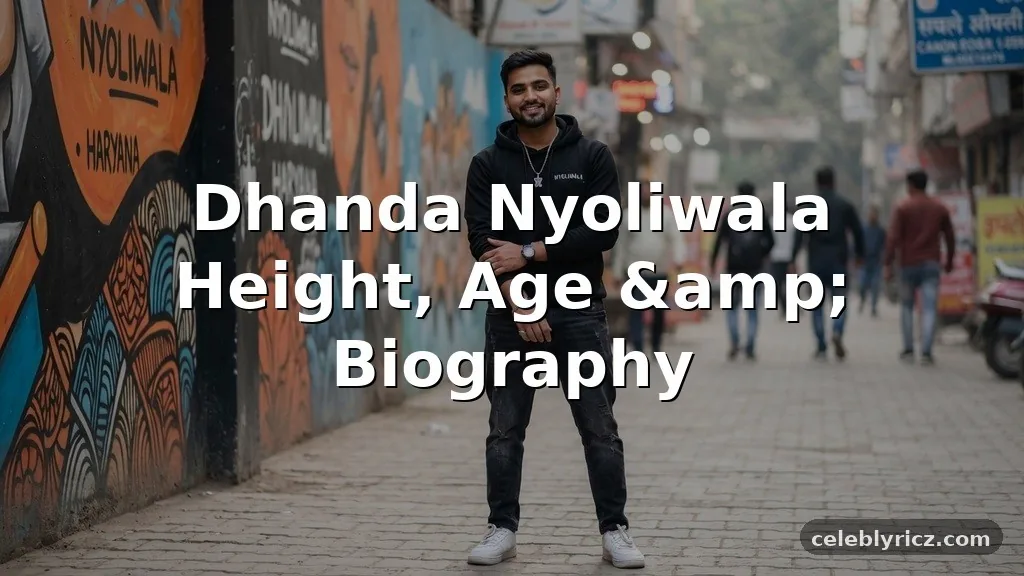

Dhanda Nyoliwala — born Parveen Dhanda — is the Haryanvi rap star whose journey from national-level athlete to global hip-hop artist is one of Indian music’s most remarkable stories. Fans searching for Dhanda Nyoliwala’s height, age, and biography find plenty of confident claims online — but the honest truth is that his exact height has never been reliably reported, and his birth date is disputed (most commonly given as May 21, 1997, which would make him 29 in 2026).
What we can document is more interesting than any single number: a bronze-medal steeplechase athlete and national-level javelin thrower whose physique was forged in elite competition; a move from Nyoli Kalan village to Australia’s Gold Coast; and a music career built on anthems like “Up To U,” “Ego Killer,” and “No Mercy.”
This profile focuses on the physical and personal side — his height and build, his age controversy, and his biography — with a full career account available in our complete Dhanda Nyoliwala biography.
Dhanda Nyoliwala Height: What We Know
Dhanda Nyoliwala’s exact height is not publicly documented. Unlike mainstream celebrities whose stats are published by agencies, independent artists like Dhanda rarely have verified measurements — and no credible source has published a specific figure.
What can be said with confidence comes from his athletic career. As a national-level javelin thrower (left-handed) and 3000m steeplechase competitor — bronze medalist at the 4th Indian Grand Prix in Patiala on June 21, 2021, in 9:24.86 — he possesses the build of an elite track-and-field athlete: powerful shoulders and core from javelin, lean endurance conditioning from steeplechase. Photographs and videos show a solid, athletic frame — broader and more powerfully built than the typical rapper, a direct legacy of his throwing background.
On stage, his physicality is part of the performance: the stamina to command a crowd for a full set comes straight from athletic training, and his confident, grounded presence reflects years of competing under pressure. For artists whose image is built on strength and authenticity, the athlete’s body is the brand — no stats required.
Why Celebrity Heights Are Often Wrong
A quick note on why you should distrust specific height figures for independent artists: unlike film actors (measured for casting) or athletes (measured for competition), musicians have no institutional reason to publish verified measurements. Numbers on fan sites are usually guesses, copied from other guesses. When no primary source exists — as with Dhanda — the responsible answer is “not publicly documented,” not a fabricated number.
Dhanda Nyoliwala Age: The Birth-Date Question
Dhanda Nyoliwala’s age is most commonly reported as 29 in 2026, based on a birth date of May 21, 1997. But this is genuinely disputed:
| Reported birth date | Age in 2026 | How common |
|---|---|---|
| May 21, 1997 | 29 | Most frequently cited across independent sources |
| May 21, 1998 | 28 | Appears in several profiles |
| July 15, 1999 | 27 | Single-source claim |
No official document has settled the question. The May 21, 1997 date appears most often and is the best-supported answer — but treat it as commonly reported, not confirmed. What the dispute itself reveals is worth noting: Dhanda has never made his age a marketing point, unusual in an industry obsessed with youth. His brand is built on bars and authenticity, not birthdays.
Dhanda Nyoliwala Quick Facts
| Fact | Detail |
|---|---|
| Real name | Parveen Dhanda |
| Stage name | Dhanda Nyoliwala (“Nyoliwala” = from Nyoli village) |
| Birth date | May 21, 1997 (most common; disputed) |
| Age in 2026 | 29 (if 1997 date correct) |
| Height | Not publicly documented; athletic build |
| Birthplace | Nyoli Kalan, Hisar, Haryana, India |
| Residence | Gold Coast, Queensland, Australia |
| Athletic background | National-level javelin; 3000m steeplechase bronze (2021) |
| Wife | Asha Saharan |
| Breakout song | “Up To U” (2022) — 75M+ YouTube views |
| Net worth (est.) | ₹6–8 crore (~$1M USD) |
Biography: From Nyoli Kalan to the World
Village Roots
Parveen Dhanda was born in Nyoli Kalan village, Hisar district, Haryana, into a grounded agrarian family — his father a government teacher, his mother a homemaker, with a younger brother who has supported him throughout. The village’s dialect, values, and struggles became his artistic raw material: he didn’t just come from Nyoli Kalan, he turned it into a brand.
The Athlete (pre-2018)
Before music, Parveen was a serious athlete — national-level javelin thrower and 3000m steeplechase runner. The bronze medal at the 4th Indian Grand Prix (Patiala, June 21, 2021, 9:24.86) is a matter of public record and the most documented achievement of his pre-music life. Elite athletics gave him discipline, pain tolerance, and competitive psychology — the same toolkit he’d later apply to music.
Australia (2018–present)
In 2018, he moved to Australia for higher education, enrolling in Mechanical Engineering at Queensland University of Technology. He lived across Queensland, Sydney, and Melbourne before settling on the Gold Coast. He left engineering for music — but the Australian years sharpened his identity and exposed him to international hip-hop, fusing with his Haryanvi foundation.
The Music Breakthrough (2019–2022)
He began writing songs in 2019, debuting with “Afgan” in 2020. The breakthrough came in 2022 with “Up To U” — written impromptu during a car ride, infused with the spirit of Urdu poet Jaun Elia — which exploded past 75 million YouTube views and made him a global desi hip-hop star. Follow-ups “Ego Killer,” “No Mercy,” and “Unstoppable,” plus the Raftaar collaboration “Chora Baba Ka,” cemented the position.
Global Artist (2023–2026)
International tours across Australia, Canada, New Zealand, and India; 1.71M+ YouTube subscribers and 3.7M Instagram followers; the first Haryanvi rapper to collaborate with English-speaking artists; and in April 2026, the “Boom Shaka” collaboration with KRSNA — 74 million views and a symbolic torch-passing between generations. The 2024 “Vomit On Paper” controversy made him a polarizing figure but didn’t slow him down.
For the full career account, see our Dhanda Nyoliwala age and biography profile.
Physical Presence: The Athlete’s Advantage on Stage
Dhanda’s athletic background gives him physical advantages most rappers lack:
- Stamina: Steeplechase conditioning translates directly to high-energy live sets — he doesn’t fade halfway through a show.
- Power: Javelin training built the upper-body strength visible in his frame and felt in his delivery.
- Composure: Years of competition taught him to perform under pressure — the same skill that steadies him in front of thousands.
- Discipline: The training mentality (show up, work, repeat) carried into his music career’s relentless output.
In an era when many rappers’ stage presence is purely theatrical, Dhanda’s is earned — the body and the bearing of someone who actually did the work. Fans sense the difference even if they can’t name it.
Personal Life: Wife and Family
Dhanda is married to Asha Saharan (also reported as Asha Dhanda), herself reported to be a national-level athlete. They live on the Gold Coast, Australia. His parents — the teacher father and homemaker mother — and his younger brother remain the grounding force he credits publicly, and the Jat community values in his lyrics reflect the values he was raised with.
The Javelin Thrower’s Body: What the Sport Builds
To understand Dhanda Nyoliwala’s physique, understand what javelin throw does to a human body. It’s among the most technically violent events in athletics — a full-sprint approach channeled through a whip-like throwing motion that demands:
- Shoulder and back power: The throwing shoulder, lats, and rotator cuff develop asymmetrically — javelin throwers are famously lopsided, with the throwing side visibly more developed. Dhanda threw left-handed, a rarity that made him stand out on the Indian circuit.
- Core rotational strength: The throw’s power comes from the hips and torso unwinding like a spring. Years of this build a thick, powerful midsection — the opposite of a distance runner’s lightness.
- Leg drive: The crossover steps and plant leg absorb enormous force, building powerful quads and glutes.
- Overall mass: Unlike sprinters or distance runners, throwers carry significant muscle. The sport rewards power-to-weight, not lightness.
The result is a powerfully built, broad-shouldered frame — the build visible in Dhanda’s photos and videos. It’s a physique that reads as strength rather than fitness-model leanness, and it gives his stage presence a grounded, immovable quality. When he plants his feet and delivers a verse, the body language is an athlete’s: balanced, coiled, deliberate.
Steeplechase Conditioning: The Engine Underneath
What’s unusual about Dhanda is that he also competed in the 3000m steeplechase — one of athletics’ most brutal events, combining distance running with barrier jumps and water pits. The steeplechase builds:
- Aerobic capacity: The lung power to sustain effort — directly transferable to performing a 60–90 minute live set without fading.
- Lower-body endurance: The legs that carry him through a show’s final song as strongly as its first.
- Mental toughness: The steeplechase is a pain-management event; athletes learn to perform while suffering. That psychology — comfort with discomfort — is the same one that powers through a grueling tour schedule.
- Leanness under power: The rare combination of thrower’s strength and distance runner’s engine produces a uniquely capable body.
His 9:24.86 bronze-medal run at Patiala in 2021 isn’t just a biographical footnote — it’s proof of a cardiovascular engine most performers would envy. When fans marvel at his stage energy, they’re watching steeplechase conditioning repurposed for hip-hop.
From Track to Stage: How Athletics Shaped His Art
The athlete-to-artist pipeline runs deeper than physique. Consider the transfers:
Discipline as Creative Method
Elite training is monotonous: same drills, same track, same weights, for years, with progress measured in centimeters and seconds. Dhanda’s music career shows the same pattern — the early years of writing (2019–2020) with little audience, the steady release schedule, the refusal to chase trends. The grind mentality is identical; only the arena changed.
Competition Psychology
Throwers compete against the field and the measuring tape simultaneously — every attempt is public, judged, final. That maps directly onto rap’s battle culture and the vulnerability of releasing music to public judgment. Dhanda’s comfort with confrontation in his lyrics (the “Ego Killer” persona, the “Vomit On Paper” fearlessness) has roots in a sport where you either deliver on the runway or you don’t.
Representing the Village
Indian athletics, like Indian hip-hop, runs on small-town talent. The javelin circuit taught Dhanda what the rap game later confirmed: the village produces champions the cities overlook. His entire brand — Nyoli Kalan on the world stage — is the athletic narrative retold in music.
The Injury Chapter
His athletic career also included the setback every elite athlete fears: a period sidelined by injury, described in profiles as leaving him bedridden — the national medalist reduced to a patient. That crucible matters. Athletes who’ve lost their bodies understand impermanence in a way the healthy don’t, and Dhanda’s pivot to music carried the urgency of someone who’d already lost one dream and refused to lose another. The hunger in his early tracks isn’t performed; it’s the sound of a second chance.
Style and Image: The Visual Identity
Dhanda Nyoliwala’s visual presentation is as deliberate as his lyrics:
- Desi-street fusion: His style blends Haryanvi rural signifiers with international hip-hop aesthetics — the visual equivalent of his musical fusion.
- Physical confidence: He dresses to show the athlete’s frame, not hide it — fitted clothes, confident posture, the bearing of someone comfortable in his body.
- Village signifiers: Elements that read as Haryanvi pride — a deliberate contrast with rappers who adopt purely Western visuals.
- Gold Coast polish: The Australian years added an international sheen — better production values in videos, sharper styling — without diluting the roots.
The image works because it’s coherent: the body, the clothes, the dialect, and the beats all tell the same story. In an era of manufactured rapper personas, Dhanda’s visual identity is documentary — it’s just him, amplified.
Age and Career Stage: Why 29 Matters in Hip-Hop
In hip-hop, 29 is a fascinating age — past the “young prodigy” window, not yet the veteran statesman. For Dhanda, the timing is ideal:
- Old enough for authority: His lyrics about struggle, village life, and social issues carry the weight of lived experience, not teenage posturing.
- Young enough for the culture: At 29, he’s still fluent in the sounds, platforms, and energies driving hip-hop forward.
- The athletic prime parallel: Throwers often peak in their late 20s — Dhanda’s music career is hitting its stride at exactly the age his athletic career would have.
- A decade of runway: With his catalog, audience, and work ethic, the next ten years — his 30s — could be his most productive, following the pattern of rappers whose best work comes with maturity.
The birth-date dispute fades against this bigger picture: whether 27, 28, or 29, he’s in the sweet spot — experienced enough to lead, hungry enough to still prove.
The Gold Coast Base: Life in Australia
Dhanda’s Gold Coast, Queensland base shapes his daily reality in ways fans don’t always consider. The Gold Coast offers what an artist-athlete needs: world-class training facilities (if he still trains — and the physique suggests he does), a laid-back creative environment, proximity to the Indian diaspora communities of Brisbane and Sydney, and the distance from India’s noise that lets him work.
His wife Asha Saharan, herself a national-level athlete, shares that world — a household where discipline is the default setting. It’s a long way from Nyoli Kalan, and that’s the point: the village made him, Australia refined him, and the music carries both.
Training Then and Now: The Fitness Thread
Dhanda has never published a workout routine, but his athletic history lets us reconstruct what built — and likely maintains — his physique:
- Throwing sessions: Technical javelin work — approach runs, release drills, video analysis — building the shoulder, back, and rotational power still visible today.
- Steeplechase training: High-mileage weeks, interval sessions, barrier technique — the aerobic base that powers his stage stamina.
- Strength work: Olympic lifts, plyometrics, and core circuits standard for throwers — the foundation of his solid frame.
- Maintenance: Even retired from competition, athletes of his caliber rarely stop training entirely. The sustained physique across years of music videos suggests ongoing gym work — the discipline doesn’t retire when the spikes do.
For young fans, the lesson is the one his life demonstrates: the body is an instrument, whether the performance is a throw or a verse. Dhanda’s career is proof that athletic discipline transfers — that the 5 a.m. track sessions of Nyoli Kalan were, in retrospect, rehearsals for the stage.
The Complete Physical Profile: Summary
| Attribute | Status |
|---|---|
| Height | Not publicly documented |
| Build | Athletic, powerfully framed (javelin background) |
| Conditioning | Elite aerobic base (steeplechase background) |
| Distinguishing traits | Left-handed thrower; competition-hardened stage presence |
| Documented achievement | Steeplechase bronze, 4th Indian Grand Prix, 9:24.86 |
| Current base | Gold Coast, Australia — active, touring performer |
Did You Know?
- Dhanda Nyoliwala is left-handed — a rarity among javelin throwers that made him stand out on the Indian athletics circuit.
- His breakout hit “Up To U” was written impromptu during a car ride, inspired by the Urdu poetry of Jaun Elia.
- He is the first Haryanvi rapper to collaborate with English-speaking artists.
- His wife Asha Saharan is also a national-level athlete — the household runs on discipline.
- His stage name literally means “Dhanda from Nyoli” — his village, worn as a crown.
Frequently Asked Questions
How tall is Dhanda Nyoliwala?
Dhanda Nyoliwala’s exact height has never been reliably reported by any credible source. He has a solid, athletic build from his background as a national-level javelin thrower and 3000m steeplechase athlete. Any specific height figure online should be treated as unverified.
How old is Dhanda Nyoliwala?
Dhanda Nyoliwala is most commonly reported as 29 years old in 2026, based on a birth date of May 21, 1997. However, sources disagree — some give May 21, 1998, and one gives July 15, 1999. The 1997 date is the most frequently cited but remains unconfirmed.
What is Dhanda Nyoliwala’s real name?
Dhanda Nyoliwala’s real name is Parveen Dhanda. “Nyoliwala” refers to his home village of Nyoli Kalan in Haryana’s Hisar district — his stage name literally means “Dhanda from Nyoli.”
Was Dhanda Nyoliwala really an athlete?
Yes. Before music, Parveen Dhanda competed at the national level in javelin throw (left-handed) and the 3000m steeplechase. He won bronze at the 4th Indian Grand Prix in Patiala on June 21, 2021, finishing the steeplechase in 9:24.86 — a documented athletic achievement.
Who is Dhanda Nyoliwala’s wife?
Dhanda Nyoliwala is married to Asha Saharan, who is reported to be a national-level athlete herself. The couple lives on the Gold Coast in Queensland, Australia.
Dhanda Nyoliwala’s height, age, and biography tell a story that’s bigger than measurements: a village athlete who became a global rapper without abandoning either identity. The exact inches don’t matter — what matters is the frame they built: javelin shoulders, steeplechase lungs, and the discipline to turn both into art.
At 29 (by the most common account), with a catalog of anthems and a worldwide audience, Parveen Dhanda has already proven the thesis of his stage name: you can take the artist out of Nyoli Kalan, but you’ll never take Nyoli Kalan out of the artist.