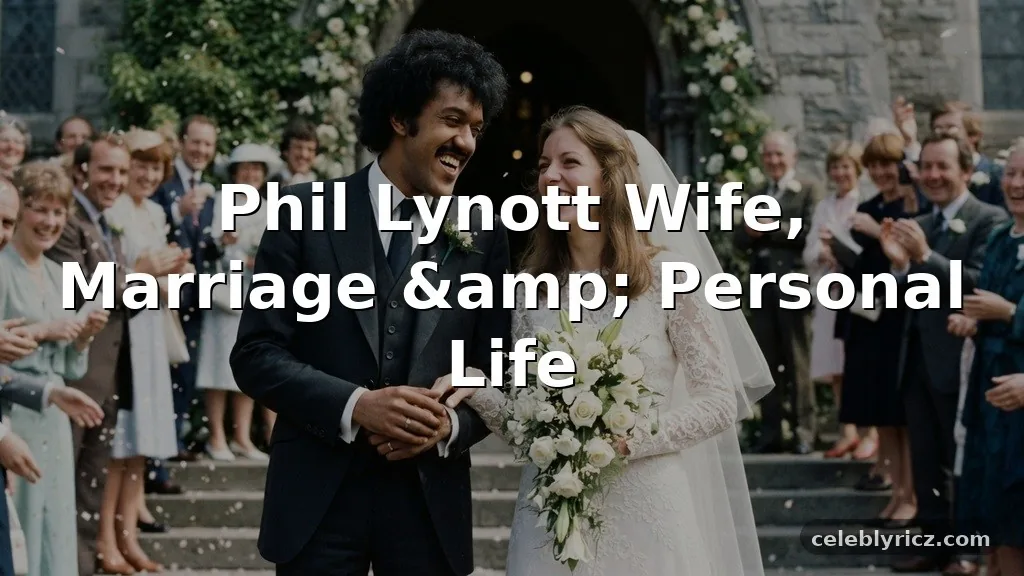

Phil Lynott’s wife was Caroline Crowther, whom he married on Valentine’s Day 1980 — after their relationship had already produced their first daughter, Sarah. They later had a second daughter, Cathleen, but the marriage ended in separation in 1984, before Lynott’s death in January 1986 at just 36. Questions about Phil Lynott’s wife, children, and family remain closely tied to his public story, because the Thin Lizzy frontman wrote so openly about love, loneliness, Dublin, and identity.
Born Philip Parris Lynott on August 20, 1949, in West Bromwich, England, and raised in Dublin, Lynott became one of rock’s most charismatic frontmen — the black Irish bassist-singer who gave the world “The Boys Are Back in Town,” “Jailbreak,” and “Whiskey in the Jar.” His personal life was as dramatic as his music: a famous father-in-law in British TV star Leslie Crowther, a devoted mother in Philomena Lynott, a son placed for adoption before fame, and a tragic decline driven by heroin and alcohol.
This biography separates documented facts from later claims. It covers Caroline Crowther’s story and the marriage, Lynott’s children, his mother Philomena, his Thin Lizzy career, his final years, and the legacy that earned him a statue in Dublin and a commemorative Irish coin.
Phil Lynott at a Glance
| Fact | Details |
|---|---|
| Full name | Philip Parris Lynott |
| Born | August 20, 1949, West Bromwich, England |
| Died | January 4, 1986, Salisbury, England (age 36) |
| Raised | Dublin, Ireland (by his grandmother) |
| Mother | Philomena Lynott |
| Father | Cecil Parris (left when Phil was weeks old) |
| Wife | Caroline Crowther (m. 1980; separated 1984) |
| Children | Sarah (b. 1978), Cathleen (b. 1980); son Macdaragh Lambe (b. 1968, adopted) |
| Band | Thin Lizzy (founder, 1969–1983) |
| Signature songs | “The Boys Are Back in Town,” “Jailbreak,” “Whiskey in the Jar” |
Early Life: West Bromwich to Dublin
Philip Parris Lynott was born on August 20, 1949, in West Bromwich, England, to Philomena Lynott, an Irish woman, and Cecil Parris, a Brazilian of Guianese descent. Parris left when Phil was three weeks old. Philomena later moved to Manchester, where she ran a small hotel — but to spare her mixed-race son the racism of 1950s England, she sent him to be raised by his grandmother in Crumlin, Dublin.
Growing up black in Catholic Ireland in the 1950s and ’60s, Lynott was an outsider twice over — and he turned that outsider status into art. He attended St Kevin’s College in Crumlin and fell in love with music: first the showbands, then rock and roll, then the poetry he would weave into his lyrics. Dublin gave him his identity; the feeling of being different gave him his voice.
The Crumlin years were formative in another way: they gave him his gang. Working-class Dublin in the 1960s was tribal — neighborhoods, schools, football allegiances — and Lynott learned to navigate it with charisma. He was the kid who could talk to anyone, who turned difference into magnetism. Bandmates would later describe a man who walked into any room and owned it, a skill honed on the streets of Crumlin where a black kid had to be twice as charming to get half the acceptance. That charm became the Thin Lizzy frontman’s superpower.
He remained fiercely close to his mother all his life. Philomena Lynott would later write the memoir My Boy: The Phil Lynott Story (1996), the definitive family account of his life. Their bond — the single mother and the son she raised at a distance but loved completely — was the emotional center of Lynott’s world.
Thin Lizzy: The Boys Are Back in Town
Lynott’s musical path ran through Dublin bands — the Black Eagles, then Skid Row — before he formed Thin Lizzy in 1969 with drummer Brian Downey and guitarist Eric Bell. The name came from a robot in The Dandy comic. Decca Records spotted them at a gig and offered a deal.
The early years were a grind. The debut albums sold modestly; the band cycled through guitarists; the breakthrough seemed perpetually one record away. What kept them going was Lynott’s belief — and his work ethic. He wrote constantly, gigged relentlessly, and refined the vision: a rock band with an Irish soul, literary lyrics, and a frontman unlike anyone else. When Eric Bell departed and the twin-guitar lineup solidified, the pieces fell into place. The lesson of the early Thin Lizzy years is persistence: seven years from formation to “The Boys Are Back in Town,” most of them in obscurity.
The breakthrough came in stages: “Whiskey in the Jar” (1972), the traditional Irish ballad reimagined as hard rock, was a surprise hit. Then Jailbreak (1976) and its immortal single “The Boys Are Back in Town” made Thin Lizzy global stars. Lynott — tall, with a big Afro and impossible swagger — was rock’s first black Irish frontman, a bassist who sang lead, a poet who rocked.
The band’s twin-guitar sound (Scott Gorham and Brian Robertson) became legendary, and Lynott’s songwriting — literary, romantic, steeped in Dublin mythology and working-class storytelling — set Thin Lizzy apart from every other hard rock band. Albums like Johnny the Fox, Bad Reputation, and Black Rose cemented the legacy. Evanescence frontwoman Amy Lee similarly built a career on fusing literary, emotional songwriting with hard rock power — proof that Lynott’s template endures.
Lynott’s lyrics deserve special attention because they were genuinely literary — closer to poetry than typical rock fare. He wrote about Dublin’s streets, its dreamers and losers, its romance and violence, with a storyteller’s eye. “Dancing in the Moonlight,” “Still in Love with You,” “Don’t Believe a Word” — these aren’t just riffs; they’re short stories. He was rock’s poet laureate of the Dublin working class, and his influence on lyricists from Bruce Springsteen’s admirers to modern indie rock is still being mapped.
On stage, he was magnetic. The bass slung low, the Afro, the mirror-image cool — Lynott performed with a physical confidence that made Thin Lizzy must-see. American tours in the late ’70s built a devoted US following; “The Boys Are Back in Town” became an eternal sports-arena anthem. At his peak, he was one of rock’s great frontmen, full stop — mentioned in the same breath as Freddie Mercury and Robert Plant by those who saw him.
Caroline Crowther: The Love Story
Caroline Crowther was the daughter of Leslie Crowther, the beloved British comedian, actor, and TV quiz-show host — about as establishment as British entertainment got. She worked at a London PR agency that represented Thin Lizzy. Their connection began over the phone: Caroline later said she was drawn to Phil’s “deep, gentle voice” before ever meeting him in person.
It was an unlikely pairing — the Dublin-born black rock star navigating a white-dominated music scene, and the polished daughter of a British TV institution. But the chemistry was undeniable. Their first daughter, Sarah, was born on December 19, 1978. Phil wrote the tender song “Sarah” in her honor — one of his most beloved compositions, a father’s lullaby set to music.
They married on Valentine’s Day, February 14, 1980. Their second daughter, Cathleen, was born on July 29, 1980. For a brief window, it looked like the rock star had found domestic happiness — the wild frontman as family man, writing lullabies between tours.
The early marriage years coincided with Lynott’s solo ambitions. Solo in Soho (1980) — released the same year he married — was a Top 30 UK album yielding the hits “Dear Miss Lonelyhearts” and “King’s Call.” He was at his commercial peak, a new husband, a father of two. Friends from the period describe genuine happiness: Phil doting on the girls, Caroline anchoring the household, the Kew mansion full of music and life. It’s the “before” picture that makes the “after” so devastating.
Marriage, Separation, and Decline
The happiness didn’t last. As Lynott’s heroin and alcohol abuse escalated through the early 1980s, the marriage strained beyond repair. By 1984, Caroline and Phil had separated. She took the girls and eventually built a quieter life; he spiraled.
Thin Lizzy disbanded in 1983. Lynott’s solo career — Solo in Soho (1980) had produced hits like “Dear Miss Lonelyhearts” and “King’s Call” (a tribute to Elvis featuring Mark Knopfler), and “Yellow Pearl” became the Top of the Pops theme — couldn’t sustain him. Collaborations with Gary Moore (“Out in the Fields,” a No. 5 UK hit in 1985; “Parisienne Walkways”) showed flashes of the old magic, but the drugs were winning.
What makes the story especially poignant is Caroline’s role at the end. Though separated, when Lynott collapsed at his Kew home on Christmas Day 1985, it was his mother who found him — and Caroline who drove over 100 miles from Bath to help, getting him to a drugs clinic and then to Salisbury Infirmary. She knew the severity of his addiction; she’d lived with it. Her final act in the marriage was trying to save his life.
The separation itself had been brutal in the way addiction-driven separations always are: the lies, the disappearances, the promises broken. Caroline had watched the man she married disappear into the drugs — and she’d made the impossible choice to protect the children by leaving. That she came back at the end, that she drove those 100 miles on Christmas, says everything about the love that survived the destruction. She didn’t owe him that drive. She did it anyway.
The Death: January 4, 1986
At Salisbury Infirmary, doctors diagnosed septicaemia (blood poisoning). Lynott was placed on a ventilator as his condition deteriorated. He regained consciousness briefly — enough to speak to his mother — but the damage was irreversible. On January 4, 1986, Philip Parris Lynott died of pneumonia and heart failure brought on by septicaemia. He was 36 years old.
The funeral was held at St Elizabeth’s Church, Richmond, on January 9, with most of Thin Lizzy’s former members attending, followed by a second service at Howth Parish Church on January 11. Leslie Crowther — his former father-in-law — was present. Lynott was buried in St Fintan’s Cemetery, Sutton, Dublin, where fans still make pilgrimages.
His last single, “Nineteen,” produced by Paul Hardcastle, had been released just weeks before his death — performed live on television in December 1985 as a poignant, unintentional farewell. Country star Dwight Yoakam has spoken about the toll of the touring life on artists of that era — Lynott’s story is its darkest chapter.
The Children: Sarah, Cathleen, and Macdaragh
Phil Lynott’s children have lived largely private lives. Sarah Lynott (born 1978) and Cathleen Lynott (born 1980) were raised by Caroline, who eventually relocated to New Zealand seeking privacy away from media scrutiny. Caroline later remarried and settled in Britain. She’s spoken publicly about Phil only rarely — most notably in the 2020 documentary Songs for While I’m Away, offering a heartfelt perspective on loving one of Ireland’s most beloved musicians through his rise and fall.
Lesser known: before fame, Lynott fathered a son, Macdaragh Lambe (born 1968), who was placed for adoption. Macdaragh later reconnected with the Lynott family — a quiet coda to a story about fathers and children that runs through Lynott’s music like a thread.
The adoption story adds a painful layer to Lynott’s biography. In 1968, he was 19 — a young musician with no money, no stability, and a child he couldn’t raise. The decision haunted the themes of his songwriting: absent fathers, lost children, the search for belonging. When Macdaragh reconnected with the family years later, it closed a circle that Lynott himself never got to close — one more reconciliation that came too late for the man but just in time for the family.
Philomena Lynott: The Mother’s Story
No account of Phil Lynott is complete without Philomena Lynott, who died in 2019. She was the constant: the mother who raised him at a distance, who found him collapsed on Christmas Day 1985 unaware of the heroin addiction, who spoke to him in his final conscious hours, and who spent the rest of her life preserving his legacy.
Her memoir My Boy (1996) is essential reading — a mother’s unsparing, loving account of genius and self-destruction. She attended the unveiling of his statue, welcomed fans to his grave, and became the guardian of his memory. When Ireland issued a commemorative coin in his honor in 2019, it was Philomena’s decades of advocacy that had kept the flame alive.
Philomena’s story is remarkable in its own right. A young Irish woman in 1940s England, pregnant by a man who vanished, raising a mixed-race child in an era of open prejudice — then making the agonizing decision to send him to Dublin for his own protection. She built a life running a Manchester hotel, stayed close to Phil across the distance, and never wavered. After his death, she could have retreated; instead, she became rock’s most devoted archivist-mother, ensuring that the world remembered not just the tragedy but the triumph. She died in 2019, having outlived her son by 33 years — a lifetime of carrying his memory.
Legacy: The Statue on Harry Street
Phil Lynott’s legacy has only grown. In 2005, a life-size bronze statue by sculptor Paul Daly was unveiled on Harry Street, off Grafton Street, Dublin — attended by former bandmates Gary Moore, Brian Robertson, Brian Downey, and Scott Gorham, and by Philomena. It remains one of Dublin’s most visited musical landmarks.
In 2019, Ireland issued a commemorative coin in his honor. Thin Lizzy’s music — “The Boys Are Back in Town” most of all — is woven into the fabric of rock culture, covered endlessly, played at every stadium. The band reformed as a touring act in 1996; when members wanted to record new material in 2012, they chose the name Black Star Riders out of respect — with the widow’s blessing — because new Thin Lizzy recordings without Lynott felt wrong.
As a black Irishman who conquered a white rock world on his own terms, as a poet-bassist-frontman, as a songwriter who made Dublin mythology universal — Lynott’s influence transcends his 36 years. He was almost impossibly cool, and entirely irreplaceable.
The influence runs deeper than the hits. Lynott pioneered the idea of the bassist as frontman-songwriter — a model later followed by artists across genres. His twin-guitar sound became the template for generations of hard rock and metal bands. His fusion of Irish literary tradition with rock and roll created a specifically Irish rock identity that U2, the Pogues, and countless others built upon. And as a black man who became an Irish cultural icon, he remains a singular figure in the history of representation — proof that identity is bigger than categories.
Frequently Asked Questions
Who was Phil Lynott’s wife?
Phil Lynott’s wife was Caroline Crowther, daughter of British TV star Leslie Crowther. They married on Valentine’s Day 1980 and had two daughters, Sarah and Cathleen, before separating in 1984 due to Lynott’s substance abuse.
How did Phil Lynott die?
Phil Lynott died on January 4, 1986, at age 36, of pneumonia and heart failure caused by septicaemia (blood poisoning) related to heroin abuse. He had collapsed at his home on Christmas Day 1985 and spent his final days on a ventilator at Salisbury Infirmary.
How many children did Phil Lynott have?
Phil Lynott had three children: daughters Sarah (born 1978) and Cathleen (born 1980) with his wife Caroline Crowther, and a son, Macdaragh Lambe (born 1968), who was placed for adoption before Lynott’s fame and later reconnected with the family.
What happened to Caroline Crowther after Phil Lynott’s death?
After Lynott’s death, Caroline Crowther stepped back from public life to raise their daughters privately, at one point relocating to New Zealand. She later remarried and settled in Britain, speaking about Phil only rarely, including in the 2020 documentary “Songs for While I’m Away.”
Where is Phil Lynott buried?
Phil Lynott is buried in St Fintan’s Cemetery in Sutton, Dublin, Ireland. A life-size bronze statue of him stands on Harry Street in Dublin, unveiled in 2005, and Ireland issued a commemorative coin in his honor in 2019.
Phil Lynott’s story is rock and roll’s great Irish tragedy: the outsider who became an icon, the poet who lived hard, the father who wrote lullabies and couldn’t outrun his demons. The marriage to Caroline Crowther — brief, loving, doomed — produced two daughters and one immortal song. The 36 years produced a legacy that Dublin literally set in bronze.
The boys came back to town, and they never really left. Every time “The Boys Are Back in Town” plays — at a stadium, in a film, on a classic rock station — Phil Lynott lives again: the tall black Irishman with the Afro and the swagger, singing his city, his loves, and his short, incandescent life.
Explore more on CelebLyricz.