
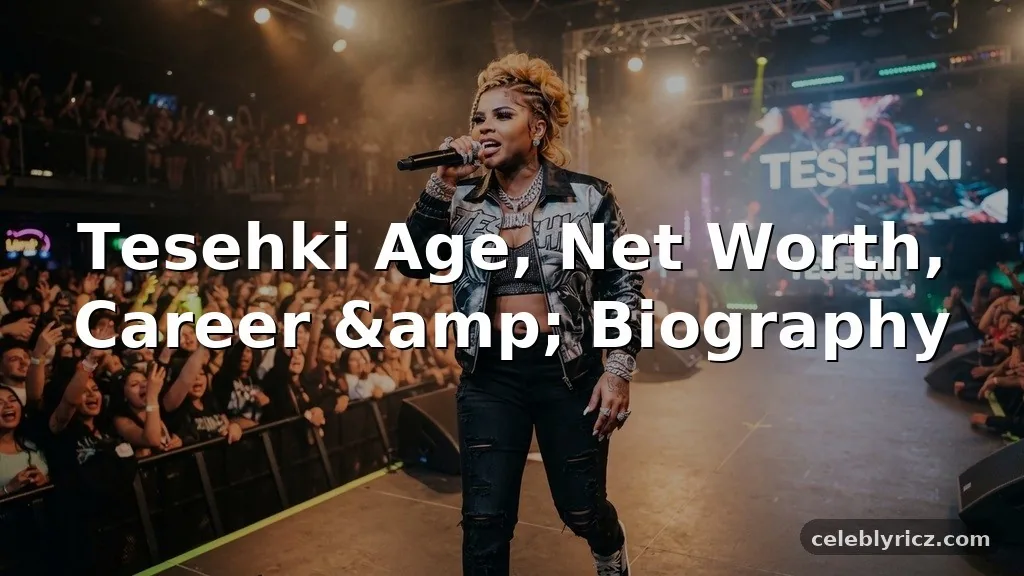

Tesehki age is one of the most searched questions about the R&B singer and reality star — and the answer requires a small correction to what most biography sites say. Born Latifa Tesehki Malone on May 22, 1995, in Baltimore, Maryland, she turned 31 in May 2026, though many profiles still list her as 30. Either way, she has packed several careers into her three decades: viral singer, Zeus Network reality star, social media powerhouse, and the older sister of Chrisean Rock.
Her story is inseparable from the modern entertainment machine. She built an audience posting cover songs online in 2014, broke through with her debut single “Real As Me” in 2022, and became a fixture of the Baddies reality franchise — all while navigating a famously turbulent public relationship with her sister. In 2026, she appears to be pivoting deliberately from reality television toward music, betting that her voice will outlast the drama.
This biography covers Tesehki’s age, her Baltimore upbringing, her large family, her music career, her reality TV fame, her relationship with Chrisean Rock, her personal life, and her estimated net worth as of 2026.
Tesehki Quick Facts
| Fact | Details |
|---|---|
| Real name | Latifa Tesehki Malone |
| Stage name | Tesehki |
| Date of birth | May 22, 1995 |
| Age | 31 years old (as of 2026; many sources still list 30) |
| Birthplace | Baltimore, Maryland, USA |
| Nationality | American |
| Profession | R&B singer, rapper, reality TV personality, influencer |
| Genres | R&B, hip-hop, emotional rap |
| Height | Approximately 5 ft 5 in – 5 ft 7 in (165–170 cm) |
| Zodiac sign | Gemini |
| Parents | Charla Malone and Eugene Malone |
| Siblings | One of twelve children; including Chrisean Rock |
| Known for | “Real As Me”; Baddies East, Baddies Caribbean (Zeus Network) |
| Relationship status | Private |
| Estimated net worth | Estimated $2–3 million (2026 estimate) |
Tesehki Age: 31 Years Old in 2026
Tesehki was born on May 22, 1995, which means she turned 31 in May 2026. Many biography sites still list her as 30 — likely because their profiles were written before her 2026 birthday or simply copied from older pages. The birth date itself is consistent across sources; only the computed age lags behind.
A Gemini, she sits at an interesting career crossroads. Her twenties were defined by experimentation — reality television, viral moments, public family conflicts, and the gradual discovery of her artistic voice. Entering her thirties, she brings a decade of audience-tested resilience and a clearer creative direction, positioning her in the prime window for independent artists building sustainable careers.
Early Life: Growing Up in West Baltimore
Latifa Malone was born in Baltimore, Maryland, and raised in West Baltimore as one of twelve children born to Charla and Eugene Malone. Growing up in a household that large, in a city with Baltimore’s particular intensity, shaped her early: competitive, expressive, and accustomed to fighting for attention — qualities that translate directly to both music and reality television.
Her siblings include Chrisean Malone — better known as Chrisean Rock, the rapper and reality star who would become both her closest collaborator and her most public rival — along with Terine Malone, Tessa Manning, Chastity Malone, and others. The Malone family is sprawling, close-knit, and complicated, and its dynamics have played out in public for years.
She began singing at a young age, drawn to R&B’s emotional storytelling. In 2014, she started posting cover-song videos to YouTube and Instagram — the classic modern origin story, building an audience one upload at a time before she had any industry backing.
Music Career: From Covers to “Real As Me”
Tesehki’s music blends R&B vocals with hip-hop cadences — emotional rap delivered with a singer’s control. Her breakthrough came in 2022 with her debut single “Real As Me,” which leveraged her growing social media presence and reality TV visibility into genuine music traction.
She followed with a run of singles that built her reputation in the independent R&B/rap space: “I Eatss,” “Bad Bad Bitch,” “Best That Ever Did It,” and 2024 collaborations including “WWD.” Her sound is raw and confessional — songs about loyalty, betrayal, love, and survival that draw directly from her very public life.
Her path mirrors other independent artists who built music careers outside the major-label system, using social media and reality TV as launchpads rather than waiting for industry permission. Rappers who came up through the underground and digital scenes — like KRSNA, who similarly built a devoted following through independent releases — show how the modern rap/R&B career can be constructed without traditional gatekeepers.
Reality TV Stardom: The Zeus Network’s Baddies Era
If music is Tesehki’s craft, reality television is what made her famous. She became a central figure on the Zeus Network’s Baddies franchise — appearing on Baddies East, Baddies Caribbean, and Baddies Midwest — the raucous ensemble series that became a cultural phenomenon in the 2020s. She also appeared on Blueface & Chrisean: Crazy in Love, the reality series built around her sister’s tumultuous relationship.
The Baddies franchise runs on confrontation, personality, and unfiltered drama — and Tesehki, with her Baltimore-bred directness, was a natural. Her confrontations, alliances, and emotional moments became some of the franchise’s most-watched content. For better and worse, reality TV gave her something music alone hadn’t yet: a massive, engaged audience that knew her name.
But the genre exacts a price. Reality stardom rewards volatility, and the line between authentic emotion and performed drama blurs fast. By 2025–2026, Tesehki appeared to be making a deliberate pivot away from reality television and toward music — a move that suggests she understands the genre’s ceiling and wants her legacy to be songs, not storylines.
Tesehki and Chrisean Rock: A Sisterhood Under a Microscope
No account of Tesehki is complete without Chrisean Rock. As her younger sister, Chrisean’s explosive fame — through her music, her relationship with Blueface, and her own reality TV presence — inevitably pulled Tesehki into its orbit. The sisters’ relationship has been a public rollercoaster: fierce loyalty one moment, bitter public disputes the next.
Their conflicts have played out across social media and reality TV alike — arguments about family, loyalty, and the pressures of fame, conducted in front of millions. It is the kind of family drama that fascinates audiences precisely because it feels real: two sisters from West Baltimore, both famous, both strong-willed, working out twelve-sibling family dynamics on camera.
What often gets lost in the drama coverage is the underlying bond. Through every public falling-out, the sisters have repeatedly reconciled — a pattern familiar to anyone from a large family. The microscope distorts, but the sisterhood endures.
Social Media Empire
Tesehki’s direct connection to fans runs through social media: over 2.3 million followers on Instagram (@tesehki), hundreds of thousands on TikTok, and tens of thousands of YouTube subscribers. Her content mixes music promotion, lifestyle posts, family moments, and the unfiltered commentary her audience expects.
That following is her real business asset. In the independent artist economy, a direct audience of millions is worth more than a record deal — it means she can release music, sell merchandise, and fill venues without intermediaries. Her social media strategy is consistent with her brand: personal, emotional, and unpolished in a way that reads as authentic.
Personal Life: Private by Design
For someone whose family drama plays out publicly, Tesehki keeps her romantic life remarkably private. Her relationship status is not publicly confirmed, and she has no confirmed spouse. Reports about her personal relationships circulate, but she has not built her brand on dating headlines — a notable discipline in the reality TV world.
Her focus, publicly at least, is on her music, her family (in all its complexity), and her reinvention. At 31, with a decade of public life behind her, she appears to be choosing intention over impulse — the pivot from reality TV to music being the clearest evidence.
What Is Tesehki’s Net Worth?
Tesehki’s net worth is estimated at $2–3 million as of 2026, according to the most commonly cited estimates — though figures range from $1.5 million to $5 million depending on the source. As with most entertainers at her level, these are estimates extrapolated from visible income, not disclosed financials.
Her income streams reflect the modern entertainer’s portfolio: music streaming and sales, reality TV appearance fees (the Baddies franchise pays its stars), social media sponsorships and brand deals, live appearances, and merchandise. The reality TV money likely formed the foundation; the music career is the long-term investment.
The trajectory matters more than the number. Artists who successfully transition from reality TV to sustained music careers — a notoriously difficult pivot — can multiply their earnings. If Tesehki’s music-first era delivers, the $2–3 million estimate will look like an early-career figure. Fellow independent musicians like Lil Tony demonstrate how young artists are building substantial careers through direct audience relationships rather than traditional industry paths.
Tesehki Singles and Releases
| Year | Release | Notes |
|---|---|---|
| 2014–2021 | Cover-song videos (YouTube, Instagram) | Early audience-building era |
| 2022 | “Real As Me” (debut single) | Breakthrough; established her as a recording artist |
| 2023 | “I Eatss” | Viral single; bold persona anthem |
| 2023–2024 | “Bad Bad Bitch,” “Best That Ever Did It” | Catalog-building singles |
| 2024 | “WWD” and collaborations | Expanded collaborative footprint |
Inside the Baddies Phenomenon
To understand Tesehki’s fame, you have to understand the Baddies franchise. Launched by the Zeus Network, the series took the ensemble-reality format — a house full of strong personalities, cameras everywhere — and aimed it squarely at an audience underserved by mainstream reality TV. It became a genuine cultural force: millions of viewers, endless clips, and a cast of stars famous primarily for being themselves at maximum volume.
Tesehki was built for this environment. Her directness, her emotional transparency, her refusal to back down — the same traits that make her music compelling made her reality TV gold. Her seasons on Baddies East, Baddies Caribbean, and Baddies Midwest produced the confrontations and confessions that define the franchise’s appeal.
But the franchise’s economics are worth noting: Zeus stars earn appearance fees, but the real money is in what the exposure enables — music streams, sponsorships, bookings. Tesehki understood this better than most cast members. She treated reality TV as marketing for the music career, not as the career itself — which is why the pivot feels strategic rather than desperate.
Baltimore’s Musical DNA
Baltimore has a distinct musical identity — from club music’s frenetic energy to a deep R&B and gospel tradition — and Tesehki carries it. Her sound’s rawness, its emotional directness, its fearless blend of singing and rapping: these are Baltimore traits, shaped by a city where music is survival language as much as entertainment.
Growing up in West Baltimore also gave her the resilience that reality TV audiences respond to. This is a city that produces tough, expressive artists — and Tesehki’s persona, equal parts vulnerable and combative, is recognizably a product of her environment. Her music doesn’t just come from Baltimore; it sounds like it.
The Reality-to-Music Pivot: Why It Is So Hard
History is littered with reality stars who tried to become musicians and failed. The audience that loves your drama doesn’t automatically buy your singles; the credibility required for music is different from the charisma required for television. Tesehki’s pivot is ambitious precisely because the odds are against it.
Her advantages are real, though. Unlike most reality-to-music attempts, she was singing before she was famous — the 2014 cover videos predate the Baddies era by years. She has a genuine vocal instrument, not a producer’s construction. And her songs draw on the same emotional rawness that made her compelling on TV, giving the music an authenticity that manufactured pop lacks.
The test will be the next body of work. Singles built her name; a cohesive project — an EP or album that proves artistic vision beyond individual tracks — would establish her as a musician first. At 31, with her audience’s attention and a clear lane in emotional R&B/rap, the opportunity is hers to take.
Personal Growth at 31
There is a noticeable maturity arc in Tesehki’s recent public presence. The chaotic energy of her early reality TV years has given way to something more intentional: talk of leaving the drama behind, focus on music, emphasis on personal growth and mental health. Turning 30 — then 31 — seems to have clarified her priorities.
This is a common pattern for reality stars who survive the genre: the ones who last are the ones who outgrow it. The drama that built the audience eventually becomes a cage, and the smart ones pivot before the audience moves on. Tesehki’s pivot looks well-timed — her music audience is growing just as her reality TV chapter closes.
Her journey also speaks to a broader truth about modern fame: the most durable careers are built on craft, not controversy. The Baddies years gave her a platform; what she builds on it now will define whether she’s remembered as a reality star who sang or a singer who once did reality TV.
Vocal Style and Artistic Identity
Musically, Tesehki occupies the space where R&B singing meets emotional rap — the lane pioneered by artists who refused to choose between melody and bars. Her voice has a church-trained richness even when the lyrics are street-raw, and that contrast is her signature: beautiful tone delivering unfiltered truth. Songs like “Real As Me” work because the vocal performance sells the vulnerability the lyrics describe.
Her artistic identity is still crystallizing, which is normal for an independent artist in her early thirties. The through line across her releases is emotional honesty — she sings about what she has lived, without the polish that would sand off the edges. In a genre that rewards authenticity above all, that is not a limitation. It is the whole game.
Frequently Asked Questions
How old is Tesehki?
Tesehki is 31 years old as of 2026. She was born Latifa Tesehki Malone on May 22, 1995, in Baltimore, Maryland. Many biography sites still list her as 30, likely because they have not updated since her May 2026 birthday.
What is Tesehki’s real name?
Her real name is Latifa Tesehki Malone. Tesehki is her stage name, derived from her middle name.
Is Tesehki related to Chrisean Rock?
Yes. Tesehki is the older sister of Chrisean Rock (born Chrisean Malone). They are two of twelve children born to Charla and Eugene Malone, and their relationship — both close and contentious — has played out publicly for years.
What shows has Tesehki appeared on?
She is best known for the Zeus Network’s Baddies franchise, including Baddies East, Baddies Caribbean, and Baddies Midwest. She also appeared on Blueface & Chrisean: Crazy in Love.
What is Tesehki’s net worth?
Her net worth is estimated at $2-3 million as of 2026, though estimates range from $1.5 million to $5 million. Her income comes from music, reality TV appearances, sponsorships, and merchandise.
Conclusion
Tesehki at 31 stands at the most interesting point of her career: famous enough from reality TV to have a real audience, talented enough as a singer to deserve one, and self-aware enough to be steering toward music as the legacy. An estimated $2–3 million net worth, millions of followers across every major platform, and a catalog of singles that keeps growing are the measurable outcomes of a decade spent building in public.
Her story — West Baltimore to viral covers to the Baddies mansion to a deliberate music-first reinvention — is the modern entertainment career in miniature: messy, public, resilient, and still being written. The next chapter belongs to the music. If her voice delivers what her ambition promises, the reality TV years will be remembered as just the prologue — the loud, chaotic opening act before the real show began. At 31, with a decade of hard-won experience and an audience that has stuck with her through every reinvention, Tesehki has earned the right to be taken seriously as an artist. The microphone was always the point; everything else was just the road getting there.
Explore more on CelebLyricz.