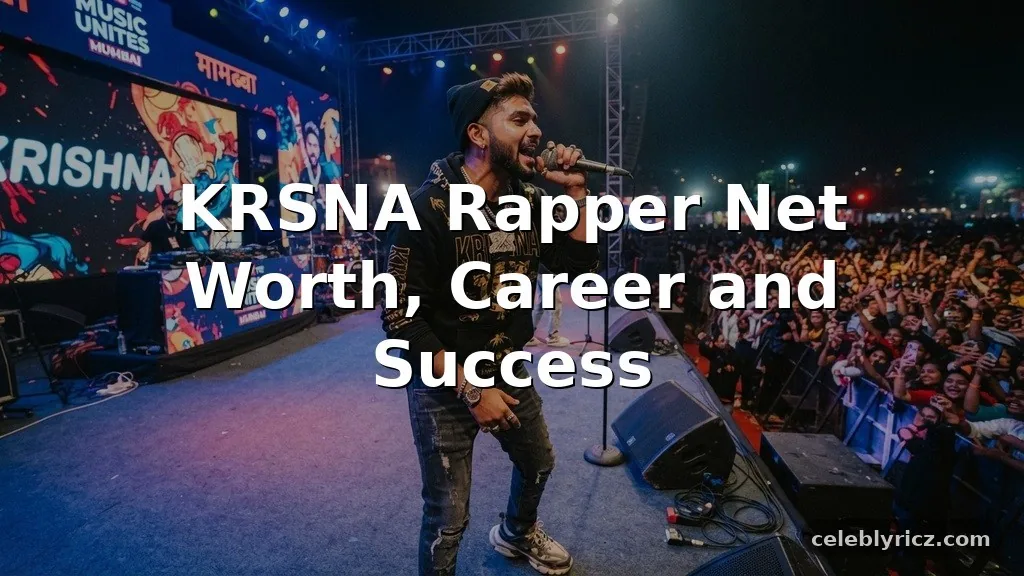

KRSNA — born Krishna Kaul — is one of the founding architects of Indian hip-hop: a rapper, songwriter, and producer whose technical lyricism and English-Hindi wordplay helped carry desi rap from the underground to the mainstream. Searches for KRSNA’s net worth produce figures ranging from a few crore rupees to several million dollars; the honest answer is that no audited public record confirms his personal wealth, with most estimates landing between ₹5–10 crore (roughly $600,000–$1.2 million) and some outlets citing higher.
Born October 4, 1989, in New Delhi, KRSNA is 37 years old in 2026. His career spans two decades — from the “Young Prozpekt” days and the viral 2010 breakthrough “Kaisa Mera Desh,” through the legendary Emiway beef, to 2026’s run of milestones: the Delhi Capitals IPL anthem “Dilli Re,” the international collaboration “Too Bait,” the 74-million-view “Boom Shaka” with Dhanda Nyoliwala, and a Rolling Stone India cover.
This guide covers KRSNA’s net worth and income, his biography and early life, his career from mixtapes to mainstream, his biggest songs and beefs, his business ventures, and where he stands in 2026.
KRSNA Net Worth in 2026
KRSNA’s net worth in 2026 is estimated between ₹5 crore and ₹10 crore (approximately $600,000–$1.2 million USD), though some outlets estimate up to $3 million. As with all independent artists, these are media estimates, not disclosed figures.
His income flows from the classic independent-rapper stack:
- Music streaming royalties — a deep catalog (67+ YouTube videos, 593M+ total views) generating steady income; YouTube analytics sites estimate ~$14.5K/month from the platform alone
- Live performances — headlining shows and festival slots across India
- Brand endorsements — including his 2025 appointment as boAt Lifestyle brand ambassador
- Kalamkaar partnership — equity in the label he co-runs with Raftaar
- Collaborations and features — paid verses for mainstream and international artists
- Reality TV — the 2026 hip-hop reality show Legacy (with Raftaar, via SVF Entertainment, streaming on YouTube and ZEE5)
What the numbers miss is influence: KRSNA is one of the few Indian rappers whose name carries weight in both the underground and the boardroom — a duality that makes his earning power more durable than viral-only artists. His trajectory mirrors other independent hip-hop builders like BigXthaPlug, who similarly turned regional authenticity into a national brand.
KRSNA Quick Facts
| Fact | Detail |
|---|---|
| Real name | Krishna Kaul |
| Stage name | KRSNA (formerly Young Prozpekt) |
| Date of birth | October 4, 1989 |
| Age in 2026 | 37 years old |
| Birthplace | New Delhi, India |
| Ethnicity | Kashmiri Pandit |
| Parents | Anil Kaul and Sumita Kaul |
| Sibling | Sister Kashish Kaul |
| Height | Approx. 5 ft 10 in (178 cm) |
| Education | Hansraj College (Delhi University); St. Xavier’s College, Mumbai |
| Profession | Rapper, songwriter, record producer |
| Languages | Hindi, English (often blended) |
| Label | Kalamkaar (partner, with Raftaar) |
| Marital status | Unmarried; keeps personal life private |
| Net worth (2026) | Estimated ₹5–10 crore (~$0.6–1.2M) |
Early Life: Delhi to South London and Back
Krishna Kaul was born on October 4, 1989, into a Kashmiri Pandit family in New Delhi. His parents, Anil Kaul and Sumita Kaul, raised him alongside his sister Kashish Kaul. During his childhood, the family relocated to South London — a move that would shape his entire artistic identity.
In London, exposed to hip-hop culture at a young age, he began writing rap lyrics at 14 — partly as a way to integrate into the local community. The London years gave him something few Indian rappers had: a native relationship with hip-hop’s birthplace culture, absorbed as a teenager rather than studied as an adult.
The family returned to India in 2003, and Krishna completed his education at Hansraj College, Delhi University, followed by post-graduate studies at St. Xavier’s College in Mumbai (Xavier Institute of Communications). That bicultural foundation — Delhi roots, London hip-hop, elite Indian education — became the bedrock of his bilingual, technically dense style.
Career: From Young Prozpekt to Indian Hip-Hop Pioneer
The Underground Years
KRSNA started his career under the alias “Young Prozpekt”, grinding through India’s nascent mid-2000s hip-hop underground — an era with no labels, no streaming payouts, and barely an audience. His breakthrough came in 2010 with “Kaisa Mera Desh”, among the first Indian hip-hop songs to go viral on YouTube. The track’s socially conscious lyricism announced a rapper who treated the form as literature, not just entertainment.
Sellout and Independence
His 2014 project Sellout — with tracks like “The Glorious First Step,” “Faded,” and “Erryday” — established his album craft. The title was characteristically provocative: a preemptive strike against purists, from an artist who always intended to take hip-hop mainstream on his own terms.
The Emiway Beef (2019)
In 2019, KRSNA became central to one of Indian hip-hop’s defining moments: his feud with Emiway Bantai. The beef began over claims of representing India globally and escalated through multiple diss tracks into one of the biggest rap battles the country had seen. Whatever one’s allegiance, the battle was culturally massive — it proved Indian hip-hop had an audience hungry for lyrical warfare at the highest level, and KRSNA’s technical superiority in the exchanges cemented his reputation as the scene’s premier lyricist.
Still Here (2021) and Mainstream Arrival
The 2021 album Still Here — featuring “Roll Up” with Badshah, “Villain,” “Saza-E-Maut” with Raftaar, and “Living Legend” — was both a statement and a victory lap. The title said everything: after 15 years, the underground king was still standing, now with mainstream cosigns. The Rolling Stone India cover in October 2025 made the coronation official.
Kalamkaar: Building the Label
As a partner at Kalamkaar alongside Raftaar, KRSNA moved from artist to executive — signing and developing the next generation of desi hip-hop talent. It’s the classic pioneer’s second act: having built the scene, build the infrastructure. His role nurturing new talent ensures his influence extends beyond his own discography.
Major Songs and Collaborations
| Song / Project | Year | Significance |
|---|---|---|
| “Kaisa Mera Desh” | 2010 | Breakthrough; among first viral Indian hip-hop tracks |
| Sellout (album) | 2014 | Early album statement |
| “Vyanjan” | — | Fan-favorite lyrical showcase |
| “Machayenge 4” | — | With Emiway Bantai — yes, they collaborated too |
| “Roll Up” (with Badshah) | 2021 | Mainstream crossover moment |
| “No Cap,” “Makasam,” “Freeverse Feast” | — | Core catalog staples |
| “Dilli Re” | 2026 | Official anthem for IPL’s Delhi Capitals |
| “Too Bait” (with AJ Tracey, Anik Khan, Enny) | 2026 | International collaboration; Bait web-series soundtrack |
| “Boom Shaka” (with Dhanda Nyoliwala) | 2026 | 74M+ YouTube views; generational link-up |
His international collaborations — with Hi-Rez, Royce da 5’9″, KXNG Crooked, Awich, and Jay Park — are unmatched among Indian rappers for sheer range, spanning American underground royalty and Asian hip-hop stars. The April 2026 “Boom Shaka” collaboration with Dhanda Nyoliwala, the Haryanvi rap pioneer, was particularly symbolic: the veteran passing the torch mid-song, to 74 million views.
He also appeared as himself in Gully Boy (2019), the film that took Mumbai hip-hop mainstream — a cameo that acknowledged his real-world role in the story the movie fictionalized.
Awards and Recognition
- Radio City Freedom Award 2023 — Best Indie Collaboration (with Brodha V)
- Rolling Stone India cover — October 2025
- boAt Lifestyle brand ambassador — appointed 2025
- Widely credited as a pioneer of Indian hip-hop, alongside the mid-2000s underground generation
- 2.04M YouTube subscribers, 593M+ total views (channel since March 2017)
Personal Life
KRSNA is unmarried and keeps his personal life intensely private — no public relationships, no family content, no lifestyle flexing beyond the occasional car (he’s reported to own a BMW M5 Competition and a 5 Series). In July 2026, he joined the Delhi Jantar Mantar protests to show solidarity with protestors — consistent with the socially conscious streak that has run through his music since “Kaisa Mera Desh.”
That privacy is itself a statement in an era of content-everything rappers. KRSNA’s brand is the bars; everything else is noise he’s chosen not to make.
What Is KRSNA Doing Now?
As of 2026, KRSNA is in the most visible phase of his career: the Delhi Capitals anthem, the AJ Tracey collaboration, the “Boom Shaka” phenomenon, the Legacy reality show with Raftaar, and his Kalamkaar executive work. At 37, he’s achieved the rare double — underground credibility and mainstream reach — and he’s using it to build infrastructure for the generation behind him. For fans of the new wave, artists like Lil Tony represent the global sound KRSNA helped make space for.
KRSNA’s Lyrical Style: What Makes Him Different
Ask Indian hip-hop fans why KRSNA matters and the answer is always the same word: pen. His technical toolkit is the most complete in desi rap:
Bilingual Wordplay
KRSNA raps primarily in Hindi and English, often within the same bar — code-switching not as a gimmick but as a natural expression of his Delhi-London upbringing. The English gives him access to hip-hop’s global vocabulary; the Hindi gives him emotional and cultural precision. Few rappers anywhere switch languages mid-flow without losing rhythm; KRSNA does it as a signature.
Battle-Rap Architecture
His diss tracks are masterclasses in battle construction: setups that seem like compliments, punchlines with double and triple meanings, and closers engineered for replay value. The Emiway beef didn’t just showcase aggression — it showcased composition, the difference between shouting and songwriting.
Social Consciousness
From “Kaisa Mera Desh” onward, his best work engages with India itself — its contradictions, its politics, its promise. This isn’t the party-rap that dominates commercial desi hip-hop; it’s closer to the conscious tradition, delivered with a technician’s precision. His July 2026 appearance at the Delhi Jantar Mantar protests was the real-world extension of lyrics he’d been writing for 15 years.
Generations of Indian Hip-Hop
| Artist | Era | Lane | Signature |
|---|---|---|---|
| KRSNA | Mid-2000s–present | Underground pioneer → mainstream | Technical lyricism; bilingual pen |
| Raftaar | 2000s–present | Mainstream architect | Commercial hits; Kalamkaar co-founder |
| Divine | 2010s–present | Street narrative | Gully Boy inspiration; Mumbai stories |
| Emiway Bantai | 2010s–present | Independent hustle | DIY empire; massive YouTube numbers |
| Dhanda Nyoliwala | 2020s–present | Regional wave | Haryanvi trap; global diaspora |
KRSNA’s unique position is chronological: he predates the Gully Boy wave by a decade, which gives him elder-statesman credibility, but his 2026 output (“Dilli Re,” “Boom Shaka,” “Too Bait”) is as current as anyone’s. He’s the rare pioneer who never became a nostalgia act.
Kalamkaar: Building the Label
The Kalamkaar partnership with Raftaar deserves a closer look, because it represents KRSNA’s evolution from artist to institution-builder. Indian hip-hop’s biggest structural problem has always been infrastructure — no A&R, no development deals, no pathway from viral to sustainable. Kalamkaar was an attempt to build that pathway.
As a partner, KRSNA brings artistic credibility that money can’t buy: young rappers sign because the man who wrote “Kaisa Mera Desh” believes in them. His A&R instincts — spotting talent, shaping records, lending verses strategically — have made the label one of desi hip-hop’s most important development engines. The 2026 Legacy reality show with Raftaar extends this mission to television, scouting the next wave on camera.
The International Strategy
KRSNA’s collaborations with Royce da 5’9″, KXNG Crooked, Hi-Rez, Awich, and Jay Park aren’t vanity features — they’re a deliberate strategy to position Indian hip-hop in global conversations. Each collaboration does double duty: it proves to international audiences that desi rap can hang at the highest technical level, and it proves to Indian audiences that their scene belongs on world stages.
The 2026 “Too Bait” collaboration — with UK star AJ Tracey, plus Anik Khan and Enny, for the Bait web-series soundtrack — is the latest and most mainstream-facing entry in this strategy. It’s the London circle closing: the kid who learned hip-hop in South London now trading bars with the UK’s biggest names as an equal.
Discography Deep Dive
Mixtapes and Early Work (2006–2013)
The Young Prozpekt era produced a run of underground mixtapes that built his reputation bar by bar. “Kaisa Mera Desh” (2010) remains the landmark — a song that still gets cited whenever Indian hip-hop’s history is written.
Sellout (2014)
His debut album proper, featuring “The Glorious First Step,” “Faded,” “Sellout,” “Erryday,” and “Last Song.” The production ranged across collaborators like Bradley Dhawan and Tony Fadd, and the title’s provocation — daring purists to call ambition betrayal — set the tone for everything after.
Still Here (2021)
The mature masterpiece: “Still Here (Intro),” “What’s My Name,” “Roll Up” with Badshah, “Villain” with Karma and Ikka, “Dream,” “Saza-E-Maut” with Raftaar, “Na Hai Time,” and “Living Legend” with Rashmeet Kaur. It’s the rare veteran album that expands the audience instead of preaching to it.
2025–2026: The Victory Lap
The current run — Rolling Stone India cover, boAt ambassadorship, “Dilli Re,” “Too Bait,” “Boom Shaka,” Legacy — is the most commercially visible stretch of his career, arriving twenty years after he started. In hip-hop, where most careers last five years, that longevity is the real statistic.
The Business of Being KRSNA
KRSNA’s estimated ₹5–10 crore net worth was built without the machinery that creates most music fortunes — no Bollywood playback empire, no reality-TV judging millions, no inherited label. His economics are the independent artist’s economics, executed at the highest level:
- Catalog as annuity: Twenty years of releases generating streaming income in perpetuity — the “Kaisa Mera Desh” streams of 2026 pay for work done in 2010.
- Live premium: As a legacy act with a young audience, his shows command headliner fees across India’s festival and college circuit.
- Label equity: The Kalamkaar partnership means he profits from other artists’ success — the executive’s income on top of the artist’s.
- Brand value: The boAt ambassadorship reflects a hard-won asset: credibility with young, urban, male consumers that brands will pay for.
- Media expansion: The Legacy reality show opens television economics — production fees, streaming rights (ZEE5), and sponsorship.
It’s a diversified, durable structure — the financial equivalent of his artistic longevity. And it explains why the net-worth estimates, even at the low end, understate his position: influence compounds like interest, and twenty years of it is worth more than any single year’s earnings suggest.
Legacy and What’s Next
KRSNA’s legacy is already secure: he is, by wide consensus, one of the two or three most important lyricists in Indian hip-hop history, and the bridge between the underground’s founding generation and its mainstream present. The Emiway beef proved the scene could sustain rap’s core ritual; the Kalamkaar work proved it could sustain careers; the 2026 run proves the pioneer can still lead from the front.
What’s next looks like more building: more Legacy, more label development, more international bridges, and — if the pattern holds — more music that reminds everyone why the pen was always the point. At 37, Krishna Kaul has outlasted nearly every peer from his era. The underground kid from Delhi via South London didn’t just survive Indian hip-hop’s transformation — he authored it.
KRSNA by the Numbers (2026)
- 20 years in Indian hip-hop (mid-2000s–2026)
- 2.04 million YouTube subscribers; 593M+ total views
- 74M+ views on “Boom Shaka” (with Dhanda Nyoliwala)
- #1 on Apple Music within 12 hours (mixtape release)
- 1M+ Spotify streams in 24 hours (same project)
- 2 studio albums (Sellout, Still Here) plus a deep mixtape catalog
- 1 Radio City Freedom Award (2023, Best Indie Collaboration)
- 1 Rolling Stone India cover (October 2025)
Frequently Asked Questions
What is KRSNA’s net worth?
KRSNA’s net worth in 2026 is estimated between ₹5 crore and ₹10 crore (roughly $600,000–$1.2 million USD), with some outlets citing higher figures. His income comes from streaming royalties, live shows, brand endorsements (including boAt), his Kalamkaar label partnership, and collaborations.
What is KRSNA’s real name?
KRSNA’s real name is Krishna Kaul. He started his career under the alias “Young Prozpekt” before adopting the KRSNA moniker. He was born on October 4, 1989, in New Delhi, India.
How old is KRSNA?
KRSNA is 37 years old in 2026. He was born on October 4, 1989, in New Delhi, into a Kashmiri Pandit family. He spent part of his childhood in South London before returning to India in 2003.
What was the KRSNA vs Emiway beef?
The KRSNA vs Emiway Bantai feud began in 2019 over claims of representing Indian hip-hop globally. It escalated through multiple diss tracks into one of India’s biggest rap battles, cementing KRSNA’s reputation as the scene’s premier technical lyricist.
What are KRSNA’s most famous songs?
KRSNA’s most famous songs include “Kaisa Mera Desh,” “Vyanjan,” “Makasam,” “Machayenge 4,” “Roll Up” (with Badshah), “No Cap,” and his 2026 hits “Dilli Re” (Delhi Capitals anthem) and “Boom Shaka” (with Dhanda Nyoliwala).
KRSNA’s story is Indian hip-hop’s story: from a London teenager writing rhymes to fit in, to a Delhi underground pioneer, to a mainstream force with international cosigns and a label to run. His estimated ₹5–10 crore net worth reflects two decades of independent grinding — but his real wealth is the scene he helped build, now producing stars he mentors.
At 37, Krishna Kaul isn’t just still here — he’s the bridge between where desi hip-hop came from and everywhere it’s going next.