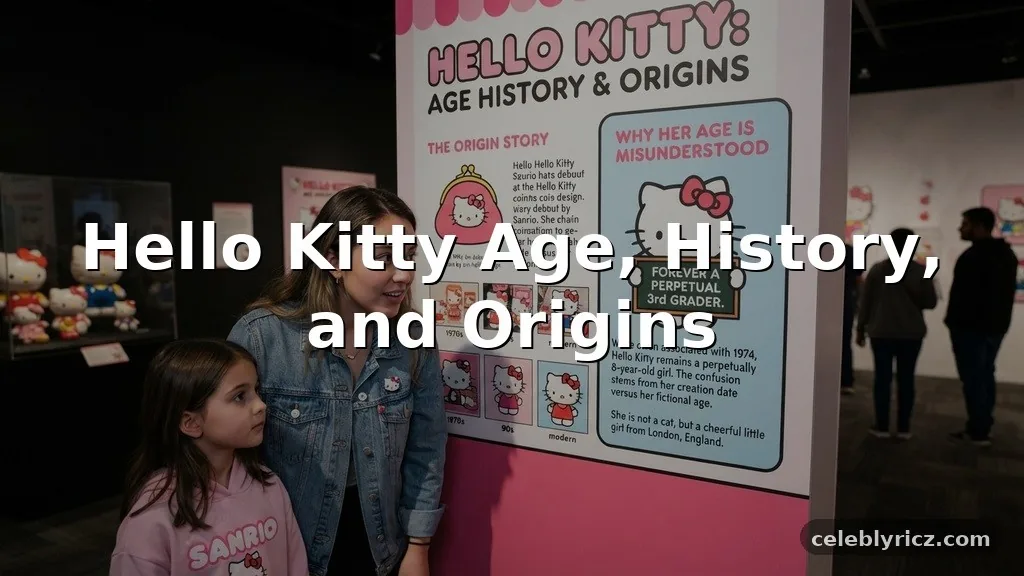

Hello Kitty is a Japanese Sanrio character whose official birthday is November 1, 1974, making her 51 years old by debut date as of 2026. Her Hello Kitty age is not treated like a normal human age, however, because Sanrio presents Kitty White as a permanently young schoolgirl rather than a character who grows older each year.
The story behind Hello Kitty is less mysterious than many internet rumors suggest. Her origins lie in a simple 1970s design by Yuko Shimizu, while her lasting success came from Sanrio’s gift business, a deliberately universal visual style, and a brand that expanded into animation, games, fashion, theme parks, and international licensing.
At a Glance: Hello Kitty’s Verified Facts
| Fact | Verified detail |
|---|---|
| Official name | Kitty White |
| Common name | Hello Kitty |
| Birthday | November 1 |
| Debut year | 1974 |
| Debut age by anniversary | 51 years in 2025 |
| Designer | Yuko Shimizu |
| Company | Sanrio |
| Character origin | Japan |
| Official fictional home | London, England |
| Species description | Sanrio identifies her as a little girl, despite her cat-like appearance |
The table separates two ideas that are often confused. Hello Kitty’s debut age is tied to 1974, but her fictional profile does not require her to become an adult in the way a real person would.
Sanrio’s official profile describes Kitty White as a cheerful girl who lives in London with her parents and twin sister, Mimmy. It also gives her a height of five apples and a weight of three apples, details that belong to the character’s stylized biography rather than a realistic human record.
What Is Hello Kitty’s Actual Age?
Hello Kitty’s official birthday is November 1, and the character first appeared in 1974. That means she reached her 50th anniversary in 2024 and is 51 years old by elapsed time from her debut as of 2026.
That calculation does not mean Sanrio has rewritten Kitty as a 51-year-old woman. The character is generally presented as a young girl, and Sanrio marketing continues to use her childlike design and personality. Her anniversary age measures the history of the brand, not a change in Kitty White’s fictional life stage.
This distinction explains why different pages may give different answers. One source may say Hello Kitty is 51 because it counts the years since her first appearance, while another may describe her as a third-grade student because it is using her continuing fictional profile.
Why Her Age Is So Often Misunderstood
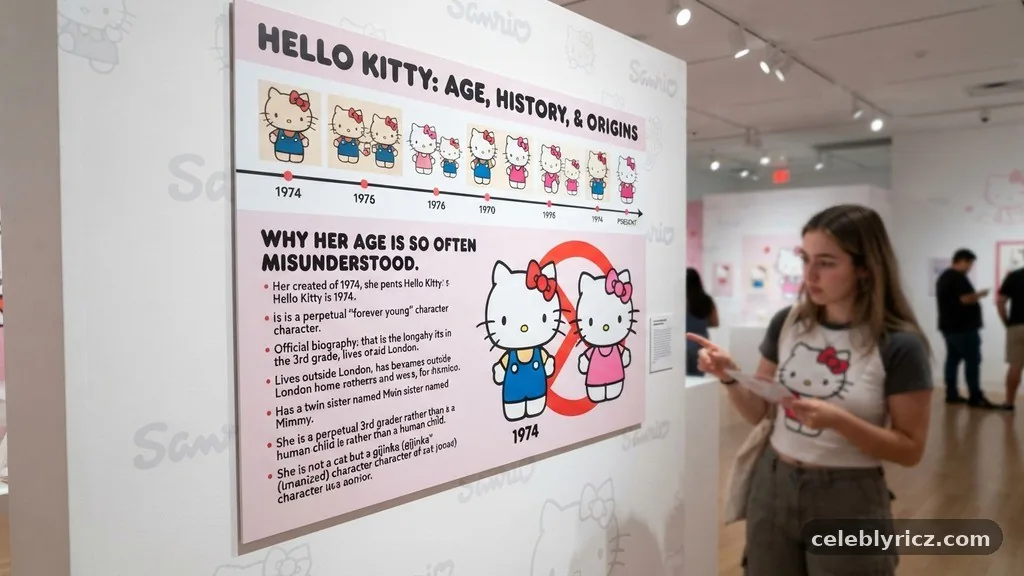
Hello Kitty has existed across several generations, which makes her seem older than the character she represents. A parent who first encountered her in the 1980s may now share Hello Kitty merchandise with a child, even though Kitty herself still has the same birthday and youthful identity.
Sanrio also celebrates milestone anniversaries prominently. The company’s 40th, 45th, and 50th anniversary campaigns encouraged fans to think about Hello Kitty’s age as a cultural timeline. Those campaigns did not establish that she had aged from a child into an adult.
A careful answer is therefore: Hello Kitty debuted in 1974, is 51 by debut anniversary in 2025, and remains a young fictional character in her official profile. Her chronological brand age and her in-story age are separate facts.
Hello Kitty’s Original Design and Yuko Shimizu
Yuko Shimizu created the original Hello Kitty design for Sanrio in the 1970s. Her drawing used a white face, rounded ears, black eyes, a small yellow nose, whiskers, and the now-famous red bow. The image was simple enough to reproduce on small consumer goods and distinctive enough to be recognized without a written name.
The bow matters because it helped distinguish Hello Kitty from a generic cat illustration. In her earliest appearances, the accessory also contributed to a friendly, gift-ready look that fit Sanrio’s focus on small products exchanged between friends.
Hello Kitty was not created as a character for a single television series. She began as a visual design attached to merchandise, which gave Sanrio unusual freedom to place her on wallets, stationery, toys, clothing, dishes, and household products.
The First Product
Sanrio introduced Hello Kitty on a small vinyl coin purse in Japan in 1975. The product is frequently identified as the character’s first major commercial appearance, and its modest size illustrates the original business context: Hello Kitty was designed for affordable everyday gifts rather than launched first as a film or comic-book star.
That beginning shaped her career. A character born on a coin purse could move naturally onto notebooks, lunch containers, pencils, plush toys, and accessories because her face remained legible at many sizes.
Yuko Shimizu was not the only artist associated with Hello Kitty over the decades. Other Sanrio designers, including Yuko Yamaguchi, later influenced the character’s visual development, product styling, and broader creative direction. The original credit remains important, but Hello Kitty’s long design history is a collaborative company story rather than the work of one person alone.
Why Hello Kitty Does Not Have a Mouth
Hello Kitty’s missing mouth is one of the most recognizable features of the design. Sanrio has explained the choice in terms of emotional openness: without a fixed mouth, viewers can imagine Hello Kitty expressing their own feelings.
The decision also made the character visually economical. Two eyes, a nose, whiskers, ears, and a bow can communicate identity quickly, while the blank lower face leaves room for projection.
That design works across languages and markets. A character whose facial expression is not tied to a spoken line can appear happy, sad, thoughtful, or comforting depending on the setting in which a fan encounters her.
A Universal Design, Not an Empty One
The lack of a mouth does not mean Hello Kitty has no personality. Her official profile associates her with friendship, kindness, baking cookies, and playing music, while her relationships with Mimmy, Dear Daniel, and other Sanrio characters give her a social world.
Her visual restraint also helped Sanrio adapt her to different artistic eras. The character can appear in a classic red-bow style, a seasonal outfit, a Japanese cultural design, or a collaboration with a fashion label without losing the core elements that identify her.
- White face: keeps the design clear on both light and dark products.
- Black eyes and whiskers: provide immediate recognition with very few lines.
- Yellow nose: adds a small contrasting detail without creating a strong facial expression.
- Bow or other accessory: distinguishes her from a generic cat and supports themed products.
- No visible mouth: allows fans to read their own emotions into the character.
These choices were practical as well as artistic. A design that remains recognizable in embroidery, plastic, print, animation, and digital icons is especially valuable to a company built around character merchandise.
Where Hello Kitty Comes From
Hello Kitty is a Japanese character created by Sanrio, but her fictional biography places her in London. Sanrio’s profile says Kitty White lives in the suburbs of London with her family, which gives the character a setting distinct from the company’s real-world origin in Japan.
This combination reflects the international imagination built into the character. Her design came from Japan, while her fictional home, name, and family details were shaped to make her feel broadly accessible to audiences outside Japan.
Kitty’s full fictional name is Kitty White. She has a twin sister named Mimmy, who is usually distinguished by a yellow bow worn on the opposite ear. Her parents are commonly identified as George and Mary White in official character material.
The Fictional Profile
Sanrio describes Kitty as a friendly, kind girl who enjoys making cookies and playing the piano. She is also associated with a close friend named Dear Daniel, although the character’s relationships are presented within a light, family-friendly fictional setting rather than a conventional dramatic storyline.
Some details have remained stable for years, while product lines and creative projects may emphasize different aspects of her world. That flexibility allows Sanrio to use Hello Kitty in school supplies, holiday goods, fashion collaborations, digital games, and family entertainment without requiring one continuous plot.
It is important not to confuse the fictional profile with a real biography. Hello Kitty has no real birth certificate, school records, personal income, or private life, and claims about those subjects should not be presented as facts.
Sanrio’s Role in Hello Kitty’s Rise
Hello Kitty’s success cannot be separated from Sanrio’s business model. The company became known for character merchandise designed to encourage communication and gift-giving, often under the broader idea that a small item can help people express affection or friendship.
Sanrio did not need to wait for a major film release to build awareness. Hello Kitty could appear simultaneously on stationery, household products, accessories, and toys, allowing the character to become part of everyday routines rather than remaining limited to one entertainment format.
The strategy was particularly effective in Japan, where character goods became a visible part of school, work, travel, and gift culture. Hello Kitty then expanded internationally through retail partnerships, licensing agreements, entertainment projects, and collaborations with companies outside the traditional toy sector.
From Stationery to a Global Brand
The range of Hello Kitty products grew far beyond the original coin purse. Fans have encountered the character on apparel, cosmetics, luggage, kitchenware, electronics accessories, watches, food packaging, and limited-edition promotional items.
Sanrio’s licensing model also allowed Hello Kitty to appear alongside brands and institutions with very different audiences. That approach kept the character visible to children while introducing her to teenagers, adult collectors, fashion consumers, and nostalgic fans who had grown up with her.
Public reports have sometimes described Hello Kitty’s global business in terms of billions of dollars in retail sales or brand value. Such figures vary by definition and time period, so they should not be treated as a single verified personal fortune or as a precise measure of annual revenue.
The strongest confirmed point is simpler: Hello Kitty became one of Sanrio’s central commercial assets and developed into one of the most widely licensed character brands in the world.
Major Milestones in Hello Kitty’s History
Hello Kitty’s history is best understood as a series of expansions rather than one sudden breakthrough. The character moved from a small Japanese gift item into a broader media and licensing system, with each phase reinforcing the previous one.
| Year or period | Milestone | Why it mattered |
|---|---|---|
| 1974 | Hello Kitty design created and prepared for merchandise | Established the visual identity |
| 1975 | First identified product, a vinyl coin purse, appears in Japan | Moved the design into Sanrio’s gift business |
| 1980s | International recognition and broader licensing expand | Introduced Hello Kitty to new markets |
| 1990s–2000s | More animation, collaborations, and product categories | Reached older consumers as well as children |
| 2010s | Large-scale experiences, digital products, and global partnerships | Kept the character relevant beyond physical goods |
| 2024 | 50th anniversary of the 1974 debut | Marked five decades of cultural and commercial visibility |
The 1980s were especially important because Hello Kitty became recognizable outside Japan. In the United States and other markets, the character was increasingly associated with Japanese popular culture, cute design, collectible goods, and a style that could move between childhood and adult fashion.
Later decades brought more animated productions and media appearances, but Hello Kitty never depended on a single canonical television story. Her primary continuity remained visual and commercial: the same face, bow, name, and emotional associations appeared in many different settings.
Hello Kitty and the Meaning of Kawaii
Hello Kitty is closely connected with kawaii, the Japanese concept commonly translated as “cute.” In this context, cute is not limited to childishness; it can also suggest softness, friendliness, vulnerability, charm, and an invitation to care for or connect with something.
Her rounded proportions and simplified face fit the visual language of kawaii. So do the bows, pastel variations, tiny accessories, and frequent use of friendship-oriented messages.
Yet Hello Kitty’s appeal is not only visual. She is also a social symbol. A Hello Kitty pencil case, plush toy, phone accessory, or shirt can function as a shared reference between people who may not speak the same language or belong to the same age group.
Why Adults Continue to Like the Character
Adult interest in Hello Kitty has several sources. Some buyers feel nostalgia for products they owned as children, while others respond to the character’s graphic clarity, fashion potential, or deliberately gentle mood.
Collaborations with clothing companies, beauty brands, musicians, airlines, restaurants, and public institutions have helped move Hello Kitty beyond a strictly children’s market. The character can appear in a luxury-inspired collection one season and on a low-cost stationery item the next.
This breadth is possible because Hello Kitty is not tied to one narrow personality or storyline. Her design can carry a serious fashion treatment, a humorous product concept, or a comforting everyday message without requiring a major change to the character herself.
Hello Kitty in Media, Places, and Collaborations
Although Hello Kitty began on merchandise, Sanrio later used her in animated series, video games, books, music-related projects, and other forms of entertainment. These appearances expanded the character’s world while keeping merchandise at the center of the brand.
Some productions focus on Kitty and her friends in short, simple situations rather than a single long-running adventure. That format suits a character whose appeal comes from recognizable relationships, visual charm, and everyday activities.
Hello Kitty has also appeared in large public experiences. Sanrio Puroland in Tokyo and Harmonyland in Oita are major examples of attractions built around Sanrio characters, while Hello Kitty-themed events and temporary installations have appeared in many other countries.
Collaborations and Cultural Reach
Collaborations have allowed the character to cross into categories that a traditional children’s mascot might not reach. Products connected to travel, technology, cosmetics, food, fashion, and sports have all used Hello Kitty’s image at different times.
The brand’s reach is also visible in the number of characters surrounding Hello Kitty. My Melody, Keroppi, Badtz-Maru, Cinnamoroll, Kuromi, and others give Sanrio a larger character universe, while Hello Kitty remains its most globally recognizable figure.
For readers seeking an authoritative overview of the company and its characters, Sanrio’s official Hello Kitty character profile is the most useful primary reference for basic biographical details.
Media appearances have supported the brand, but they have not replaced the original design logic. Whether Hello Kitty is printed on a notebook, rendered as a digital avatar, or presented in a theme park, recognition still depends on the same compact visual vocabulary established in the 1970s.
Financial Context: What Hello Kitty Is Worth
Hello Kitty is frequently described as a multibillion-dollar character brand, but the wording needs care. Public estimates have used different methods, including retail sales, licensing revenue, brand value, and the value of products sold by outside companies.
Those categories are not interchangeable. A retail-sales estimate may count the total price paid by consumers for licensed goods, while Sanrio’s own revenue would reflect only the income recognized by the company through its business activities.
No single, universally accepted figure represents Hello Kitty’s personal net worth. She is fictional, and Sanrio does not publish a personal balance sheet for the character.
Why Estimates Differ
Brand estimates may cover different years and markets. One report may measure a particular period of licensed merchandise, while another may discuss the cumulative economic impact of the character since 1974.
Currency conversion, wholesale versus retail pricing, and the inclusion or exclusion of theme parks can also change the result. For that reason, responsible descriptions use terms such as “estimated brand value” or “reported merchandise sales,” not a definite personal fortune.
The defensible conclusion is that Hello Kitty has generated enormous commercial value for Sanrio and its licensees over five decades. The precise amount associated with the character alone remains dependent on the definition and source used.
If you enjoy celebrity biographies like this one, you may also like Alex Warren’s net worth and music career and Amy Lee’s music career and Pat McAfee’s career and earnings.
Frequently Asked Questions
How old is Hello Kitty?
Hello Kitty debuted in 1974 and has a birthday on November 1. She is 51 years old by debut anniversary as of 2026, but her fictional profile continues to present her as a young girl rather than an adult.
What is Hello Kitty’s real name?
Her official fictional name is Kitty White. “Hello Kitty” is the common character name used by Sanrio and the public.
Who designed Hello Kitty?
Yuko Shimizu designed the original Hello Kitty character for Sanrio. Other artists, including Yuko Yamaguchi, later contributed to the character’s development and product styling.
Is Hello Kitty actually a cat?
Hello Kitty has a cat-like appearance, but Sanrio describes her as a little girl named Kitty White. The clearest explanation is that she is a human-like character with feline visual features.
What was Hello Kitty’s first product?
The first widely identified Hello Kitty product was a small vinyl coin purse released in Japan in 1975. It helped establish her as a merchandise character rather than a figure introduced first through film or television.
Where does Hello Kitty live?
Her fictional home is London, England. Sanrio created the character in Japan, so her real-world origin and fictional home are different.
Does Hello Kitty have a mouth?
Hello Kitty is drawn without a visible mouth. Sanrio has associated that choice with emotional openness, allowing viewers to imagine how she feels rather than assigning her one permanent expression.
Is the dark Hello Kitty backstory real?
No reliable official source supports the popular dark-origin rumor. The documented history points to a 1970s Sanrio design by Yuko Shimizu and a first merchandise appearance in 1975.
Is Hello Kitty LGBTQ?
Sanrio has not officially identified Hello Kitty as LGBTQ. Fans may develop their own interpretations, but those interpretations are not confirmed character canon.
Does Hello Kitty have a personal net worth?
No. Hello Kitty is fictional, so references to her “net worth” are estimates about the commercial performance or brand value of products and licensing associated with her image.
Final Takeaway
Hello Kitty’s age is best expressed in two ways: she is 51 years old by the history of her 1974 debut as of 2026, while her fictional identity remains that of a young girl. Her origins are firmly documented in Japan, where Yuko Shimizu created the design for Sanrio before the character appeared on a vinyl coin purse in 1975.
The lasting importance of Hello Kitty’s age, history, and origins comes from the contrast between a simple white face and an extraordinarily adaptable global brand. The official record is more compelling than the rumors: a carefully designed character, a flexible company strategy, and five decades of connection with fans around the world.