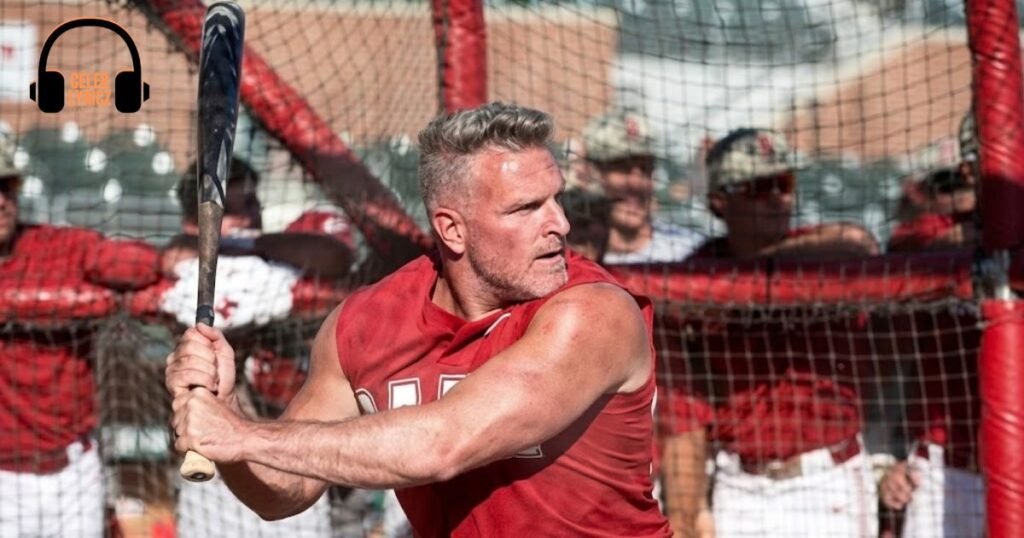

Pat McAfee has pulled off one of the most remarkable career pivots in sports history — from NFL punter to the highest-paid personality in sports media. Born Patrick Justin McAfee on May 2, 1987, in Plum, Pennsylvania, he is 39 years old in 2026, and his estimated $60 million net worth reflects an $85 million ESPN contract, a media company he owns outright, and one of the most loyal audiences in broadcasting.
His journey defies every convention: a seventh-round draft pick who became an All-Pro punter, retired at 29, and built The Pat McAfee Show from a Barstool side project into a daily ESPN institution — all while refusing to leave Indianapolis. His net worth, career, salary, earnings, and ESPN deal remain among the most searched topics in sports media.
This complete profile covers everything about Pat McAfee: his age and Pennsylvania roots, his NFL career with the Indianapolis Colts, his shocking early retirement, the building of his media empire, the FanDuel and ESPN megadeals, his College GameDay role, his estimated net worth breakdown, and his personal life. Here are the verified facts.
Pat McAfee at a Glance
| Fact | Detail |
|---|---|
| Full name | Patrick Justin McAfee |
| Date of birth | May 2, 1987 |
| Age (2026) | 39 years old |
| Birthplace | Plum, Pennsylvania, USA |
| Height / Weight | 6’1″ (185 cm) / ~233 lbs (106 kg) |
| NFL career | Indianapolis Colts punter (2009–2016) |
| NFL honors | First-Team All-Pro (2014); 2× Pro Bowl (2014, 2016) |
| Current role | Host of The Pat McAfee Show; ESPN College GameDay analyst |
| ESPN deal | 5 years, $85 million (~$17M/year, signed 2023) |
| Spouse | Samantha McAfee |
| Residence | Indianapolis, Indiana |
| Net worth (estimated) | Around $60 million |
Born in May 1987, Pat McAfee turned 39 on May 2, 2026. He retired from the NFL at 29 — an age when most punters are entering their prime — and built a media fortune that dwarfs his playing earnings before he turned 40.
Early Life in Pennsylvania
Patrick Justin McAfee was born on May 2, 1987, in Plum, Pennsylvania, a suburb of Pittsburgh. He grew up a Pittsburgh Steelers fan, and his working-class Pennsylvania roots — the directness, the humor, the pierogi loyalty — remain central to his on-air persona.
He attended West Virginia University, where he became one of college football’s best punters. The Colts selected him in the seventh round of the 2009 NFL Draft — 222nd overall. Seventh-rounders are supposed to be camp bodies; McAfee became a star.
Even in college, his personality stood out: funny, fearless, and utterly himself. Teammates gravitated to him, a preview of the audience magnetism that would later define his media career.
NFL Career: Indianapolis Colts (2009–2016)
McAfee spent all eight of his NFL seasons with the Indianapolis Colts, developing into the league’s most entertaining punter — a phrase that sounds like faint praise until you watched him play. He was a genuine weapon: booming punts, fearless tackles on returns (unheard of for punters), and even emergency kickoff duties.
His peak came in 2014: First-Team All-Pro honors and a Pro Bowl selection, making him officially the best punter in football. He earned a second Pro Bowl nod in 2016 and signed a five-year, $14.5 million extension that made him one of the highest-paid punters in the league. His career earnings totaled roughly $15–20 million.
He was also a character: the onside-kick recoveries, the touchdown-saving tackles, the larger-than-life celebrations. Colts fans adored him, and his popularity in Indianapolis would later anchor his entire media operation.
The Shocking Retirement (2017)
On February 2, 2017, McAfee announced his retirement from the NFL at age 29 — with two years remaining on his contract. He made the announcement on Comedy Central, a deliberately unconventional choice that signaled where he was headed. He had spent offseasons doing stand-up comedy across Indiana; the media path was already forming.
The reasons were practical: he was facing his third knee surgery in four years, and his relationship with then-Colts general manager Ryan Grigson had strained. But the deeper truth was ambition — McAfee saw a bigger future in media than in punting, and he was willing to walk away from millions in guaranteed NFL money to chase it.
It remains one of the boldest retirements in recent sports history: a player at his position’s peak, voluntarily leaving, to bet on himself. Like Cowboys star CeeDee Lamb betting on himself with a training-camp holdout years later, McAfee understood his leverage — and used it.
Building the Media Empire
Barstool Beginnings
After retiring, McAfee joined Barstool Sports, where The Pat McAfee Show began taking shape. But he quickly realized he wanted ownership, not employment. In 2018, he left Barstool to form Pat McAfee Inc. and run the show independently — a decision that would make him tens of millions.
The independent years were the foundation: daily shows streamed on YouTube, a growing cast of co-hosts and contributors, and a style — loose, funny, profane, deeply knowledgeable — that traditional sports media could not replicate. His YouTube channel amassed millions of subscribers, and the show became a daily habit for a generation of sports fans.
The FanDuel Megadeal ($120 Million)
In December 2021, McAfee signed a four-year, $120 million deal with FanDuel — $30 million per year — while retaining ownership of his show. The partnership brought production infrastructure and a proper studio (the “Thunderdome” in Indianapolis) to the operation. For 18 months, it was one of the richest talent deals in sports media.
The ESPN Era ($85 Million)
In May 2023, McAfee made another stunning move: he opted out of the FanDuel deal — walking away from $30 million a year — to sign a five-year, $85 million contract with ESPN (approximately $17 million annually). The show joined ESPN’s weekday programming, airing on the cable channel, ESPN+, and ESPN’s YouTube channel.
The key condition, which McAfee insisted on: creative control. He kept ownership of Pat McAfee Inc. and full editorial independence — a deal structure unprecedented for ESPN talent. The network got the audience; McAfee kept the keys.
In 2026, reports indicate ESPN and McAfee are in extension talks for a new deal reportedly worth $60–65 million per year — which would make him the highest-paid talent in sports media history. Bleacher Report’s 2026 ranking already places his annual intake around $30 million, third among all sports media personalities behind Stephen A. Smith and Tom Brady.
College GameDay and WWE
Beyond his daily show, McAfee is a regular analyst on ESPN’s College GameDay, the network’s flagship college football program, alongside Rece Davis, Kirk Herbstreit, Desmond Howard, and Nick Saban. His energy — part analyst, part hype man, part comedian — reshaped the show’s chemistry and helped drive its continued ratings dominance.
He has also been a recurring WWE personality, serving as a commentator and even wrestling at WrestleMania weekend events. The WWE crossover fits his persona perfectly: sports entertainment for a sports entertainer.
Net Worth Breakdown: How the $60 Million Was Built
| Income source | Details |
|---|---|
| NFL career (2009–2016) | ~$15–20M in salary and bonuses with the Colts |
| FanDuel deal (2021–2023) | $120M/4yr deal (~$30M/yr); exited after 18 months |
| ESPN deal (2023–present) | $85M/5yr (~$17M/yr); extension talks reportedly $60–65M/yr |
| Pat McAfee Inc. | Full ownership of the media company and show IP |
| YouTube & podcast | Ad revenue, podcast distribution (iHeart, Spotify, Apple) |
| Sponsorships & merch | Live show sponsors, merchandise sales |
| WWE | Commentary and appearance fees |
| Real estate | 12-acre Indianapolis estate (purchased 2015, now ~$1.6–1.8M) |
The most widely cited estimate puts Pat McAfee’s net worth at approximately $60 million as of 2026, with some outlets ranging $55–65 million. The ESPN contract is the single biggest driver, but the full ownership of Pat McAfee Inc. — the company, the IP, the audience relationship — is the asset that makes him truly wealthy. He does not just earn a salary; he owns the factory.
Notably, his media earnings dwarf his NFL earnings: his current ESPN salary surpasses his entire eight-year football income in a single year. It is the ultimate validation of the 2017 retirement gamble.
The Indianapolis estate deserves a note too: purchased in 2015 for $925,000, the 12-acre property now valued around $1.6–1.8 million sits minutes from the Thunderdome studio. It is both home and headquarters — the physical embodiment of a career built on staying put while the world came to him.
Why Indianapolis? The Thunderdome Strategy
Every deal, every platform, every negotiation has run through Indianapolis — the city where McAfee played and never left. His studio, the “Thunderdome,” sits on Oaklandon Road near his $1.2 million home, in the city that made him. While every other sports media star clusters in New York or Los Angeles, McAfee built an empire from Indiana.
The strategy is both personal and brilliant: lower costs, total control, and a chip-on-the-shoulder identity that resonates with the middle-American audience traditional sports media often ignores. Indianapolis is not where he ended up — it is where he chose to win from.
His loyalty to the city mirrors the community-first approach of athletes like cricket star Tilak Varma, whose Hyderabad roots remain central to his identity, and pickleball star Anna Bright, who built her career from her training base rather than chasing traditional hubs.
Personal Life
Pat McAfee married Samantha McAfee (née Ludy) in 2020. The couple lives in Indianapolis and keeps a relatively low profile despite his massive public presence. Samantha occasionally appears on the show and is a beloved figure among the show’s fanbase.
Off the air, McAfee is known for his loyalty — to his co-hosts (many of whom have been with him since the early independent days), to Indianapolis, and to the fans he calls his friends. His on-air persona — loud, profane, hilarious — is, by all accounts, not an act.
He remains deeply connected to West Virginia University and the Colts, and his charity work in Indianapolis reflects a genuine attachment to the community that adopted him.
Controversies and Criticisms
McAfee’s rise has not been without friction. His loose, unfiltered style has occasionally clashed with ESPN’s corporate culture, generating headlines about internal tensions. His show’s massive platform has also drawn scrutiny over the responsibility that comes with it — particularly around sensitive topics.
He has navigated these storms with his characteristic approach: address it directly on the show, refuse to be censored, and let the audience decide. The creative-control clause in his ESPN deal exists precisely because both sides knew the friction was inevitable — and the ratings have justified the arrangement.
Anatomy of The Pat McAfee Show
What makes The Pat McAfee Show work? The formula looks chaotic but is carefully constructed: a daily three-hour live broadcast blending sports analysis, comedy, celebrity interviews, and genuine news-breaking. The cast — a rotating ensemble of former athletes, comedians, and insiders — creates the chemistry of a locker room rather than a studio.
The show’s superpower is access. Active NFL players, coaches, and newsmakers appear regularly, speaking more freely than they would on traditional outlets — because McAfee is one of them, a former player who speaks the language. The show has broken major sports stories, hosted presidential candidates, and become required viewing for the sports-obsessed.
Distribution is everywhere: ESPN cable, ESPN+, ESPN’s YouTube channel, McAfee’s own YouTube, and podcast feeds on iHeart, Apple, and Spotify. That ubiquity — meeting the audience on every platform simultaneously — is the modern media playbook McAfee helped write.
McAfee’s Business Philosophy: Own Everything
The through-line of McAfee’s business career is ownership. He left Barstool to own his show. He structured the FanDuel deal to keep his IP. He made creative control a non-negotiable condition of the ESPN contract. At every step, he chose equity and independence over the biggest immediate paycheck — including walking away from $30 million a year at FanDuel.
It is a philosophy with roots in his NFL experience: players are assets who capture a fraction of the value they create. McAfee decided to be the owner, not the asset. Pat McAfee Inc. — the company, the brand, the audience relationship — is worth far more than any single contract, and it is entirely his.
Young athletes and creators study his deals the way film students study Scorsese. The lesson: leverage is built, not given — through audience, through independence, and through the willingness to walk away.
What’s Next: The $60 Million Question
At 39, McAfee’s next contract will define the ceiling for sports media talent. The reported $60–65 million per year extension figure — if it materializes — would not just make him the highest-paid personality in sports media; it would reset the market for everyone behind him, the way his FanDuel deal did in 2021.
Beyond the contract, the empire keeps expanding: the show’s audience grows, College GameDay thrives with his energy, and Pat McAfee Inc. could eventually become an acquirer rather than just a producer — buying shows, signing talent, building a network. The Indianapolis Thunderdome might be the headquarters of something much bigger than one show.
The only certainty is that whatever comes next will be on his terms. That has been the one constant from the seventh-round draft pick to the $85 million man: Pat McAfee does what Pat McAfee wants — and the industry adjusts.
Cultural Impact: Changing Sports Media Forever
Pat McAfee’s influence extends far beyond his own balance sheet. He proved that a daily sports show could thrive outside the traditional media capitals, outside the traditional formats, and outside the traditional rules — and still land on ESPN. Every independent sports creator with a microphone owes him a debt.
He also changed what sports television sounds like. The polished, suit-and-tie analyst model — perfect hair, careful opinions — now shares the stage with McAfee’s barstool energy: profane, hilarious, and startlingly insightful. College GameDay, once the most traditional show in sports, now features a guy who does wrestling moves in celebration. The old guard adapted or got left behind.
Perhaps most importantly, he demonstrated that athletes can own their post-career narratives. The old path — retire, wait for a network call, accept whatever analyst chair is offered — is obsolete. McAfee’s path — build the audience yourself, own the IP, make the networks come to you — is the new template. A generation of players is already following it.
Frequently Asked Questions
What is Pat McAfee’s net worth?
Pat McAfee’s net worth is estimated at approximately $60 million as of 2026 (with estimates ranging $55–65 million). His wealth comes primarily from his five-year, $85 million ESPN contract, his prior $120 million FanDuel deal, full ownership of Pat McAfee Inc., and his NFL career earnings of roughly $15–20 million.
How much does Pat McAfee make from ESPN?
Pat McAfee’s ESPN contract, signed in May 2023, pays approximately $17 million per year over five years ($85 million total). In 2026, ESPN and McAfee are reportedly in extension talks for a new deal worth $60–65 million per year, which would make him the highest-paid talent in sports media.
Why did Pat McAfee retire from the NFL?
Pat McAfee retired from the Indianapolis Colts in February 2017 at age 29, with two years left on his contract. He cited his health (facing a third knee surgery in four years), a strained relationship with the general manager, and a bigger ambition: building a media career. He announced it on Comedy Central.
Is Pat McAfee married?
Yes. Pat McAfee married Samantha McAfee in 2020. The couple lives in Indianapolis, Indiana, where McAfee runs his entire media operation from his “Thunderdome” studio.
How old is Pat McAfee?
Pat McAfee is 39 years old in 2026. He was born Patrick Justin McAfee on May 2, 1987, in Plum, Pennsylvania, and turned 39 on May 2, 2026.
Final Takeaway
Pat McAfee’s net worth — approximately $60 million in 2026 — tells the story of the boldest career pivot in modern sports: a seventh-round punter who retired at 29, bet everything on himself, and built a media empire from Indianapolis that now pays him more in a year than football paid in eight. The $85 million ESPN deal, the $120 million FanDuel deal before it, and the company he owns outright are monuments to self-belief.
As extension talks reportedly push toward $60–65 million a year, McAfee stands on the verge of becoming the highest-paid personality in sports media history — from a studio in Indiana, on his own terms. For anyone who has ever been told to stay in their lane, Pat McAfee is living proof: build your own road, and the world will pave it behind you.
From seventh-round afterthought to All-Pro to media mogul, his story is the American dream with better jokes. The punter became the punchline’s author — and then bought the whole comedy club. At 39, with the industry bending around him, Pat McAfee’s greatest trick may be that he is just getting started.