
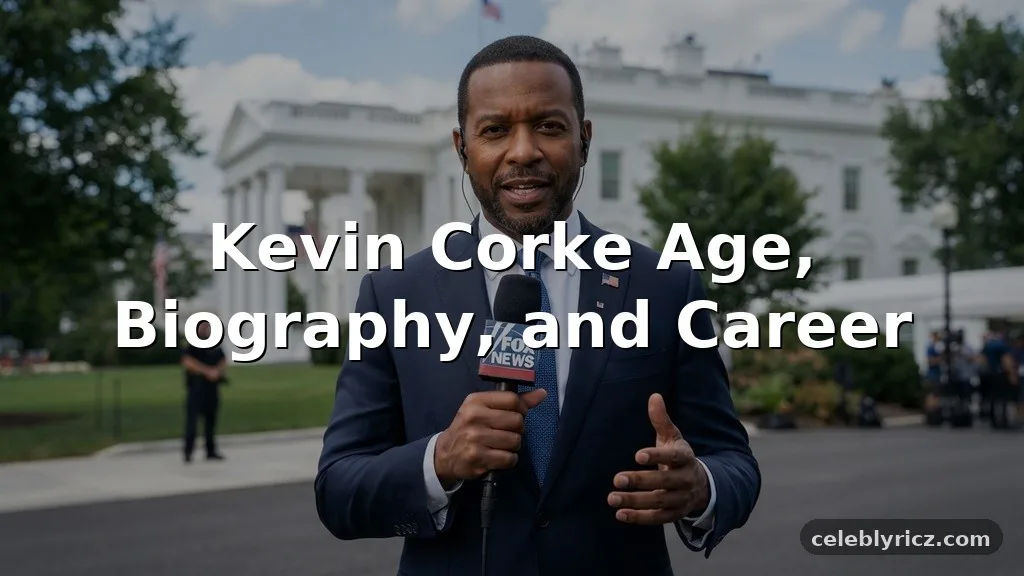

Kevin Corke has reported from the White House briefing room under four consecutive presidents — Bush, Obama, Trump, and Biden — a run of continuous access few correspondents can match. Before politics, he called games for ESPN. Before ESPN, he earned three graduate-level credentials including a Harvard fellowship. It is one of the most unusual résumés in American broadcast journalism.
This Kevin Corke biography covers his reported age and Detroit roots, his University of Colorado and Harvard education, the ESPN SportsCenter years, the NBC News Washington tenure, his Fox News White House correspondence since 2014, his awards, and the honest limits of what is known about his personal life and finances.
Corke is famously private — a genuine rarity in an industry built on visibility, and a man who has kept that boundary intact across nearly forty years in front of cameras. This profile respects that firm boundary while fully documenting a remarkable and consequential public career. Here is what the documented record shows.
At a Glance
| Fact | Details |
|---|---|
| Full name | Kevin Eugene Corke (reported) |
| Reported birth date | February 6, 1965 (most reported; one source says 1963) |
| Reported age in 2026 | 61 years old |
| Birthplace | Detroit, Michigan, United States (reported) |
| Education | BA & MA Journalism, University of Colorado Boulder; Harvard Kennedy School (Littauer Fellow) |
| Profession | Television journalist, White House correspondent |
| Current role | Senior National Correspondent / White House Correspondent, Fox News (since 2014) |
| Previous networks | ESPN, NBC News, KUSA Denver, WTVJ Miami |
| Administrations covered | Bush, Obama, Trump, Biden |
| Awards | Multiple Emmys, including National Sports Emmy (2003) |
| Net worth | Estimated $2–5 million (unverified) |
How Old Is Kevin Corke?
Kevin Corke’s birthdate is most commonly reported as February 6, 1965, which would make him 61 years old in 2026. One profile lists February 6, 1963 instead. He has never publicly confirmed his birthdate, so the 1965 date — repeated across the majority of biographical sources — is used here with that caveat.
What is not in doubt is the length of his career: he has been in broadcast journalism since the late 1980s, a nearly four-decade run that spans sports, local news, network news, and cable news at the highest level.
Detroit Roots
Corke was born and raised in Detroit, Michigan, according to the most detailed profiles. The city’s industrial work ethic and cultural depth are often credited with shaping his grounded, direct, no-nonsense reporting style — a demeanor colleagues describe as composed under pressure.
Little is publicly known about his parents or siblings; Corke has kept his family background entirely private throughout his career. That discretion extends to nearly every aspect of his personal life, a deliberate choice in a profession where many trade on visibility.
The Detroit Work Ethic
Profiles of Corke invariably mention Detroit, and for good reason. The city’s culture — forged in factories, tempered by hard times — prizes showing up, doing the work, and letting results speak. Colleagues describe exactly that in Corke: the correspondent who is always prepared, never rattled, and allergic to shortcuts. It is tempting to romanticize hometown influence, but in his case the throughline is visible across four decades: a Detroit-bred seriousness that the briefing room rewards and the camera respects.
Education: Colorado, Then Harvard
Corke’s academic credentials are among the strongest in broadcast journalism. He earned both his bachelor’s and master’s degrees in journalism from the University of Colorado Boulder, building the technical foundation for a career in front of the camera.
He then attended Harvard University’s Kennedy School of Government, earning an additional master’s degree focused on public policy — and receiving the Littauer Fellow citation, awarded for academic excellence, leadership, and commitment to public-interest work. The combination of broadcast training and policy education explains the distinctive quality of his political reporting: technically precise and contextually deep.
He is a life member of the Kappa Alpha Psi fraternity. One profile reports he enrolled at the UDC David A. Clarke School of Law in 2023 — an unusual mid-career move that, if accurate, would add a legal education to an already formidable résumé.
ESPN: The SportsCenter Years
Before politics, Corke was a sports broadcaster — and a prominent one. As a SportsCenter anchor at ESPN, he delivered highlights to millions of nightly viewers, and his play-by-play work spanned ten different sports, from college football to the Olympics. He covered the Olympic Games in Torino and Atlanta, the Super Bowl, and NCAA championships, earning a National Sports Emmy in 2003 — the industry’s highest honor for sports broadcasting excellence. His play-by-play versatility across ten sports marked him as one of ESPN’s most adaptable talents.
The sports years built skills that transferred directly to political reporting: thinking on live television, distilling complex fast-moving events into clear narratives, and performing under the pressure of millions watching. The composure viewers see in his White House reporting was forged in sports’ unscripted chaos.
Like ESPN star Pat McAfee, who parlayed sports broadcasting into a broader media empire, Corke used sports television as a launchpad — though his trajectory bent toward hard news rather than entertainment.
Local News and NBC: Denver, Miami, Washington
Between and around the ESPN years, Corke built a formidable local-news résumé: anchor and reporter at KUSA-TV (9News) in Denver, and primary news anchor at WTVJ-TV, the NBC station in Miami. Local news is where broadcasters learn the complete craft — writing, reporting, anchoring, and connecting with a community.
From 2004 to 2008, he served as a Washington, D.C. correspondent for NBC News, covering the Bush administration from the White House, the Pentagon, and the Supreme Court. The NBC tenure established him as a serious political reporter and set the stage for everything that followed.
Fox News: Four Administrations (2014–Present)
Corke joined Fox News Channel in 2014 as a senior national correspondent, quickly becoming one of the network’s primary White House correspondents. What followed was historically unusual: continuous White House coverage across the Bush, Obama, Trump, and Biden administrations — four consecutive presidencies, each with radically different relationships to the press.
His reporting portfolio at Fox has been wide: presidential travel (including Trump’s 2018 Europe trip), the Virginia Tech tragedy, the final Space Shuttle flight, the 2020 protests, Supreme Court decisions, and U.S. foreign policy. He has reported from more than 50 countries. He also serves as a frequent guest anchor on “Fox News @ Night,” stepping into the anchor chair with the same steadiness he brings to reporting.
Covering the White House across parties requires a particular discipline — maintaining source relationships and credibility regardless of who holds the office. Colleagues across the ideological spectrum credit Corke with exactly that: a reporter whose questions are tough but fair, and whose demeanor never becomes the story. Fellow White House correspondent Kaitlan Collins covers the same beat from CNN’s side of the briefing room, and the two represent a generation of correspondents defined by preparation over performance.
Awards and Recognition
Corke’s trophy case reflects the two halves of his career. The National Sports Emmy from 2003 honors the ESPN years — recognition from sports broadcasting’s highest authority. The Littauer Fellow citation from Harvard’s Kennedy School honors the academic half — recognition from one of the world’s great policy institutions. Few journalists can claim top honors in both athletics and academia, and the pairing captures what makes his career distinctive.
Beyond the headline awards, his regional Emmys from the local-news years and the sustained trust of four White House press operations tell the fuller story: excellence recognized at every level, in every medium, across nearly four decades.
- Multiple Emmy Awards, including a National Sports Emmy (2003)
- Littauer Fellow citation, Harvard Kennedy School of Government
- Regional journalism honors across local-news career
- Life Member, Kappa Alpha Psi fraternity
Personal Life: The Privacy Boundary
Corke’s personal life is among the most private in television news. In 2022, he publicly stated “I am not married” — yet some biography sites claim he is married to a woman named Rebecca Ramanda Corke with two children. The contradiction is unresolved: no verified photos, interviews, or records confirm either account beyond his own 2022 statement.
This profile reports the conflict rather than choosing a side. What is verifiable: he keeps his social media strictly professional, shares no family details publicly, and has built a career in which the work — not the personality — is the product. In an era when many journalists become influencers, Corke’s old-school boundary is itself a statement.
His stated interests include reading, sports, travel, and international affairs — the pursuits of a man whose profession is understanding the world.
Kevin Corke Net Worth and Salary
Corke’s net worth is estimated between $2 million and $5 million by biography sites, with some citing $2–3 million specifically. One profile lists an annual Fox News salary of approximately $112,000, though that figure is unverified and seems low for a senior correspondent in the Washington market.
What is certain is the earning arc: nearly four decades across ESPN, NBC, and Fox News, plus a stint as COO of Archangel Communications LLC (2013–2024), would have produced substantial career earnings. Like most television journalists, his wealth reflects longevity and network tenure rather than any single windfall.
Covering Four White Houses
Few correspondents in history have covered four consecutive administrations from the briefing room. Corke’s run — Bush, Obama, Trump, Biden — spans the pre-social-media presidency through the post-everything presidency, and the contrast between those eras is itself a story about American media.
Under Bush, the briefing room operated on relatively traditional terms: scheduled briefings, established access norms, print and broadcast dominance. Obama brought digital transformation and a more controlled message operation. Trump shattered every norm — hostile briefings, Twitter as official communication, “fake news” as presidential vocabulary. Biden restored some traditional structures while navigating a fractured media landscape.
Through all of it, Corke’s approach stayed constant: prepared questions, professional demeanor, no theatrics. That consistency is harder than it looks. Correspondents who adapt their style to each administration’s temperature often lose credibility with audiences; those who perform outrage for cameras lose it with sources. Corke’s four-administration tenure suggests he avoided both traps.
The Craft of the White House Correspondent
White House correspondence is a specialized craft that looks simple and is brutally difficult. The daily work involves monitoring administration announcements, cultivating sources across agencies, attending briefings where a single question must be sharp enough to matter and careful enough to get answered, and then translating all of it into clear television segments on deadline.
The briefing room itself is theater with consequences: seventy-odd seats, cameras everywhere, and a press secretary whose job is to reveal as little as possible. The correspondents who thrive combine deep policy knowledge — Corke’s Harvard Kennedy School training is tailor-made for this — with the performer’s timing he learned at ESPN. Ask the wrong question and you waste your turn; ask the right one and you can drive a news cycle.
Corke’s longevity in the room testifies to something colleagues value above all: reliability. Producers know his live shots will be clean, accurate, and on time. Sources know he will represent their answers fairly. In a beat where trust is currency, he is wealthy.
The Sports-to-Politics Transition
Corke’s move from sports to hard news is rarer than it looks. The skill sets overlap — live performance, quick analysis, storytelling under deadline — but the cultures differ enormously. Sports broadcasting rewards personality; political reporting punishes it. The transition requires a deliberate reinvention, and many who attempt it fail to make the credibility leap.
Corke managed it through education and patience. The Harvard Kennedy School degree signaled seriousness to political editors; the NBC Washington years proved he could handle the beat; and by the time Fox News hired him in 2014, the sports past was an asset (composure, versatility) rather than a liability. It is a career pivot that deserves study: proof that reinvention works when it is backed by genuine preparation.
Reporting From 50+ Countries
Beyond the White House, Corke’s passport tells its own story: more than 50 countries across his career, from presidential foreign trips to standalone international assignments. Foreign reporting tests every journalistic muscle — logistics, cultural fluency, filing under impossible conditions — and it broadens a correspondent’s understanding of how American politics looks from the outside.
The 2018 Trump Europe trip, which Corke covered, exemplified the challenge: a high-stakes NATO summit, a Helsinki meeting with Vladimir Putin, and wall-to-wall global attention, all requiring instant analysis across time zones. These are the assignments that separate career correspondents from the rest — and Corke has a decades-long record of handling them.
The Business Chapter: Archangel Communications
From 2013 to 2024, Corke served as COO of Archangel Communications LLC, a business venture that ran parallel to his journalism career. Details of the company’s operations are not widely publicized — consistent with Corke’s privacy — but the role suggests business interests beyond the newsroom.
The dual-track career is increasingly common among veteran journalists: media salaries, even at the network level, have ceilings, and side ventures provide both income diversification and post-broadcast options. For Corke, whose on-air career spans nearly four decades, the business chapter represents prudent long-term planning.
The Privacy Paradox
Corke’s privacy is genuinely unusual in 2026. Television journalists are expected to be brands: active social feeds, personal anecdotes, behind-the-scenes content. Corke’s social media is strictly professional — work clips, no personal reveals. He has given the public almost nothing about his family, relationships, or daily life, and he has maintained that boundary for decades.
The paradox is that the privacy fuels the curiosity it seeks to avoid. Search interest in “Kevin Corke wife” and “Kevin Corke family” is enormous precisely because the answers are unavailable — and the vacuum gets filled by speculation, including the disputed marriage claims this profile documents. It is a no-win dynamic: share nothing and invite invention, or share something and invite scrutiny.
His choice reflects an older journalistic ethic: the reporter should not be the story. In an era when many correspondents cultivate celebrity, Corke’s insistence on being known only for his work reads as both anachronistic and admirable. Whether the boundary holds in an age of total information is an open question — but four decades in, he has not blinked.
Legacy and the Next Chapter
At a reported 61, Corke’s legacy is already substantial: the rare correspondent trusted across four administrations, the sports anchor who became a policy expert, the Harvard fellow who never lost the common touch or the Detroit-bred work ethic. His career argues that credibility is built slowly — degree by degree, assignment by assignment, administration by administration.
What comes next is unwritten. The reported law school enrollment suggests intellectual restlessness; the business background suggests options beyond broadcasting; and the journalism itself shows no signs of slowing. White House correspondents often become authors, analysts, or academics — all paths his résumé would support.
Whatever the next chapter, the throughline is clear. Kevin Corke built a career on the unfashionable virtues: preparation over performance, fairness over heat, work over celebrity. In the briefing room and beyond, that is a legacy worth having.
Frequently Asked Questions
How old is Kevin Corke?
His birthdate is most commonly reported as February 6, 1965, which would make him 61 in 2026 — though one source says 1963 and he has never confirmed it himself.
Where does Kevin Corke work now?
He is a senior national correspondent and White House correspondent for Fox News Channel in Washington, D.C., a role he has held since 2014.
Did Kevin Corke work for ESPN?
Yes. Before political journalism, he was a SportsCenter anchor and play-by-play broadcaster at ESPN, covering the Olympics, Super Bowl, and NCAA events, and winning a National Sports Emmy in 2003.
Is Kevin Corke married?
His marital status is unconfirmed and disputed: he stated in 2022 that he is not married, but some sites claim a wife and children. No verified evidence confirms either account beyond his own statement.
What is Kevin Corke’s net worth?
His net worth is estimated between $2 million and $5 million by biography sites, though the figures are unverified.
Conclusion
Kevin Corke’s biography is the story of a journalist who mastered two professions — sports and politics — and earned the trust of four White Houses in the process. From Detroit to Boulder to Harvard to the briefing room, his path reflects a rare combination: the performer’s composure, the scholar’s depth, and the reporter’s discipline.
At a reported 61, he remains what he has always been: the steady presence in the scrum, asking the tough question fairly and going home without becoming the story himself. In a media age that richly rewards heat over light, Corke’s distinguished career is a standing argument for the old virtues — preparation, fairness, and the radical act of letting the story be the star.
Explore more on CelebLyricz.