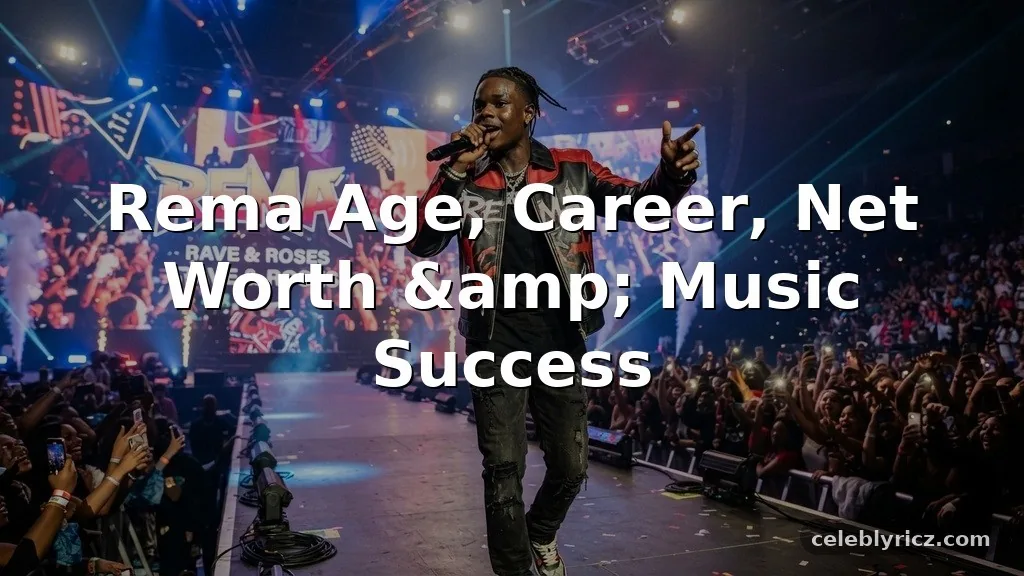

Rema is 26 years old in 2026, and he has already done what most artists never do: taken a sound from Benin City, Nigeria, to the top of the global charts. Born Divine Ikubor on May 1, 2000, he broke through with “Dumebi” in 2019, then conquered the world with “Calm Down” — the Selena Gomez remix that spent a record 58 weeks atop the Billboard Afrobeats chart and peaked at number three on the Hot 100.
This Rema biography covers his age and Benin City roots, the viral freestyle that caught D’Prince’s attention, the Mavin Records signing, the Calm Down phenomenon, his albums Rave & Roses and HEIS, the Grammy nomination, his estimated net worth, and what he is doing in 2026.
His story is the Afrobeats globalization story in miniature: church choirs to Instagram to the biggest stages on earth.
At a Glance
| Fact | Details |
|---|---|
| Stage name | Rema |
| Real name | Divine Ikubor |
| Born | May 1, 2000, Benin City, Nigeria |
| Age in 2026 | 26 years old (Taurus) |
| Genre | Afrobeats / Afrofusion / Trap |
| Label | Jonzing World / Mavin Records |
| Breakthrough | “Dumebi” (2019) |
| Global hit | “Calm Down” (2022; remix feat. Selena Gomez) |
| Albums | Rave & Roses (2022), HEIS (2024) |
| Grammy | Nominated, Best Global Music Album (2025) |
| Net worth | Estimated $5–10 million (unverified) |
How Old Is Rema?
Rema was born on May 1, 2000, in Benin City, Edo State, Nigeria, making him 26 years old in 2026. His Taurus sign suits the profile: determined, patient, and quietly relentless — the qualities that carried him from tragedy to triumph before he turned 20.
He became famous at 17 and a global star by 22. Few artists in history have compressed that much ascent into that little time — and the psychological toll of it is something he has begun to discuss openly, a candor that itself marks his maturation from teenage prodigy to thoughtful adult artist.
He became famous at 17 and a global star by 22. The speed of it all is something he has reflected on publicly, saying in 2026 that “everything moved so fast” after his breakthrough — and that he has been taking time to reassess his life and career.
Benin City Roots and Early Hardship
Divine Ikubor grew up in Benin City, one of Nigeria’s most culturally historic cities, raised in a Christian household alongside his siblings. His childhood was marked by devastating loss: his father and his older brother both died when he was young, events that profoundly shaped his emotional worldview and later became recurring themes in his music.
With his father and brother gone, Rema became the family breadwinner while still in his teens — a weight that forged the ambition and emotional maturity listeners hear in his songs. He attended the Ighile Group of Schools in Edo State, singing and rapping through secondary school, and like many African artists, honed his voice in church, where rhythm, melody, and public performance became second nature.
The Viral Freestyle That Changed Everything
In 2018, Rema posted a freestyle over D’Prince’s track “Gucci Gang” on Instagram. D’Prince — the Mavin Records artist and executive — saw it, was intrigued, and reached out. The two negotiated Rema’s relocation to Lagos, where he signed with D’Prince’s Jonzing World, a subsidiary of Mavin Records, the powerhouse label founded by legendary producer Don Jazzy.
It is the modern music-discovery fairy tale: no demo tapes, no showcases — just a phone video, an algorithm, and an executive with ears. Within a year, the teenager from Benin City was a signed artist with the full machinery of Nigeria’s biggest label behind him.
“Dumebi” and the 2019 Breakthrough
In 2019, Rema released his self-titled debut EP, Rema, which hit number one on Apple Music Nigeria — an extraordinary debut for a teenager. The “Dumebi” music video, released May 21, 2019, became the milestone: a sun-drenched, irresistible track that announced a new voice in Afrobeats. “Iron Man” — which earned a spot on Barack Obama’s summer playlist — confirmed he was not a one-song wonder.
His sound was immediately distinctive: Afrobeats fused with trap, dancehall, and pop, delivered with a melodic sensibility that felt global from the start. Nigerian audiences heard the future; international audiences heard something they did not know they had been waiting for. Both were right. He called it Afrorave — his own term for the high-energy fusion he was building. The industry took notice, and so did the brands: in September 2021, he became a Pepsi Nigeria ambassador alongside Ayra Starr.
“Calm Down”: The Global Phenomenon
The 2022 single “Calm Down” changed everything. The original was already a hit, but the remix featuring Selena Gomez turned it into a genuine global phenomenon: it peaked at number three on the Billboard Hot 100, topped the Billboard Afrobeats Songs chart for a record-breaking 58 weeks, and became the most-streamed Afrobeats song in history.
The numbers are staggering — billions of streams across platforms, chart runs measured in years rather than weeks. “Calm Down” did not just succeed; it expanded the market, introducing Afrobeats to audiences who had never engaged with the genre. For a 22-year-old from Benin City to carry that weight is remarkable; that he carried it effortlessly is the point.
The Selena Gomez collaboration — pairing one of pop’s biggest names with Afrobeats’ brightest young star — was a masterstroke of cross-market strategy: her pop audience met his Afrobeats world, and both emerged bigger. It remains the defining Afrobeats crossover record — the song other crossovers are measured against.
Rave & Roses and HEIS
His debut studio album, Rave & Roses (2022), arrived at the peak of the “Calm Down” wave and reached number 81 on the Billboard 200 — a strong U.S. debut for an Afrobeats artist. The 2023 EP Ravage kept the momentum going, and his second album, HEIS (2024), marked a deliberate artistic pivot: harder, darker, more experimental, led by the single “Benin Boys” featuring Shallipopi.
HEIS earned Rema his first Grammy nomination — Best Global Music Album at the 67th Annual Grammy Awards. The nomination was historic validation: the kid discovered on Instagram was now recognized by the Recording Academy. Like fellow genre-blending artist KRSNA, who built a career fusing hip-hop with local sounds, Rema proved that regional music with global ambition can reach the industry’s highest honors.
Rema’s Sound: Afrorave and Afrofusion
Rema’s music draws from an unusually eclectic palette: Nigerian Afrobeats, American hip-hop and trap, Caribbean dancehall, Indian and Bollywood melodies, and electronic dance music. That omnivorous listening — absorbed as a teenager through the internet — became his sonic identity.
He describes his style as Afrorave: Afrobeats energy fused with rave-culture intensity. The result is music that works in Lagos clubs and London festivals equally — rhythmic enough for the dancefloor, melodic enough for pop radio, and distinctive enough to stand out in the crowded Afrobeats field alongside giants like Wizkid, Burna Boy, and Davido.
His vocal delivery — a half-sung, half-rapped melodic flow — influenced a generation of younger Nigerian artists. At 26, he is already an elder statesman of the sound he helped popularize.
Rema Net Worth
Rema’s net worth is estimated between $5 million and $10 million as of 2026, though no verified figure exists and estimates vary widely. The “Calm Down” streaming billions, global touring, publishing rights, and brand endorsements (including Pepsi) clearly place him among Africa’s most commercially successful young musicians.
His income streams are the modern artist’s portfolio: streaming royalties from billions of plays, live performance fees that grew with his global profile, songwriting and publishing income, brand partnerships, and the Mavin Records machinery amplifying it all. The Selena Gomez remix alone generated publishing and royalty income at a scale few Afrobeats artists have ever seen.
Like fellow streaming-era musician Forrest Frank, whose digital-native career bypassed traditional gatekeepers, Rema’s wealth was built on the internet’s terms — discovered on Instagram, scaled on streaming, monetized globally.
Personal Life and 2026
Rema keeps his romantic life largely private, though he offered a rare glimpse in September 2026 during a livestream with streamer Okiki: he revealed that a woman he wanted a serious relationship with had rejected him because she was not ready to commit — an experience that inspired his single “Oh No,” released September 11, 2026.
“The song was inspired by a lady I wanted a serious relationship with, but she said she still wants to be on the streets,” he said, declining to identify her. The candor was characteristic: his music has always processed his emotional life in public, from family loss to heartbreak.
As of 2026, he continues to record and tour, with “Oh No” marking his latest release. He has spoken about reassessing his life after the whirlwind of early fame — the rare young star thinking deliberately about what comes next rather than just chasing the next hit.
The Mavin Records Machine
Rema’s success is inseparable from the Mavin Records ecosystem. Founded by Don Jazzy — arguably the most important producer in Afrobeats history — Mavin is Nigeria’s premier hit factory, and its Jonzing World imprint, run by D’Prince, was the perfect incubator for a teenage prodigy. The label provided what raw talent cannot: distribution, marketing muscle, industry relationships, and strategic patience.
The roster context matters. Mavin’s stable has included Ayra Starr — Rema’s generational peer and fellow Pepsi ambassador — creating a friendly rivalry that pushed both artists. Being developed alongside the best young talent in Nigerian music, rather than in isolation, sharpened Rema’s competitive edge and gave him a built-in audience of label-mate fans.
Don Jazzy’s imprimatur also carried weight internationally. When the most respected name in Afrobeats co-signs a teenager, global labels, playlist editors, and collaborators pay attention. The Selena Gomez remix did not happen in a vacuum — it happened because the Mavin machine had already positioned Rema as Afrobeats’ next global export.
Tours, Festivals, and the Live Show
The “Calm Down” era turned Rema into a global touring act. Festival slots across Europe and North America, headline shows in London and New York, and Afrobeats’ growing festival circuit presence — he played them all, often to audiences discovering him in real time. The live show is where Afrorave makes its fullest sense: high-energy, choreographed, and built for massive crowds.
Touring is also where the economics of modern Afrobeats stardom become real. Streaming pays in fractions of pennies; a sold-out arena pays in millions. Rema’s ability to convert streaming numbers into ticket sales — to be a live draw, not just a playlist artist — is what separates durable stars from viral moments.
His stagecraft reflects the Benin City church-choir roots: commanding a crowd is a skill learned early, in front of congregations rather than audiences. The confidence that reads as swagger on stage was forged in far humbler rooms.
Rema and the Afrobeats Giants
Afrobeats’ global breakthrough was led by the “big three” — Wizkid, Burna Boy, and Davido — who spent a decade building the infrastructure Rema inherited. His generation’s task was different: not to prove Afrobeats could travel, but to take it further than anyone imagined. “Calm Down” did exactly that, outperforming even the giants’ biggest records on key metrics.
The generational handoff has been graceful. The established stars publicly embraced Rema — there is no rivalry narrative, only a shared project of taking Nigerian music worldwide. Wizkid’s estimated $26 million net worth shows the ceiling; Rema’s trajectory suggests he is climbing toward it.
What distinguishes Rema within the field is his experimental streak. Where some Afrobeats stars refine a proven formula, HEIS showed a willingness to break it — darker production, harder edges, artistic risk. That restlessness is the mark of an artist playing a longer game than chart cycles.
Style, Image, and Cultural Impact
Rema’s visual identity — the fashion-forward styling, the confident stage persona, the Benin City pride woven into his branding (“Benin Boys”) — made him a youth-culture icon beyond music. He represents a generation of Nigerian creatives who are unapologetically local and effortlessly global at once.
His influence on younger artists is already visible: the melodic rap-sung flow, the genre-blending fearlessness, the internet-native career path. He normalized the idea that a Nigerian teenager with a phone could reach the world — no gatekeepers required, just talent and Wi-Fi.
Culturally, “Calm Down” did diplomatic work no policy could: it made Afrobeats a default global pop language. When a song spends 58 weeks atop a Billboard chart, it stops being a genre record and becomes simply a pop record. Rema did not just cross over; he moved the border.
Awards and Recognition
Rema’s trophy case reflects his rapid ascent. The Grammy nomination for HEIS — Best Global Music Album at the 67th Annual Grammy Awards — stands as the career milestone, placing him in the Recording Academy’s recognition tier. It was his first Grammy nomination, and for an artist discovered on Instagram less than a decade earlier, it represented a remarkable institutional validation.
Beyond the Grammys, “Calm Down” collected honors and records across the industry: the 58-week Billboard Afrobeats Songs reign remains one of the most dominant chart runs in the chart’s history, and the song’s multi-billion stream counts earned certifications in markets around the world. His debut EP’s Apple Music Nigeria chart-topper status, the Pepsi ambassadorship, and his placement on Barack Obama’s playlist (via “Iron Man”) each marked a different kind of arrival — commercial, corporate, and cultural.
He has also been named among the top 10 richest musicians in Nigeria on Forbes-style lists for 2025 — a financial recognition that mirrors the artistic one. For a 26-year-old, the shelf is already crowded; the question is how much room he will need in the decades ahead.
The “Oh No” Era and What’s Next
September 2026 brought “Oh No,” Rema’s latest single — and with it, the most personal rollout of his career. The livestream revelation about the rejected relationship gave fans the backstory before the song even dropped, a vulnerability-first marketing approach that turned heartbreak into narrative. The single, listed by Apple Music as a 2026 release, centers on romantic uncertainty — familiar thematic territory, delivered with new emotional directness.
The release also signaled his current creative posture: reflective rather than triumphant. After the HEIS experiment and the reassessment he has described, “Oh No” feels like an artist clearing his throat before the next big statement. A third album is the obvious next milestone — and given his pattern of reinvention, expectations are high.
The longer-term questions are the interesting ones. Can he convert the “Calm Down” peak into a decades-long career? The Grammy nomination suggests the industry sees him as more than a hitmaker. His experimental instincts suggest he agrees. The Benin City kid who became the family’s breadwinner at 17 has never played it safe — there is no reason to start now.
Frequently Asked Questions
How old is Rema?
Rema is 26 years old in 2026. He was born Divine Ikubor on May 1, 2000, in Benin City, Nigeria.
What is Rema’s biggest song?
“Calm Down” (2022), especially the Selena Gomez remix — it peaked at #3 on the Billboard Hot 100 and spent a record 58 weeks atop the Billboard Afrobeats chart.
What label is Rema signed to?
Jonzing World, a subsidiary of Mavin Records (founded by Don Jazzy). He was discovered by D’Prince via a viral 2018 Instagram freestyle.
Has Rema won a Grammy?
Not yet, but his 2024 album HEIS earned him his first Grammy nomination — Best Global Music Album at the 67th Annual Grammy Awards.
What is Rema’s net worth?
His net worth is estimated between $5 million and $10 million as of 2026 (unverified), driven by streaming, touring, publishing, and endorsements.
Conclusion
Rema’s biography is the Afrobeats dream made real — and then some more: a Benin City teenager, marked by loss, discovered on Instagram, signed by one of Nigeria’s biggest labels, and within three years carrying a song to the top of the global charts. “Calm Down” did not just make him a star — it expanded what Afrobeats could be.
At 26, with two albums, a Grammy nomination, and billions of streams behind him, he is already a veteran of the sound he helped take worldwide. The reassessment he has described in 2026 — the deliberate pause to consider what comes next — is the move of an artist who understands that the hardest part of a career is not the breakthrough but the second act. Breakthroughs are about talent and timing; longevity is about choices.
The reassessment he has described in 2026 suggests an artist thinking about longevity, not just hits. If the first chapter was about arrival, the next one will be about legacy — and he has earned the right to write it entirely on his own terms.Explore more on CelebLyricz.