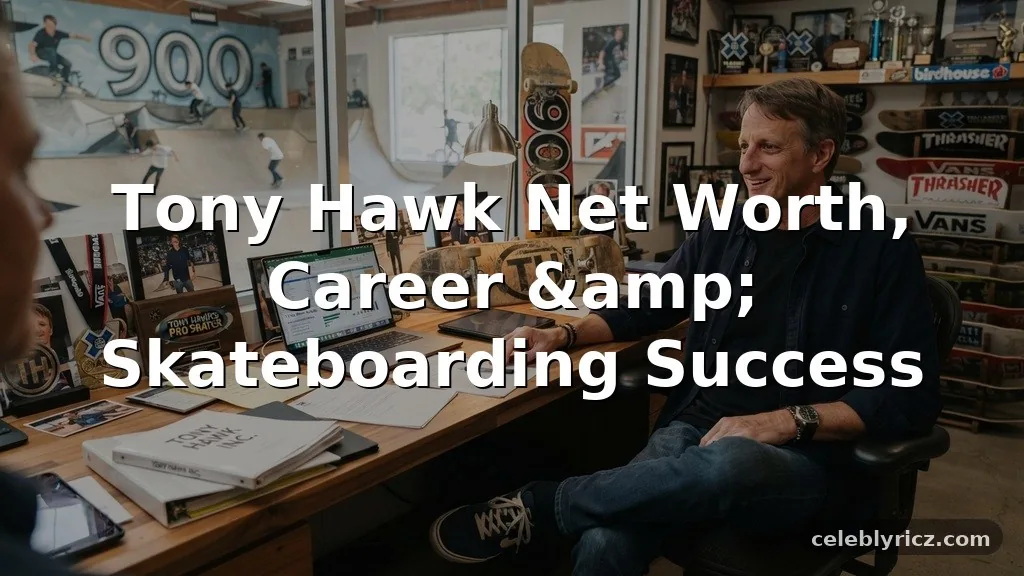

Tony Hawk is not just the most famous skateboarder who ever lived — he is arguably the reason skateboarding became a global phenomenon. Born Anthony Frank Hawk on May 12, 1968, in San Diego, California, he turned professional at 14, dominated vert skating through the 1980s and 1990s, and in 1999 landed the 900 — two-and-a-half mid-air rotations — a trick so difficult it had never been completed in competition. He is 58 years old in 2026, and his influence on sports, gaming, and youth culture is immeasurable.
The business story is just as remarkable as the athletic one. Celebrity Net Worth and most major outlets estimate the Tony Hawk net worth figure at approximately $140 million as of 2026 — built not on contest winnings but on Birdhouse Skateboards, the Tony Hawk’s Pro Skater video-game franchise (which grossed over $1.4 billion), clothing lines, endorsements, savvy startup investments, and media appearances. No audited statement confirms the number, but the $140 million consensus is among the best-supported estimates in celebrity finance.
This complete guide to Tony Hawk’s net worth, career, and skateboarding success covers his San Diego childhood and Bones Brigade years, his 70+ contest wins and X Games golds, the legendary 900, the early-90s lean years when he survived on $5-a-day Taco Bell, the founding of Birdhouse, the billion-dollar video-game deal, his investments in companies like Blue Bottle Coffee and DocuSign, his philanthropy through The Skatepark Project, his four marriages and four children, and what the Birdman is doing now at 58.
Tony Hawk at a Glance
| Fact | Details |
|---|---|
| Full name | Anthony Frank Hawk |
| Nicknames | The Birdman |
| Date of birth | May 12, 1968 |
| Age in 2026 | 58 years old |
| Birthplace | San Diego, California, United States |
| Height | 6 ft 3 in (1.91 m) |
| Turned pro | Age 14 (1982) |
| Signature achievement | First 900 landed in competition (X Games, 1999) |
| Contest wins | 70+; X Games vert golds (1995, 1997, and more) |
| Businesses | Birdhouse Skateboards, Hawk Clothing, 900 Films, Blitz Distribution |
| Video games | Tony Hawk’s Pro Skater series (Activision, 1999–); $1.4B+ franchise revenue |
| Philanthropy | The Skatepark Project (formerly Tony Hawk Foundation) |
| Spouses | Cindy Dunbar (1990–1993), Erin Lee (1996–2004), Lhotse Merriam (2006–2011), Catherine Goodman (m. 2015) |
| Children | 4: Riley, Spencer, Keegan (sons), Kadence Clover (daughter) |
| Estimated net worth (2026) | ~$140 million (unverified estimate) |
Early Life: A Hyperactive Kid Finds a Board
Tony Hawk was born on May 12, 1968, in San Diego, California, to Frank and Nancy Hawk, the youngest of four children with two older sisters and an older brother, Steve. As a child, he was famously hyperactive and hard on himself — his parents have described a kid who needed an outlet. At nine years old, his brother gave him his first skateboard, and the outlet was found.
He took to skating with obsessive intensity, practicing for hours daily at local skateparks. By 12, he was winning amateur contests against older teenagers; at 13, he was sponsored by the legendary Bones Brigade, Powell-Peralta’s elite team; at 14, he turned professional. By 16, he was widely considered the best competitive vert skateboarder in the world — a prodigy who had compressed a decade of progression into a few years. Coaches and older pros recognized it immediately: this was not just talent but a once-in-a-generation competitive temperament.
The Bones Brigade Years
The Bones Brigade — Powell-Peralta’s legendary team — was the most important crew in 1980s skateboarding, a traveling circus of prodigies that included Steve Caballero, Mike McGill, Lance Mountain, Tommy Guerrero, and the visionary Stacy Peralta behind the camera. Hawk, the baby-faced teenager among veterans, absorbed everything: contest strategy, video parts, and the showmanship that would define his public persona.
The Brigade’s videos — The Search for Animal Chin (1987) foremost among them — were skateboarding’s first true media events, and Hawk was their breakout star. His video parts showcased a skater doing things nobody else could do, and the exposure built the fanbase that would later buy his games and his boards. In an era before social media, the Brigade’s VHS tapes were the algorithm — passed hand to hand, watched until they wore out, minting legends one living room at a time. The team invented modern skate media; Hawk was its first global celebrity.
Competitive Career: Dominance on Vert
Hawk’s competitive career spanned the 1980s and 1990s, an era when vert (vertical ramp) skating was skateboarding’s premier discipline. He won more than 70 contests, including X Games vert gold medals in the 1990s, and invented dozens of tricks that remain in the modern repertoire. Trick invention is skateboarding’s purest currency — contests are forgotten, but a trick with your name on it lives forever — and Hawk’s account is among the richest in history. His style — technical, innovative, relentlessly progressive — redefined what was possible on a ramp.
His dominance coincided with skateboarding’s boom-bust cycles. When the sport’s popularity crashed in the early 1990s, even Hawk felt it: he has spoken openly about the lean years when money was so tight he survived on $5-a-day Taco Bell. Those hard times taught him the business lessons that would later make him rich — never depend on a single income stream, own your brand, and build for the long term.
The 900: Skateboarding’s Moon Landing
On June 27, 1999, at the X Games in San Francisco, Tony Hawk attempted the 900 — two and a half full rotations (900 degrees) in the air off a vert ramp. He had tried and failed it for years; it was considered the holy grail of vert skating. On his eleventh attempt that day, with the clock expired and the crowd roaring, he landed it — the first 900 ever completed in competition.
The moment transcended skateboarding. It led sports broadcasts, made international news, and became the defining image of Hawk’s career — the 31-year-old veteran achieving the impossible in the sport’s biggest spotlight. He retired from professional competition shortly after, going out at the absolute peak. Athletes dream of exits like that — the last act as the best act — and almost none of them get it. Like all great athletic farewells, the timing was perfect: there was nothing left to prove.
Tony Hawk Career Timeline
| Year | Milestone |
|---|---|
| 1968 | Born May 12 in San Diego, California |
| 1977 | Receives first skateboard from brother Steve at age 9 |
| 1982 | Turns professional at 14; joins Bones Brigade |
| 1980s | Dominates vert competitions; stars in Bones Brigade videos |
| 1992 | Co-founds Birdhouse with Per Welinder during industry downturn |
| 1995–1999 | X Games vert medals, including golds |
| 1999 | Lands the 900 at X Games; Tony Hawk’s Pro Skater released; retires from competition |
| 2002 | Founds Tony Hawk Foundation (now The Skatepark Project) |
| 2000s–2010s | Video-game franchise grows to 18 titles, $1.4B+ revenue; startup investments pay off |
| 2015 | Marries Catherine Goodman |
| 2024 | Becomes a grandfather |
| 2026 | Estimated net worth ~$140 million; still skating at 58 |
Birdhouse and the Business Empire
In 1992, during skateboarding’s downturn, Hawk co-founded Birdhouse (originally Birdhouse Projects) with fellow pro Per Welinder — betting on himself when the industry wouldn’t. The company grew into one of skateboarding’s cornerstone brands, selling decks, apparel, and accessories worldwide. He later added Hawk Clothing, the 900 Films production company, and Blitz Distribution.
The business philosophy was the lesson of the Taco Bell years: own the means of production. It is a principle he has repeated to young skaters for decades — the sponsors can drop you, the contests can dry up, but equity endures. While other pros collected sponsorship checks, Hawk built companies. Birdhouse gave him equity, control, and a brand that appreciated as skateboarding rebounded — the foundation of everything that followed.
Tony Hawk’s Pro Skater: The $1.4 Billion Franchise
In 1998, Hawk signed the deal that changed his financial life: licensing his name to Activision for Tony Hawk’s Pro Skater, released in 1999. The game was a revelation — fluid, fun, and packed with punk-rock attitude — and it became one of the best-selling and best-reviewed sports games ever made. The timing, coinciding with the 900, was cosmic.
The franchise has since released 18 titles and grossed over $1.4 billion globally. More importantly, it introduced skateboarding to millions of kids who had never touched a board — creating a generation of skaters and, not incidentally, customers for Birdhouse products. The games’ soundtracks alone shaped youth music taste for a decade. Hawk’s licensing deal gave him a share of one of gaming’s great windfalls, and it remains the single biggest contributor to his estimated $140 million net worth.
How the Games Changed Skateboarding Culture
The Pro Skater series did something no marketing campaign could: it made skateboarding feel accessible. Kids who had never stood on a board learned its physics, its spots, its style through a controller — then went outside and tried it for real. Skatepark attendance surged; board sales boomed; the sport’s demographic exploded beyond its Southern California base.
The soundtracks were a cultural force of their own — punk, ska, and hip-hop compilations that introduced millions of players to bands they would love for life. And the games kept Hawk relevant across generations: kids who discovered him through Pro Skater 3 on PlayStation 2 are now adults buying boards for their own children. It is the longest-running relevance engine in action sports — proof that the right partnership, at exactly the right moment, can echo for decades.
Investments, Endorsements, and Media
Hawk proved to be a sharp investor. He was an early shareholder in Blue Bottle Coffee (acquired by Nestlé), DocuSign, and Nest (acquired by Google) — startup bets that paid off handsomely and diversified his wealth far beyond skateboarding. These were not vanity investments but genuine early-stage positions, the kind that turn a rich athlete into a wealthy investor. Endorsement deals with Vans, Nixon, Liquid Death, and others added steady income.
His media career spans cameos in The Simpsons, Jackass, xXx, and Sharknado 5, plus reality and competition shows. He remains a fixture at skate events, demos, and exhibitions — still skating at 58, still drawing crowds, still instantly recognizable to generations who grew up with his name on their game consoles. The Birdman never really retired; he just changed venues.
How the $140 Million Breaks Down
| Wealth source | Details |
|---|---|
| Video-game licensing | Tony Hawk’s Pro Skater franchise ($1.4B+ gross); Hawk’s licensing share — largest single contributor |
| Birdhouse & apparel | Equity in skateboard company, Hawk Clothing, 900 Films, Blitz Distribution |
| Startup investments | Early stakes in Blue Bottle Coffee, DocuSign, Nest |
| Endorsements | Vans, Nixon, Liquid Death, and others over three decades |
| Contest winnings | 70+ wins — meaningful early income, modest vs. later wealth |
| Media & appearances | Film/TV cameos, demos, speaking, exhibitions |
| Real estate | San Diego/Encinitas-area properties |
| Estimated net worth (2026) | ~$140 million (unverified; Celebrity Net Worth consensus) |
The breakdown reveals the real story: contest winnings built the legend, but ownership built the fortune. The video-game licensing, the company equity, and the startup investments — all assets, not salaries — are what separate Hawk’s $140 million from the modest career earnings of most action-sports athletes. It is the same ownership lesson that defines modern sports wealth, from Michael Jordan’s Nike equity to the media companies of stars like Steve Cram, whose age, career, and longevity show a different but equally instructive path through sports business.
Philanthropy: The Skatepark Project
In 2002, Hawk founded the Tony Hawk Foundation, now known as The Skatepark Project, to fund public skateparks in underserved communities. The organization has helped build more than 600 skateparks across the United States and internationally, giving kids in low-income areas the same kind of outlet that saved a hyperactive nine-year-old in San Diego. Each park is a permanent piece of infrastructure — concrete proof, literally, that skateboarding belongs to everyone, not just kids with backyard ramps.
The philanthropy is personal: Hawk has said he wants every kid to have access to the sport regardless of zip code. It is also strategic legacy-building — the parks carry skateboarding’s future the way his games carried its past.
Personal Life: Marriages, Children, and Family
Hawk has been married four times: to Cindy Dunbar (1990–1993), Erin Lee (1996–2004), Lhotse Merriam (2006–2011), and Catherine Goodman, whom he married in June 2015. He has four children: sons Riley Hawk (a professional skateboarder in his own right), Spencer, and Keegan, and daughter Kadence Clover Hawk. He is also a stepfather and became a grandfather in 2024.
The family lives in the San Diego area (Encinitas), where Hawk grew up skating — the same coastline, the same skateparks, the same ocean air that shaped him nearly fifty years ago. Riley Hawk’s own pro career — skating for Baker and carrying the family name into a new generation — is a source of obvious pride. Watching your son drop into the same vert ramps you dominated, three decades later, must be among the strangest and sweetest experiences in sports. For a man whose childhood needed an outlet, building a family life around the sport that saved him has a pleasing symmetry.
Tony Hawk’s Legacy and Cultural Impact
Hawk’s legacy operates on three levels. Athletically, he is the greatest vert skater ever — the 900, the 70+ wins, the invented tricks. Culturally, he mainstreamed skateboarding: the video games alone did more for the sport’s global growth than any single event. Commercially, he wrote the playbook for athlete-as-entrepreneur in action sports, proving that ownership beats endorsement.
Skateboarding’s inclusion in the Olympics — debuting at Tokyo 2020 and continuing in Paris 2024 — was in many ways the culmination of Hawk’s life’s work: the backyard pastime, legitimized on the world’s biggest stage. He was there, commentating and celebrating, the bridge between the sport’s rebel roots and its Olympic future. The kid once dismissed as a sidewalk nuisance had become the elder statesman of an Olympic discipline — a transformation no one in 1977 could have imagined. Fellow athletes who built enduring second acts understand this arc well — as our profile of CeeDee Lamb’s age, career, and NFL success shows, the transition from competition to cultural institution is the hardest trick of all.
Frequently Asked Questions
What is Tony Hawk’s net worth in 2026?
Tony Hawk’s net worth is estimated at approximately $140 million as of 2026, according to Celebrity Net Worth and most major outlets. The wealth comes primarily from video-game licensing, Birdhouse Skateboards, startup investments, and endorsements. The figure is an unverified estimate.
How old is Tony Hawk?
Tony Hawk was born on May 12, 1968, in San Diego, California, making him 58 years old in 2026.
What is the 900 that Tony Hawk landed?
The 900 is a skateboarding trick involving two-and-a-half mid-air rotations (900 degrees) off a vert ramp. Tony Hawk landed the first one ever completed in competition at the 1999 X Games in San Francisco, on his eleventh attempt of the day.
Who is Tony Hawk’s wife?
Tony Hawk is married to Catherine Goodman; they wed in June 2015. It is his fourth marriage — he was previously married to Cindy Dunbar, Erin Lee, and Lhotse Merriam. He has four children, including pro skater Riley Hawk.
Does Tony Hawk still skateboard?
Yes. Although Hawk retired from professional competition around 1999, he continues to skate regularly, participates in demonstrations and exhibitions, and remains deeply involved in the sport through The Skatepark Project and his business ventures.
Conclusion
Tony Hawk’s estimated $140 million net worth tells only half the story. The other half is the hyperactive nine-year-old who found a skateboard, the teenager who turned pro at 14, the champion who survived on Taco Bell during the lean years, and the 31-year-old who landed the impossible 900 with the clock expired. The money followed the mastery — first through Birdhouse, then through a video-game franchise that introduced skateboarding to the world, then through investments as sharp as his kickflips. At every stage, the pattern repeated: master the craft first, let the business follow.
At 58, the Birdman is still skating, still building parks for kids who remind him of himself, and still the first name anyone thinks of when they hear the word “skateboarder.” From a nine-year-old’s Christmas-present board to a $140 million empire, the trajectory has never really changed direction — only scale. Few athletes have ever mattered more to their sport — and fewer still have converted that meaning into a $140 million empire without losing the plot. The 900 took eleven attempts. The empire took a lifetime. Both landed — and both, in the end, were about the same thing: committing fully, in mid-air, to something no one had ever done before.