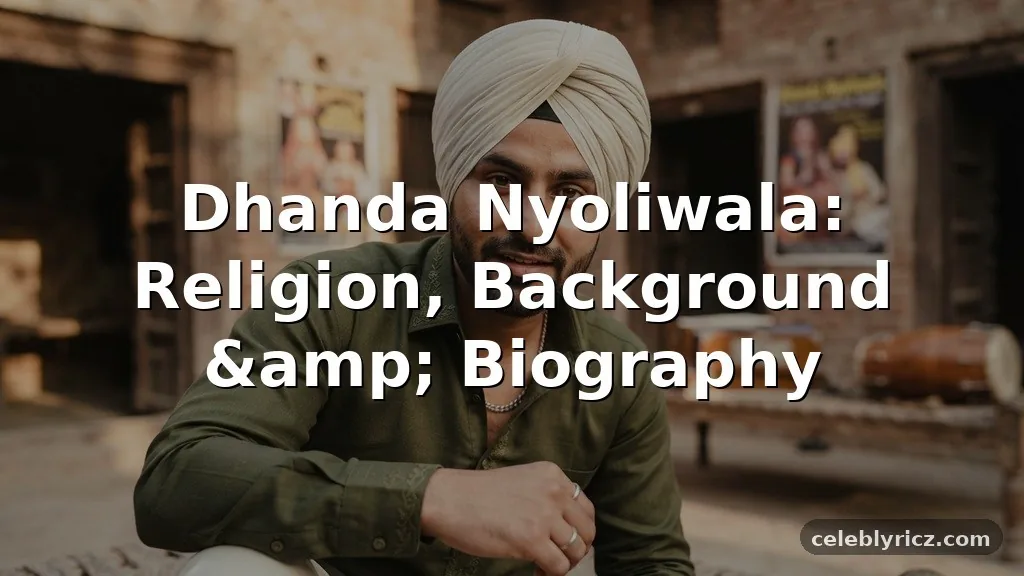

Dhanda Nyoliwala — born Parveen Dhanda — is the Haryanvi rap pioneer whose music carries the unmistakable imprint of his roots: his village, his community, his faith, and the cultural soil of rural Haryana. Born on May 21, 1997, in Nyoli Kalan village of Haryana’s Hisar district, the 29-year-old rapper has become the global face of Haryanvi drill while staying deeply connected to the background that made him.
This biography focuses on the foundations — Dhanda Nyoliwala’s religion, caste, family background, upbringing, and the cultural forces that shaped his music. From his Jaat heritage to his Hindu faith, from his athlete’s discipline to his Australian awakening, these are the roots behind the Billboard charts and the Bollywood debut.
For his full career story — the discography, the controversies, the streaming records, and the Mirzapur: The Movie breakthrough — see our companion biography. This is the story of where Dhanda Nyoliwala comes from, and why it matters to everything he creates.
Dhanda Nyoliwala: Background at a Glance
| Fact | Details |
|---|---|
| Real name | Parveen Dhanda |
| Age | 29 (born May 21, 1997) |
| Birthplace | Nyoli Kalan, Hisar district, Haryana, India |
| Religion | Hinduism |
| Caste / Community | Jaat (Haryanvi agrarian community) |
| Family | Father: former government school teacher; family details kept private |
| Wife (reported) | Asha Saharan, discus throw athlete (unconfirmed) |
| Education | Local government school (Haryana); higher studies in Queensland, Australia |
| Languages | Haryanvi (mother tongue), Hindi, English |
| Former profession | National-level javelin thrower |
Religion: Dhanda Nyoliwala’s Hindu Faith
Dhanda Nyoliwala follows Hinduism, the faith of his family and his village. Like many Haryanvi artists, his relationship with religion is cultural as much as devotional — woven into festivals, family rituals, community gatherings, and the rhythms of rural life rather than performed for cameras.
His music occasionally touches on faith and tradition, though he is far better known for street narratives than spiritual ones. When spiritual themes do surface, they carry the matter-of-fact devotion of rural Hinduism — faith as lived practice rather than theological statement, present in the background of life like the village temple itself. The Hindu festivals of Haryana — Holi, Diwali, Teej, and local melas — form the backdrop of his upbringing, and the values of his community (honor, loyalty, hard work, respect for elders) permeate his lyrics even when religion is not the explicit subject.
In an era when artists’ faith is often scrutinized or politicized, Dhanda has kept his religious identity simple and uncontroversial: a Hindu from a Hindu family, raised in Hindu traditions, making music for everyone. That straightforwardness is characteristic — he has never used faith as branding or controversy, just as background.
Caste and Community: The Jaat Identity
Dhanda Nyoliwala belongs to the Jaat community — Haryana’s dominant agrarian caste, known for farming, military service, athletic prowess, and a fierce sense of pride. Jaat identity is central to Haryanvi culture, and it is central to Dhanda’s art.
His lyrics are steeped in Jaat signifiers: references to village honor, physical strength, agricultural life, community loyalty, and the distinctive Jaat swagger that Haryana is famous for. For Jaat listeners, his music is affirmation — their language, their values, their attitude broadcast to the world. For outsiders, it is an education in a culture rarely represented in mainstream Indian media. This cultural translation — making Jaat village life legible and compelling to global audiences — is one of Dhanda’s underappreciated achievements, turning regional specificity into universal resonance.
The caste dimension of his work is worth understanding honestly. In India, caste pride in art is debated — celebrated as cultural assertion by supporters, criticized as exclusionary by others. Dhanda navigates this by rooting his pride in place and experience rather than supremacy: his music celebrates where he is from without denigrating where others are from. The distinction matters, and his massive cross-community audience suggests it lands.
Nyoli Kalan: The Village That Made Him
Nyoli Kalan, in Haryana’s Hisar district, is not just Dhanda’s birthplace — it is his artistic foundation. His stage name itself is a tribute: “Nyoliwala” means “the one from Nyoli,” a permanent declaration that no matter how far he goes — Queensland, Toronto, Bollywood — he remains the village boy.
Growing up in Nyoli Kalan meant immersion in Haryanvi as a living language: the jokes, the proverbs, the insults, the poetry of everyday speech. That linguistic wealth is his greatest artistic asset. When he raps in Haryanvi, he is not translating hip-hop into a regional language — he is revealing that the language was always musical, always rhythmic, always ready for the beat.
The village also gave him his subjects: the fields, the akhadas (wrestling grounds), the community politics, the generational tensions between tradition and modernity. Every Dhanda Nyoliwala song is, in some sense, a dispatch from Nyoli Kalan — a place most of his global audience will never visit but now feels they know. In this sense, every Dhanda Nyoliwala track doubles as cultural preservation — archiving the sounds, stories, and spirit of rural Haryana for a generation growing up far from it.
Family: A Teacher’s Son
Dhanda’s father is a former teacher at a government school — a detail that speaks volumes. In rural Haryana, a teacher’s family represents education, respectability, and aspiration. Dhanda grew up with books as well as fields, discipline as well as swagger.
He has kept his parents’ and siblings’ names private, shielding them from the fame machine — a choice that reflects both Haryanvi values of family privacy and a deliberate strategy. Unlike many celebrities who monetize their families, Dhanda’s inner circle remains off-limits, and his fans respect the boundary.
The teacher’s son becoming a drill rapper is itself a story of generational change. His father’s generation sought security through government service; Dhanda’s seeks expression through art. Both, in their way, are acts of ambition — and the discipline his father modeled as an educator echoes in Dhanda’s relentless work ethic.
The Athlete’s Background: Javelin and Discipline
Before music, Dhanda was a national-level javelin thrower — a fact that explains much about his artistry. Haryana’s sports culture, which has produced Olympic champions, runs on discipline: dawn practices, physical conditioning, mental toughness, and the lonely pursuit of incremental improvement.
Those athletic years built the performer. Stage presence, breath control, physical stamina for long sets, the ability to perform under pressure — all are athletic skills transferred to music. The aggression in his delivery is the javelin thrower’s explosive power, redirected into vocal performance.
His reported wife, Asha Saharan, is herself a discus throw athlete who has competed nationally — suggesting that the athletic world remains his personal milieu even as music became his profession. Champions recognize champions.
Australia: The Background That Changed Everything
The 2018 move to Queensland, Australia, for higher studies is the hinge of Dhanda’s biography. Everything before was preparation; everything after was execution. In Australia, two transformations occurred simultaneously: he encountered global hip-hop production at a new level of sophistication, and distance from home intensified his Haryanvi identity.
This is a classic immigrant-artist dynamic: leaving home teaches you what home means. Surrounded by Australian drill, UK grime influences, and trap production, Dhanda began to hear his own language differently — as raw material for something unprecedented. The songs he started writing in 2019 were love letters to Haryana composed in Queensland.
His educational pursuits in Australia (sources mention both English Honours and engineering tracks) also reflect the background of a young man hedging his bets — studying while creating, keeping options open until music made the choice for him. By 2020, the choice was made: hip-hop, full-time, forever.
Language as Identity: Haryanvi, Hindi, and English
Dhanda Nyoliwala works across three languages, each serving a different artistic purpose. Haryanvi is his soul — the mother tongue of his hardest, most authentic work, the language of “Russian Bandana” and “Up To U.” Hindi broadens his reach across North India. English connects him to global hip-hop and his Australian years.
His multilingualism is not just practical but philosophical: it asserts that a Haryanvi artist need not choose between roots and reach. He can rap in his village dialect on a drill beat, drop Hindi hooks for national audiences, and lace English verses for international collaborations — all without compromising any of them.
This linguistic confidence has been liberating for regional artists across India. Dhanda proved that the mother tongue is not a limitation to overcome but a weapon to wield — a lesson now echoed in every emerging regional hip-hop scene.
Faith, Values, and the Moral Code in His Music
Beneath the aggression of Haryanvi drill, Dhanda’s music carries a discernible moral code — one rooted in his background. Loyalty to friends, respect for family, defense of honor, disdain for betrayal, pride in honest work: these are village values translated into rap ethics.
His Hindu upbringing’s emphasis on dharma (duty/righteousness) echoes in his narratives, even when the surface content is confrontational. The “good man in a hard world” persona — the protector, the loyal friend, the proud son — is a traditional archetype wearing modern clothes.
This moral grounding is part of why his controversies have not derailed him. When authorities criticize his lyrics, his audience hears not glorification but documentation — a young man from their world telling their truths. The values underneath the volume are ones his community recognizes and respects.
The Private Man: Guarding Family and Faith
In an industry of oversharing, Dhanda Nyoliwala’s privacy is radical. His parents’ names are unknown to the public. His marriage to Asha Saharan remains unconfirmed by the couple themselves. His religious practice is personal, not performative. He gives the world his music and keeps the rest — a boundary that has only deepened fan respect, proving that in the attention economy, restraint can be the most powerful statement of all.
This reticence is deeply Haryanvi — a culture that values dignity over display, substance over spectacle. It is also smart brand management: mystery sustains interest, and the focus stays on the art. While other artists feud publicly and livestream their lives, Dhanda lets the music speak, and the music speaks volumes.
For fans, the privacy creates a particular kind of intimacy: they feel they know him through his lyrics — the village, the values, the voice — while respecting that the man behind them owes them nothing more. It is a mature contract between artist and audience, rare in the social media age.
Background as Artistic Superpower
What makes Dhanda Nyoliwala extraordinary is not that he transcended his background but that he weaponized it. The village dialect, the Jaat pride, the athlete’s discipline, the teacher’s son’s work ethic, the Hindu festival calendar, the Australian awakening — every element of his biography became artistic fuel.
Compare his path to other regional innovators: artists like BigXthaPlug, who turned Texas regional identity into a national rap movement, or Indian hip-hop pioneers like KRSNA, whose Delhi underground roots shaped a generation. Dhanda belongs in this company — the artists who proved that the most specific stories travel the farthest.
His background is not a footnote to his success; it is the success. Remove Nyoli Kalan, the Jaat community, the javelin fields, or the Queensland years, and there is no Dhanda Nyoliwala — just another rapper. With them, there is a phenomenon.
Dhanda Nyoliwala’s Cultural Impact
Dhanda’s background story has changed what young Haryanvis believe is possible. A generation of village kids now sees a path from Hisar to Billboard — not through abandoning their identity but through amplifying it. That psychological shift is his most lasting contribution, beyond any stream count.
He has also changed how India sees Haryana. Beyond the stereotypes of khap panchayats and rustic comedy, Dhanda presents a Haryana that is modern, global, artistic, and proud — a complex, contemporary culture producing world-class art. Representation matters, and his is transformative.
As he enters his Bollywood era with Mirzapur: The Movie, his background remains his anchor. The industry will try to shape him; his roots will keep him honest. That tension — between the village and the world — is where his best art lives, and it is far from exhausted.
Childhood in Haryana: The Formative Years
Dhanda Nyoliwala’s childhood in Nyoli Kalan was quintessentially Haryanvi: mornings in the fields, afternoons at the local government school, evenings absorbed in the community life of the village. It was a childhood of physical activity, oral culture, and tight-knit community — the opposite of the digital isolation many artists grow up in.
The Haryanvi language he absorbed as a child is famously expressive — rich in proverbs, rhythmic in its cadence, blunt in its humor. Linguists note that Haryanvi’s tonal qualities and punchy consonants make it naturally suited to rhythmic delivery. Dhanda did not study this; he lived it, internalizing the musicality of his mother tongue long before he ever heard a drill beat.
His childhood also coincided with Haryana’s transformation — rapid urbanization, the rise of smartphones, the collision of traditional village life with global media. Dhanda’s generation straddles both worlds, and his art is the product of that straddling: village stories told through global sounds.
Education: From Government School to Australia
Dhanda’s educational journey mirrors his artistic one — rooted locally, expanded globally. He attended a local government school in Haryana, where his father (a government school teacher) would have understood the system’s strengths and limitations intimately. The discipline of schooling, combined with athletic training, structured his early years.
The leap to Queensland, Australia, for higher studies in 2018 was transformative beyond academics. For a village boy from Hisar, Australia was another planet — new cultures, new sounds, new freedoms. The education that mattered most was not in the classroom but in the clubs, the studios, and the multicultural streets where global hip-hop lived and breathed.
This educational arc — government school to international university to self-taught musician — reflects a common pattern among India’s new creative class: formal education provides the foundation and the visa, but the real learning happens in pursuit of passion. Dhanda’s degrees matter less than what he taught himself about music, production, and identity.
Personal Life: The Man Behind the Music
What is known about Dhanda Nyoliwala’s personal life fits on a short list: born Parveen Dhanda, Hindu, Jaat, from Nyoli Kalan, former athlete, reportedly married to Asha Saharan, based between Australia and India. What is not known could fill volumes — and that is by design.
He does not do celebrity gossip, public feuds, or lifestyle flexing. His social media is about music, not mansions. In an era when artists monetize every aspect of their existence, Dhanda’s restraint is almost rebellious — a statement that the art is the product, not the personality.
This privacy extends to his beliefs and values. He has never positioned himself as a religious figure, a political voice, or a social activist. He is a musician from a specific background making music for anyone who feels it — and that universality, paradoxically, comes from his deep specificity.
Frequently Asked Questions
What is Dhanda Nyoliwala’s religion?
Dhanda Nyoliwala follows Hinduism. He was raised in a Hindu family in Nyoli Kalan village, Haryana, and his cultural background — festivals, values, and traditions — reflects his Hindu upbringing, though he keeps his personal faith private rather than performative.
What is Dhanda Nyoliwala’s caste?
Dhanda Nyoliwala belongs to the Jaat community, Haryana’s prominent agrarian caste. His music frequently reflects Jaat cultural pride, village values, and Haryanvi identity.
What is Dhanda Nyoliwala’s real name and age?
Dhanda Nyoliwala’s real name is Parveen Dhanda. He was born on May 21, 1997, in Nyoli Kalan, Hisar district, Haryana, making him 29 years old as of 2026.
Where is Dhanda Nyoliwala from?
Dhanda Nyoliwala is from Nyoli Kalan village in Haryana’s Hisar district, India. His stage name means “the one from Nyoli.” He later moved to Queensland, Australia, for higher studies in 2018, where he began his music career.
Is Dhanda Nyoliwala married?
Dhanda Nyoliwala is reportedly married to Asha Saharan, a discus throw athlete, with their wedding allegedly held on December 8, 2019. The couple has never officially confirmed the marriage, and Dhanda keeps his family life strictly private.
Dhanda Nyoliwala’s background — the Hindu faith, the Jaat heritage, the teacher’s household, the javelin fields, the village dialect, the Australian awakening — is not just biography. It is the raw material of his art, the source code of Haryanvi drill, and the reason his music resonates from Hisar to Toronto.
At 29, Parveen Dhanda has taken everything his background gave him — the faith, the fields, the family, the language — and turned it into a global phenomenon — without ever abandoning the village, the values, or the voice that made him. The boy from Nyoli Kalan remains, at heart, exactly that: the one from Nyoli. And the world of music is better for it.
Explore more on CelebLyricz.