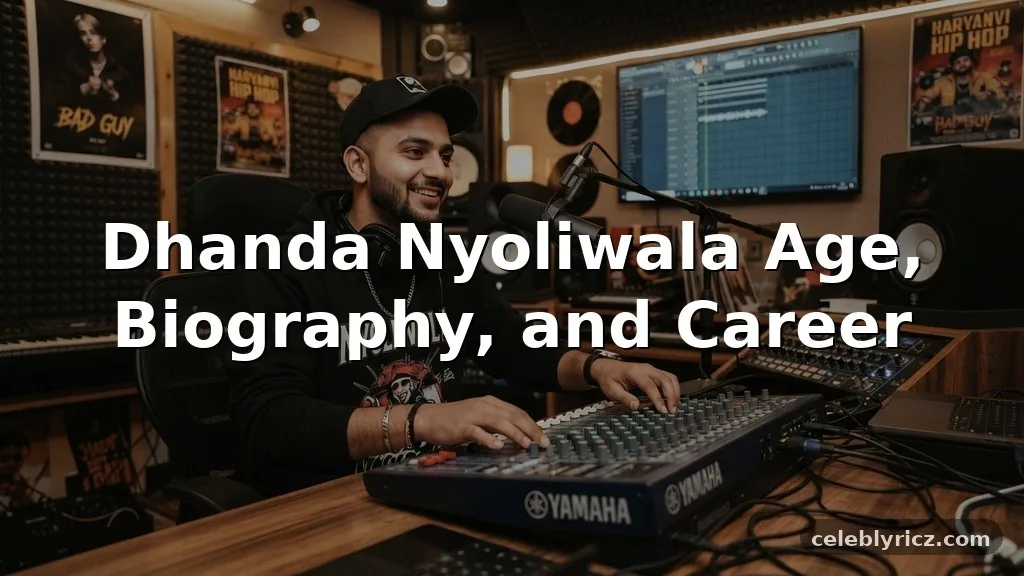

Dhanda Nyoliwala is the voice of Haryanvi hip-hop’s global moment. Born Parveen Dhanda in a village in Haryana’s Hisar district, he went from national-level javelin thrower to Australia-based rap star, building a career on an unlikely formula: raw village dialect, Urdu poetry influences, trap production, and lyrics about farmers, pride, and struggle that resonate from rural India to the diaspora worldwide.
His breakout single “Up To U” — reportedly written impromptu during a car ride and inspired by the poetry of Jaun Elia — exploded past 75 million YouTube views and turned a regional artist into an international name. Since then, tracks like “No Mercy,” “Ego Killer,” and “Russian Bandana” have cemented his place as the pioneer who took Haryanvi rap global.
This article answers every major question about him: Dhanda Nyoliwala’s age and real name, his biography from Nyoli Kalan to Australia’s Gold Coast, his athletic career, his discography, his wife Asha Saharan, his net worth, and the controversy that tested his career. Where sources conflict — and on his birth year, they do — this guide lays out the disagreement honestly.
How Old Is Dhanda Nyoliwala?
Dhanda Nyoliwala’s date of birth is most commonly reported as May 21, 1997, which would make him 29 years old in 2026, having celebrated his birthday in May. A few sources list 1998 or even 1999 instead, which is why you will see his age given as 27 or 28 on some pages — those figures trace back to the alternative birth years, not to different math.
The May 21, 1997 date appears across the majority of biography sources and is the most defensible answer, but it has never been confirmed by an official document or a direct statement from the artist himself. As with many independent musicians from rural backgrounds, the paper trail is thin and the internet has filled it inconsistently.
What is not in dispute is the timeline of his public career: an athlete through the early 2020s — including a national-level bronze medal in 2021 — who transitioned fully into music around 2020–2022 and broke through at an age when most rappers are still finding their sound. Whatever the exact birth year, his rise happened fast.
Dhanda Nyoliwala Quick Facts
| Detail | Information |
|---|---|
| Real name | Parveen Dhanda |
| Stage name | Dhanda Nyoliwala (“Nyoliwala” = from Nyoli village) |
| Date of birth | May 21, 1997 (most reported; some sources say 1998/1999) |
| Age | 29 years old in 2026 (per 1997 birth year) |
| Birthplace | Nyoli Kalan, Hisar, Haryana, India |
| Nationality | Indian (based in Australia) |
| Residence | Gold Coast, Queensland, Australia |
| Profession | Rapper, singer, lyricist |
| Athletic background | National-level javelin thrower, 3000m steeplechase |
| Wife | Asha Saharan (athlete) |
| Breakthrough | “Up To U” (2022) |
| Net worth | Estimated ₹6–8 crore (roughly $1 million USD) |
Real Name and the Meaning of “Nyoliwala”
Dhanda Nyoliwala was born Parveen Dhanda. His stage name is a declaration of identity: “Dhanda” from his family name, “Nyoliwala” meaning “the one from Nyoli” — Nyoli Kalan, his village in Haryana’s Hisar district. In an industry where artists often hide their roots behind glamorous aliases, he built his entire brand around his.
The name is a promise to his audience. When a Haryanvi kid from a farming village hears “Nyoliwala,” he hears himself — the dialect, the pride, the refusal to sand down regional identity for mainstream acceptance. That authenticity is the foundation of everything Parveen Dhanda has built as an artist.
It also sets him apart in Indian hip-hop, where stage names tend toward the international and the abstract. Dhanda Nyoliwala sounds like exactly what it is: a village name carried onto global stages, from Gold Coast studios to concert halls across North America. For more on his physical stats and background, see our profile of Dhanda Nyoliwala’s height, age, and biography.
Early Life in Nyoli Kalan, Haryana
Parveen Dhanda grew up in Nyoli Kalan, a village in the Hisar district of Haryana, in a typical agrarian Haryanvi household. Village life — the fields, the dialect, the codes of Jat community pride, the rhythms of farming seasons — became the raw material of his music. He did not adopt rural themes as an aesthetic; they are his first language.
His upbringing was disciplined and traditional. Haryana’s village culture prizes physical toughness, respect for elders, and community loyalty, and those values run through his lyrics as surely as the trap beats underneath them. The social commentary in his songs — on farmers’ struggles, caste dynamics, and village life — comes from lived observation, not research.
From an early age, he channeled his energy into sports rather than studies. The athletic path would take him to national-level competition before music ever entered the picture — and the discipline of training would later transfer directly to the grind of an independent music career.
Family Background
Dhanda Nyoliwala comes from a grounded Jat family. His father works as a government teacher — a respected, stable profession in rural Haryana — while his mother is a homemaker. He has a younger brother who has supported him emotionally and professionally throughout his journey from athletics to music to international touring.
The family’s values — respect, hard work, humility — surface constantly in his public statements. Even as his fame grew and his life moved to Australia, he has presented himself as a village boy who made it, not a star who left the village behind. That framing is deliberate, and his audience rewards it with fierce loyalty.
The Athlete Years: Javelin and Steeplechase
Before he was a rapper, Parveen Dhanda was a serious athlete. He competed at the national level in the javelin throw — as a left-handed thrower, a rarity that gave him a distinctive edge — and in the grueling 3000-metre steeplechase. He attended Haryana Agricultural University (HAU) in Hisar, an institution known for its fiercely competitive student athletics culture.
The proof of his elite level is on the record: on June 21, 2021, he won a bronze medal in the steeplechase at the 4th Indian Grand Prix athletics meet at the Netaji Subhas National Institute of Sports in Patiala, finishing in 9:24.86. That is a genuinely competitive time — the mark of an athlete operating at the sharp end of Indian track and field, not a hobbyist.
Athletics shaped him in ways that still show. The work ethic, the comfort with suffering, the ability to perform under pressure — these are transferable skills, and Dhanda has transferred them wholesale into music. The independent artist’s grind of writing, recording, releasing, and touring is an endurance event, and he trained for endurance events.
Moving to Australia
In 2018, Parveen Dhanda moved to Australia to pursue higher education, enrolling at the Queensland University of Technology — with some profiles specifying mechanical engineering, which he ultimately left to follow music. He lived across Queensland, Sydney, and Melbourne before settling in Gold Coast, Queensland, where he is now based.
The move was transformative in ways beyond education. Distance from Haryana gave him perspective on it; the diaspora experience — living between cultures, belonging fully to neither — sharpened the identity themes that define his music. Many of his most resonant songs are, at their core, about being Haryanvi in a world that is not.
Australia also gave him the infrastructure of a developed music industry: studios, collaborators, and an Indian diaspora audience hungry for authentic desi sounds. The village boy from Hisar found, in Gold Coast, the launchpad for a global career.
Finding Music: From “Afgan” to “Up To U”
Dhanda started writing songs in 2019, during his early years in Australia, and by 2020 he had fully transitioned into music. His debut Haryanvi track “Afgan” announced a new artist with a fully formed point of view — no tentative genre experiments, just village dialect over hard production, delivered with total conviction.
The breakthrough came in 2022 with “Up To U.” The story behind it has become legend: written impromptu during a car ride, inspired by the poetry of the great Urdu poet Jaun Elia, the track fused high literary influence with street-level Haryanvi delivery. It exploded past 75 million views on YouTube and turned Dhanda Nyoliwala from a regional curiosity into a national conversation.
The Jaun Elia connection is worth pausing on. Most viral rap hits are not inspired by classical Urdu poetry, and the fact that this one was tells you everything about Dhanda’s artistic ambition. He was not just making bangers; he was building a bridge between the literary traditions he admired and the village voice he owned. A deeper dive into his releases is covered in our Dhanda Nyoliwala biography and career overview.
Breakthrough Songs and Career Highlights
After “Up To U,” the hits kept coming: “No Mercy,” “Unstoppable,” and “Ego Killer” established him as a consistent hitmaker rather than a one-song wonder, while “Russian Bandana” showed his range. Each release reinforced the formula — Haryanvi pride, hard-hitting production, and lyrics with something to say — while expanding his audience across India, Australia, Canada, New Zealand, and beyond.
A landmark moment came with “Chora Baba Ka,” his collaboration with Raftaar, one of Indian hip-hop’s biggest names. The co-sign mattered: it placed Dhanda in the mainstream desi hip-hop conversation and validated Haryanvi rap as a force within the broader scene, not just a regional curiosity.
He also made history as the first Haryanvi rapper to collaborate with English-speaking international artists, pushing the dialect onto stages and streams it had never reached. His live shows — across Australia, Canada, New Zealand, and India — have drawn the kind of passionate crowds that turn regional stars into movement leaders.
Notable Tracks
| Track | Notes |
|---|---|
| “Afgan” (2020) | Debut Haryanvi track |
| “Up To U” (2022) | Breakout hit, 75M+ YouTube views, Jaun Elia-inspired |
| “No Mercy” | Fan-favorite anthem |
| “Ego Killer” | Signature confrontational track |
| “Russian Bandana” | Showcased stylistic range |
| “Chora Baba Ka” (with Raftaar) | Landmark mainstream collaboration |
Musical Style and Influences
Dhanda Nyoliwala’s sound is a deliberate fusion: Haryanvi folk roots and village dialect over modern trap and drill-inspired production, layered with lyrical depth drawn from Urdu poetry. He cites influences ranging from Jaun Elia and Hafeez Jalandhari on the literary side to international rappers like Dutchavelli and Hopsin on the sonic side.
What separates him from other regional artists is the fearlessness of the blend. He does not dilute the Haryanvi to make it palatable, and he does not treat the poetry as decoration — the social commentary on farmers’ struggles, caste issues, and village life is the point, not the garnish. That layered approach gives his music a depth that appeals equally to rural Indian audiences and the global diaspora.
His style has effectively created a template: Haryanvi folk-fusion rap did not exist as a recognized lane before him, and now it does. Younger artists from the region cite him as the proof that you do not need to abandon your dialect to reach the world — a legacy that may outlast any individual song.
International Collaborations
Dhanda’s collaborations trace his expanding orbit. The Raftaar partnership brought him into Indian hip-hop’s mainstream; his work with English-speaking international artists carried Haryanvi rap across language barriers that once seemed absolute. Each collaboration has been strategic — not clout-chasing, but bridge-building.
The international shows tell the same story. Touring Australia, Canada, New Zealand, and India, he has performed for diaspora crowds that treat his concerts as cultural homecomings and for new audiences discovering Haryanvi music for the first time. The village-to-global pipeline he built is now infrastructure other artists travel on.
His streaming numbers back it up: with over 1.71 million YouTube subscribers and 3.7 million Instagram followers as of 2026, plus strong Spotify performance for a regional-language artist, Dhanda Nyoliwala is among the most-streamed Indian regional hip-hop acts in the world. The numbers are not just vanity metrics; they are the economic base of an independent career.
Net Worth and Income
Dhanda Nyoliwala’s net worth is estimated between ₹6 crore and ₹8 crore INR — roughly $720,000 to $960,000 USD, commonly rounded to about $1 million. His annual earnings are estimated at ₹3–4 crore, remarkable for an independent Haryanvi rapper without major-label backing.
The income is multi-stream: music streaming royalties, YouTube revenue, live performances and international tours, brand collaborations, and merchandise. As an independent artist, he keeps a larger share of each rupee than a label-signed act would — the trade-off being that he funds his own production, videos, and touring.
The trajectory is still upward. Each international tour and each viral track compounds the base, and the diaspora markets he serves — Australia, Canada, the US — are high-spending live-music territories. For a self-made artist who started recording on his own dime in Gold Coast, the financial story is as impressive as the artistic one.
Wife and Personal Life
Dhanda Nyoliwala is married to Asha Saharan, herself an accomplished athlete — profiles describe her as a national-level discus throw champion, with some sources also mentioning kabaddi. The couple lives in Gold Coast, Australia, balancing their athletic and artistic lives with the family values — respect, hard work, humility — that both were raised on.
Their partnership is a meeting of two elite-competitor mindsets. Both understand discipline, both understand pressure, and both built their identities through performance — hers on the field, his on the stage. It is the kind of pairing that makes intuitive sense even to outsiders.
Beyond the marriage, Dhanda keeps his personal life guarded. He is Hindu, from the Jat community, and publicly proud of both — but the details of his daily life stay private. His social media is a professional instrument: music, shows, and cultural statements, not domestic exhibition.
The “Vomit On Paper” Controversy
In 2024, Dhanda’s track “Vomit On Paper” sparked a major religious controversy. The song’s lyrics and music video — which featured imagery resembling the popular spiritual figure Pandit Dhirendra Krishna Shastri (Baba Bageshwar) and showed disrespect toward a saffron-clad figure — were widely perceived as insulting religious sentiments and challenging religious authority.
The backlash was intense, with critics accusing him of deliberately provoking Hindu religious feelings for attention. Supporters countered that the track was social commentary on godmen and blind faith — consistent with the confrontational, question-everything stance of his broader catalog. The truth, as usual, sits in the contested middle: art that offends is not automatically art without a point, but offensiveness has consequences regardless of intent.
The controversy tested his career and clarified his audience. He did not apologize his way out of it, and his core fanbase — which values his refusal to back down — largely stayed with him. If anything, the episode confirmed his position as Indian hip-hop’s most willing provocateur on questions of faith, power, and tradition.
Height and Appearance
Dhanda Nyoliwala’s exact height is not officially confirmed, with biography sources offering varying figures typical of the genre’s loose relationship with measurements. What is documented is the athletic build — the legacy of his javelin and steeplechase years is visible in his physical presence, and it contributes to a commanding stage persona.
His appearance matches the music’s aesthetic: rooted, physical, unpretentious. There is no pop-star polish to the presentation, and that is the point — the authenticity his audience pays for would evaporate under too much styling.
Frequently Asked Questions
What is Dhanda Nyoliwala’s real name and age?
Dhanda Nyoliwala’s real name is Parveen Dhanda. His date of birth is most commonly reported as May 21, 1997, which makes him 29 years old in 2026, though some sources list 1998 or 1999.
Where is Dhanda Nyoliwala from?
He is from Nyoli Kalan village in the Hisar district of Haryana, India — the “Nyoliwala” in his stage name means “from Nyoli.” He currently lives in Gold Coast, Queensland, Australia, where he moved in 2018.
What are Dhanda Nyoliwala’s most popular songs?
His breakout hit was “Up To U” (2022), with over 75 million YouTube views. Other major tracks include “No Mercy,” “Unstoppable,” “Ego Killer,” “Russian Bandana,” and his collaboration with Raftaar, “Chora Baba Ka.”
Who is Dhanda Nyoliwala’s wife?
He is married to Asha Saharan, a national-level athlete reported as a discus throw champion. The couple lives in Gold Coast, Australia.
What is Dhanda Nyoliwala’s net worth?
His net worth is estimated between ₹6 crore and ₹8 crore INR (roughly $1 million USD), built from streaming royalties, YouTube revenue, international tours, and brand work as an independent artist.
Conclusion
Dhanda Nyoliwala’s age — 29 in 2026, per the most-reported birth date — barely hints at how much ground he has covered: national-level athlete, engineering dropout, immigrant, and finally the pioneer who took Haryanvi rap global. From “Afgan” to “Up To U” to the Raftaar collaboration, his career is a case study in what happens when an artist refuses to dilute who he is. The village made him, Australia launched him, and the world is still catching up. His journey parallels other independent hip-hop success stories — including Krsna’s biography, age, career, and net worth, another rapper who built a career on authenticity and independence.
Controversies like “Vomit On Paper” will keep testing him, and the birth-year confusion will keep biography sites busy, but neither touches the core achievement: Parveen Dhanda from Nyoli Kalan proved that a village dialect, honestly delivered, can fill concert halls on four continents. In an industry built on imitation, the most radical thing he ever did was sound exactly like himself.