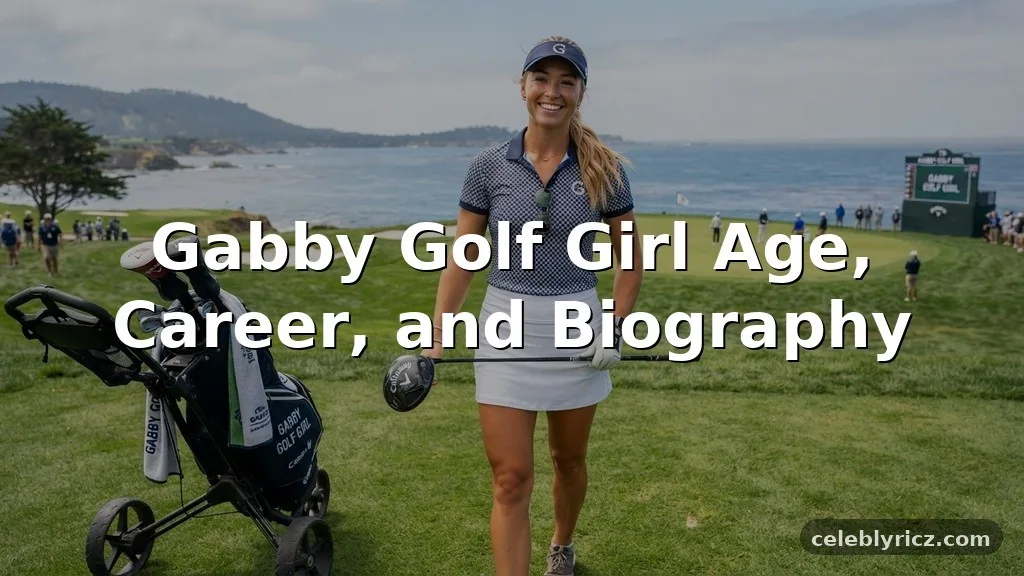

Gabby Golf Girl is 19 years old in 2026 — and Gabriella DeGasperis has already lived two remarkable lives: junior golf prodigy and social media pioneer. Born September 8, 2007, in Bronxville, New York, she started swinging plastic clubs at age 2, was winning tournaments by 5, shot a school-record 64 as an eighth grader — and then, starting in 2022, turned her golf journey into one of the sport’s biggest digital followings across Instagram, TikTok, and YouTube, with 1.2 million Instagram followers and a YouTube channel topping 114 million views.
Her bio says it simply: “golf but more fun.” That philosophy — elite skill wrapped in genuine joy — made her the face of golf’s Gen Z revolution. She’s played rounds with Jon Rahm and Steph Curry, competed in the Creator Classic alongside stars like Wesley Bryan, and signed endorsements with TaylorMade and TravisMathew. With high school graduation in 2026 and LPGA dreams ahead, Gabby Golf Girl is at the hinge point between creator and competitor.
This guide covers Gabby Golf Girl’s age and birthday, her early life and junior golf career, her record-breaking school years, her rise as a “golfluencer,” her brand partnerships, her Creator Classic appearances, her estimated net worth, and answers to the most-searched questions.
Gabby Golf Girl at a Glance
| Fact | Details |
|---|---|
| Real name | Gabriella DeGasperis |
| Born | September 8, 2007, Bronxville, New York |
| Age in 2026 | 19 (turned 19 in September 2026) |
| Based | Palm Beach, Florida (formerly Briarcliff Manor, NY) |
| Education | The Benjamin School (graduated 2026) |
| Started golf | Age 2 |
| @gabbygolfgirl — 1.2M followers | |
| YouTube | gabbygolfgirl — 266K subs, 114.7M views |
| TikTok | 268K followers |
| Key sponsors | TaylorMade, TravisMathew, Shot Scope, Malbon |
| Net worth (est.) | ~$1 million |
Early Life: Pink Clubs at Age 2
Gabriella DeGasperis was born on September 8, 2007, in Bronxville, New York. Her golf origin story is charmingly specific: at age 2, her parents gave her a set of pink clubs, which she swung on the grass at home. By 5, her father Ron DeGasperis — who describes himself as an “avid but average golfer” — took her to the course for the first time. She was also playing tennis, but at 6 she chose golf fully. The pink clubs had done their work.
The family was based in Briarcliff Manor, playing at Trump National Golf Club Westchester, where she was coached by Judy Carlson, the club’s Director of Instruction. The results came fast: by 2016, she’d amassed over 20 wins in the 7-and-under age group, and in 2015 she placed 4th at the U.S. Kids World Championship at Pinehurst Resort — one of junior golf’s most prestigious events. This wasn’t a kid with a camera; this was a prodigy with a scorecard.
The coaching matters. Judy Carlson — a PGA professional and one of the top instructors in the New York area — gave Gabby technical foundations that show in every swing video: the positions, the tempo, the repeatability. Junior golf at the elite level is a full-family commitment: dawn practices, weekend tournaments across the region, national events like the U.S. Kids Worlds at Pinehurst. The DeGasperis family invested the time, the money, and the miles — the invisible infrastructure behind every junior prodigy. Ron’s “avid but average” self-description undersells his role: he was the practice partner, the tournament driver, the believer.
School Stardom: The 64
At The Benjamin School, Gabby’s legend grew. As an eighth grader, she shot 64 at Plantation Preserve — breaking the school record — and became one of only two middle schoolers to make the varsity team. A 64 at any level is elite; as an eighth grader, it’s the kind of round that makes college coaches take notice.
She balanced the golf with academics at one of Florida’s top private schools, maintaining the student-athlete dual track that defines junior golf’s elite tier. The discipline required — dawn range sessions, tournament travel, homework on planes — forged the work ethic that now powers both her game and her content empire.
The Benjamin School years also produced the content-creation skills. Student-athletes at elite programs learn time management by necessity — and Gabby applied the same discipline to posting: film after practice, edit at night, publish on schedule. The move from New York to Florida was itself strategic: year-round golf weather, elite junior competition, and proximity to the sport’s media infrastructure. Palm Beach is where junior golf’s power centers cluster — coaches, tournaments, sponsors, all within driving distance.
Golf’s Youth Revolution
To understand Gabby’s significance, understand golf’s problem. For decades, the sport skewed old, male, and exclusive — participation declining, courses closing, young people priced out or bored out. The pandemic provided a temporary boom (outdoor, socially distanced), but the demographic challenge remained: how does a centuries-old sport speak to teenagers?
The answer turned out to be creators. A generation of “golfluencers” — Gabby foremost among the young women — used short-form video to rebrand the game: trick shots instead of dress codes, personality instead of protocol, fun instead of formality. Junior participation surged; girls’ golf became one of the fastest-growing segments. Gabby didn’t just ride this wave — for millions of young viewers, she is the wave. When a 19-year-old with 1.2 million followers says golf is fun, golf becomes fun.
The establishment noticed. The PGA Tour’s Creator Classic — a real competition for digital golf stars, staged at TPC Sawgrass and East Lake alongside tour events — is the institutional embrace of the movement. Traditional golf media now covers creators as athletes. Equipment brands sign teenagers. Gabby’s career is the proof of concept: the future of golf marketing isn’t a tour pro in a polo; it’s a teenager with a camera and a 64 on her scorecard.
Becoming Gabby Golf Girl (2022–present)
In 2022, Gabby started creating content seriously — and the timing was perfect. Golf was booming with young players (the pandemic had driven record participation), short-form video was exploding, and the sport had almost no Gen Z female voices. Gabby filled the vacuum with something the golf world had never seen: a genuinely elite young player who was also genuinely entertaining.
The content mix is the formula: trick shots, course vlogs, swing tips, challenges, and collaborations — all delivered with the “golf but more fun” ethos. She doesn’t dumb the game down; she opens it up. Beginners learn; experienced players enjoy the skill; everyone enjoys the personality. Creator Jenny Popach built a following on high-energy short-form content in a different niche — Gabby did it by making a traditionally stuffy sport feel joyful.
The content strategy is smarter than it looks. Trick shots are the hooks — visually arresting, endlessly shareable, algorithm-friendly. Course vlogs are the substance — real golf, real scores, real personality across 18 holes. Swing tips are the value — instructional content that builds authority and gets saved. Collaborations are the growth engine — each guest brings their audience. And the through-line is authenticity: she posts the bad shots too, the three-putts, the chunked chips. That honesty is the differentiator in a sport whose media has traditionally shown only perfection.
The numbers compounded: 1.2 million Instagram followers, 266,000 YouTube subscribers with 114.7 million total views, 268,000 on TikTok, 490,000 on Facebook. Her YouTube is one of golf’s fastest-growing channels — remarkable for a sport whose digital audience skews older.
Playing with the Stars
Gabby’s credibility opened doors that pure influencers can’t access. She’s played with former world No. 1 Jon Rahm and NBA superstar Steph Curry — rounds that generated massive content and proved she belongs in elite company. These aren’t ceremonial pro-ams; she’s a legitimate player holding her own.
The Rahm and Curry rounds illustrate different kinds of credibility. Rahm — a major champion, one of the world’s best ball-strikers — doesn’t waste time on novelty acts; playing with Gabby was an acknowledgment that her game is real. Curry — the NBA’s most famous golf obsessive, a legitimate single-digit handicap — represents the celebrity-golf crossover audience Gabby bridges. Both rounds generated millions of views, but more importantly, they generated respect: the comments weren’t “who is this influencer” but “she can actually play.” In golf, that’s the only credential that matters.
The Creator Classic appearances cemented her status in golf’s new competitive-entertainment hybrid. In March 2025 at TPC Sawgrass, she shot +6 alongside Tisha Alyn and Wesley Bryan; in August 2025 at East Lake (ahead of the Tour Championship), she finished +5 with Sabrina Andolpho. The Creator Classic — golf’s answer to the influencer boxing craze, but with actual skill — is where the sport’s digital and competitive worlds collide, and Gabby belongs in both.
The Creator Classic deserves explanation because it’s genuinely novel: a real golf tournament, on real tour venues (TPC Sawgrass’s Stadium Course, East Lake), contested by creators with real games, broadcast to audiences that dwarf traditional golf telecasts among young viewers. Gabby’s +6 at Sawgrass — on one of the world’s hardest courses, under cameras, against legitimate competition — proved the game travels. She wasn’t just a trick-shot artist; she was a player. The August 2025 East Lake edition, staged ahead of the Tour Championship with the sport’s spotlight nearby, confirmed she’s a fixture in this new format.
Skateboarding legend Tony Hawk similarly bridged athletic credibility and mainstream entertainment — the athlete as media figure, the competitor as creator. Gabby is writing golf’s version of that playbook.
Brand Partnerships and Business
Gabby’s endorsement portfolio reads like a golf-industry who’s who: TaylorMade (equipment), TravisMathew (apparel), Shot Scope, Rapsodo, Malbon, Macade Golf — and in 2026, hydration brand Electrolit as her latest ambassador role. For a 19-year-old amateur, it’s an extraordinary commercial footprint.
The business model is the modern athlete-creator hybrid: sponsors pay for access to her young, engaged audience; the audience grows through authentic content; the content showcases the sponsors’ products in action. It’s more effective than traditional golf advertising because it’s native — she’s actually using the clubs, wearing the clothes, drinking the product. The NIL (name, image, likeness) era made this possible for amateurs; Gabby maximized it.
The Electrolit deal (2026) illustrates the expansion: a hydration brand, not a golf brand, signing a golfer — because her audience extends beyond golf into general Gen Z lifestyle. That’s the creator premium: sponsors aren’t just buying golf eyeballs; they’re buying a trusted voice with young consumers. As her audience grows, expect non-endemic brands (beauty, fashion, tech) to follow — the same trajectory that turned traditional athletes into lifestyle icons.
The Golfluencer Movement
Gabby is the leading face of “golfluencing” — the movement making golf younger, more diverse, and more fun. Her impact is measurable: junior golf participation among girls has surged, and Gabby’s content is frequently cited as inspiration. She answers the sport’s existential question (how does golf attract Gen Z?) with her entire career: make it fun, make it accessible, meet them where they are.
The “golf but more fun” mantra is a quiet rebellion against the sport’s stuffiness. No dress-code lectures, no intimidation, no gatekeeping — just a teenager (now 19) who loves the game and wants you to love it too. It’s working: her comment sections are full of kids who started playing because of her videos.
The role-model dimension is real and worth naming. Girls’ golf has historically lacked visible young stars — the LPGA’s greats are admired but distant, and junior golf can feel lonely for girls in male-dominated fields. Gabby is the peer, not the idol: close enough in age to relate to, good enough to aspire to. Parents write about daughters who picked up clubs after watching her; coaches report junior clinics filling up. Influence you can measure in participation numbers is influence that matters.
What’s Next: The LPGA Dream
With high school graduation in 2026, Gabby faces the classic fork: pursue competitive golf (college golf, then the LPGA Tour) or lean fully into the creator career. She’s said she dreams of the LPGA — and the game backs it up. But the creator economy pays now, while competitive golf is a gamble.
The college golf question is the immediate one. Top junior girls typically commit to powerhouse programs — and Gabby’s junior résumé (the 64, the U.S. Kids Worlds finish, the tournament wins) would interest plenty of coaches. College golf offers world-class coaching, competition, and a degree — the traditional path to the LPGA via Q-school. But it also demands amateur-status compliance and a schedule that competes with content creation. Some programs now embrace creator-athletes; others still view cameras as distractions. Her choice will signal which future she’s prioritizing.
The LPGA path itself is brutally competitive: thousands of elite juniors, hundreds of college standouts, all chasing a few dozen tour cards via Q-school. Gabby’s advantage isn’t just talent — it’s financial. Most aspiring pros grind on mini-tours, broke and stressed; Gabby has a million-dollar brand funding the journey. She can afford the best coaching, the travel, the time. If the game is there — and the 64 suggests it is — the runway is hers.
The smart money says she’ll do both — and the Creator Classic proves the hybrid path exists. College golf would develop her game while the content funds the journey; the LPGA remains the dream, the content the engine. At 19, she doesn’t have to choose yet. The pink clubs started this; where it goes is up to her.
Gabby Golf Girl Net Worth
Gabby Golf Girl’s net worth is estimated at around $1 million — built on brand partnerships, sponsored content, YouTube revenue, and appearance fees. For a 19-year-old amateur athlete, it’s remarkable; for a creator with 2 million+ combined followers in a lucrative niche (golf audiences are famously affluent), it’s the expected math.
| Income stream | Details |
|---|---|
| Brand endorsements | TaylorMade, TravisMathew, Electrolit, others — the largest share |
| Sponsored content | Instagram/YouTube integrations |
| YouTube ad revenue | 114.7M total views |
| Appearances & events | Creator Classic, pro-ams, exhibitions |
Frequently Asked Questions
How old is Gabby Golf Girl?
Gabby Golf Girl is 19 years old in 2026. She was born Gabriella DeGasperis on September 8, 2007, in Bronxville, New York, and turned 19 in September 2026.
What is Gabby Golf Girl’s real name?
Gabby Golf Girl’s real name is Gabriella DeGasperis. She was born in Bronxville, New York, and is now based in Palm Beach, Florida.
Is Gabby Golf Girl a professional golfer?
Not yet. Gabby Golf Girl is an elite amateur golfer and content creator who has said she dreams of playing on the LPGA Tour. She was a junior standout (20+ wins in the 7-and-under division, 4th at the 2015 U.S. Kids World Championship) and shot a school-record 64 as an eighth grader.
What is Gabby Golf Girl’s net worth?
Gabby Golf Girl’s net worth is estimated at around $1 million, earned through brand endorsements (TaylorMade, TravisMathew, Electrolit), sponsored content, YouTube revenue, and appearances. This is an estimate, not a disclosed figure.
Who sponsors Gabby Golf Girl?
Gabby Golf Girl’s sponsors include TaylorMade (equipment), TravisMathew (apparel), Shot Scope, Rapsodo, Malbon, Macade Golf, and Electrolit (hydration, 2026). She has one of the strongest endorsement portfolios of any amateur golfer her age.
Gabby Golf Girl’s story starts with pink clubs at age 2 and runs through junior trophies, a school-record 64, a million Instagram followers, rounds with Jon Rahm and Steph Curry, and a TaylorMade bag. At 19, Gabriella DeGasperis has already changed what a golfer looks like — and she’s only just getting started on the course and the content.
Consider the full arc: the toddler with pink clubs, the 5-year-old on the course with dad, the 7-and-under champion, the Pinehurst finalist, the eighth grader shooting 64, the teenager who pointed a camera at it all and built a movement. Every stage prepared the next — the junior titles gave the content credibility, the content gave the junior career an audience, the audience attracted the sponsors, the sponsors fund the LPGA dream. It’s a flywheel, and it’s still spinning faster.
The LPGA dream is the next chapter, but the legacy is already secure: she made golf fun for a generation that wasn’t watching. “Golf but more fun” isn’t just a bio line — it’s a mission statement, and it’s working. The pink clubs worked. Everything since has been follow-through.
And that’s the deeper story: a 19-year-old who solved golf’s hardest problem — relevance — not with a marketing campaign but with a camera and a genuine love for the game. The trophies, the followers, the sponsors, the estimated million dollars: they’re all real. But the kids picking up clubs because of her videos? That’s the metric that matters. Gabriella DeGasperis didn’t just build a brand. She built a pipeline — and the game will be feeling it for decades. The LPGA dream is still the north star guiding it all. Watch this space — she’s only 19.
Explore more on CelebLyricz.