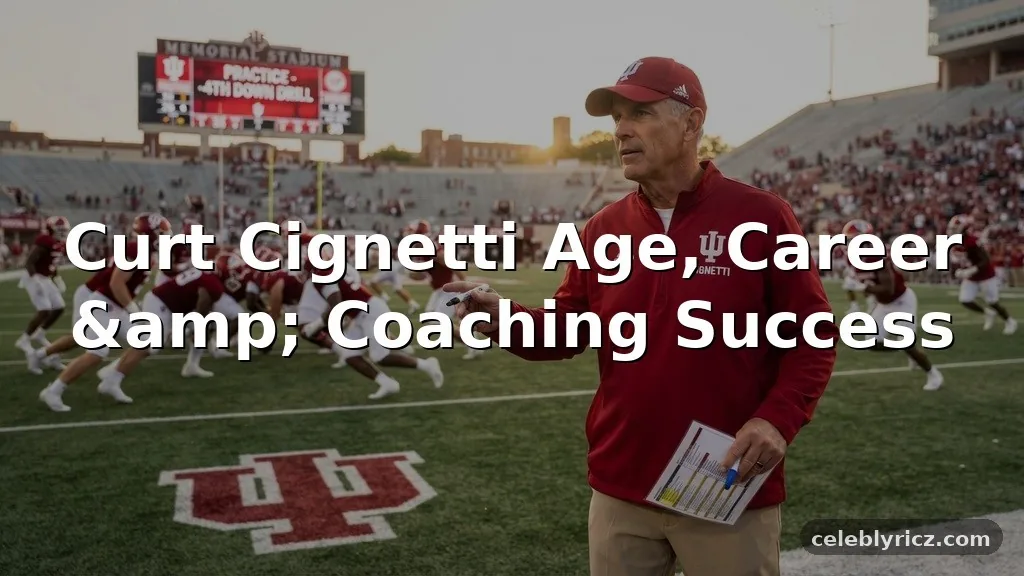

Curt Cignetti did not become a household name until his 60s, and then he did it all at once. Hired by Indiana in late 2023 to fix the losingest program in major college football history, he delivered the two best seasons in school history back to back — capped by a perfect 16-0 national championship run in 2025. At an age when most coaches are winding down, Cignetti became one of the highest-paid coaches in America.
This Curt Cignetti biography covers his age, family background, and playing days as a West Virginia quarterback, his long climb through the assistant ranks — including a national title on Nick Saban’s first Alabama staff — his head-coaching stops at IUP, Elon, and James Madison, the Indiana turnaround, his $13.2 million contract, and his family life away from football.
What makes Cignetti’s story unusual is not just the late-career explosion but the decades of winning that preceded it. He never had a losing season as a head coach at any level. The Indiana championship was the loudest chapter, but the blueprint was written over 40 years. Here is how it happened.
At a Glance
| Fact | Details |
|---|---|
| Full name | Curt Cignetti |
| Birth date | June 2, 1961 |
| Age in 2026 | 65 years old |
| Birthplace | Pittsburgh, Pennsylvania, United States |
| Height | 6 ft 3 in (191 cm) |
| Current position | Head football coach, Indiana Hoosiers |
| Conference | Big Ten |
| Playing career | Quarterback, West Virginia (1979–1982) |
| Record at Indiana | 31–2 (as of the 2026 season) |
| Career head-coaching record | 150–37 |
| Annual salary | $13.2 million (through 2033) |
| Wife | Manette Cignetti |
| Children | 3 (Curtis John, Carly Ann, Natalie Elise) |
| Net worth | Not publicly disclosed; estimated in the tens of millions |
How Old Is Curt Cignetti?
Curt Cignetti was born on June 2, 1961, in Pittsburgh, Pennsylvania, which makes him 65 years old in 2026. He is the son of the late Frank Cignetti Sr., a College Football Hall of Fame coach who won 199 games as a head coach at West Virginia and Indiana University of Pennsylvania.
His age became part of his legend. When Indiana hired him at 62, skeptics wondered whether a career Division II and FCS coach could handle the Big Ten. Two seasons later, he was a two-time national coach of the year holding an eight-year, nine-figure contract — proof that in coaching, timing and fit can matter more than the calendar.
He has said he hopes to retire at Indiana, and the contract running through 2033 suggests the school plans for exactly that. For now, at 65, he remains one of the most energetic and quotable figures in the sport.
Early Life and Football Family
Cignetti was born while his father was an assistant coach at a Pennsylvania high school, and the family moved with Frank Sr.’s career — including a stop at Princeton before settling at West Virginia in 1970. Curt grew up around football offices, film rooms, and practice fields, absorbing the profession from the inside.
He graduated from Morgantown High School in Morgantown, West Virginia, where he played quarterback. His younger brother, Frank Cignetti Jr., also went into coaching and has worked as an offensive coordinator at the college level. Football was not just the family business; it was the family language.
Playing Career at West Virginia
Cignetti played quarterback at West Virginia University from 1979 to 1982, earning his bachelor’s degree in business administration in 1982. He played under both his father, Frank Sr., and Don Nehlen during his time in Morgantown, a rare experience of being coached by his own dad at the major-college level.
He was a two-year letterman — a solid college player, not a star. That background shaped his coaching identity: he understood the game from the perspective of a quarterback who had to out-think opponents, and he carried that analytical approach into every coaching stop that followed.
The Long Climb: Assistant Coaching Years (1983–2010)
After graduating, Cignetti began coaching as a graduate assistant at Pittsburgh in 1983–84, working under Hall of Fame coach Johnny Majors. What followed was a 27-year apprenticeship across the college football map: quarterbacks coach at Davidson (1985), Rice (1986–88), and Temple (1989–92); quarterbacks and tight ends at Pittsburgh (1993–99); and quarterbacks, tight ends, and recruiting coordinator at NC State (2000–06).
At NC State, he coached Philip Rivers, the ACC Player of the Year, and recruited future Super Bowl champion quarterback Russell Wilson to the Wolfpack. The 2002 NC State team set a school record with 11 wins, and the program went to five bowls in his seven seasons, winning four.
In 2007, he joined Nick Saban’s inaugural staff at Alabama as wide receivers coach and recruiting coordinator. He spent four years in Tuscaloosa, helping build the foundation of the Saban dynasty and winning a national championship in 2009. The Alabama years gave him a firsthand look at how an elite program operates — lessons he would apply at every head-coaching stop.
First Head-Coaching Jobs: IUP and Elon
Cignetti got his first head-coaching job in 2011 at Indiana University of Pennsylvania (IUP), the Division II school where his father had coached for decades. In six seasons he went 53–17, won conference titles, made four NCAA playoff appearances, and finished in the national top 10 three times. He was named conference coach of the year in 2012.
In 2017, he took over at Elon, an FCS program that had been among the worst in its division. He produced two winning seasons and two playoff appearances in two years — then left for a bigger opportunity. The pattern was set: Cignetti took over struggling programs and won immediately.
James Madison: From FCS Power to FBS Contender
At James Madison (2019–2023), Cignetti inherited a recent FCS national champion and kept it elite: three straight top-three FCS finishes, three semifinal trips, and a national title-game appearance. When JMU moved up to the FBS and the Sun Belt, skeptics expected a transition period. Instead, Cignetti went 19–4 over two seasons and was named Sun Belt Coach of the Year in 2023.
His overall JMU record was 52–9. More importantly, he proved his program-building model worked at every level — Division II, FCS, and the FBS Group of Five. When Indiana called in November 2023, he was the hottest coaching commodity in the country, and his introductory press conference produced the viral “Google me” moment that introduced his confidence to a national audience.
The Indiana Turnaround and the 2025 National Championship
Cignetti took over what was widely called the losingest program in FBS history — Indiana had won a combined nine games in the three years before his arrival. He brought a wave of transfers, many from James Madison, and installed his up-tempo, aggressive system. The result in 2024: a program-record 11 wins, the school’s first College Football Playoff berth, Big Ten Coach of the Year honors, and the Eddie Robinson national coach of the year award.
Then came 2025, one of the great seasons in college football history. Indiana went 16–0, won its first outright Big Ten title since 1945, beat Alabama in the Rose Bowl semifinal on January 1, and defeated Miami in the national championship game. It was the first football national title in school history, and Cignetti swept the national coaching awards: AP, AFCA, Bobby Dodd, Bear Bryant, Walter Camp, and Sporting News coach of the year.
His Indiana record stands at 31–2, and his overall head-coaching record is 150–37 — without a single losing season at any stop. Players embraced his direct style and quick quips, and his sideline demeanor made him one of the sport’s most entertaining figures.
The $13.2 Million Contract
Success brought three raises in just over two years. After the championship, Indiana finalized an eight-year extension in February 2026 paying Cignetti an average of $13.2 million per year through the 2033 season — a total value of $105.6 million. The deal includes a $500,000 base salary, outside marketing income rising past $9.65 million annually, and a $1 million yearly retention bonus.
The contract places him alongside Georgia’s Kirby Smart and LSU’s Lane Kiffin as one of only three active coaches earning at least $13 million per year. It also raised his buyout to $15 million, a clear signal that Indiana intends to keep him in Bloomington for the rest of his career.
Curt Cignetti Net Worth and Salary
Curt Cignetti’s exact net worth is not publicly disclosed, but with an average annual salary of $13.2 million through 2033, estimates generally place his wealth in the tens of millions of dollars. His career earnings accelerated dramatically late: he arrived at Indiana in late 2023 on a six-year, $27 million deal and has since received three raises.
Beyond salary, his contract includes substantial outside marketing and promotional income plus annual retention bonuses. Like most high-profile college coaches, he also earns from endorsements, speaking engagements, and media appearances that come with championship fame.
For context, his compensation now rivals the biggest names in the sport. Only Kirby Smart at Georgia earns more on paper, putting a 65-year-old who spent most of his career outside the Power conferences among the true financial elite of college football.
Coaching Philosophy and Style
Cignetti’s teams are known for aggressive, up-tempo offense and disciplined, opportunistic defense. Coordinators Mike Shanahan (offense) and Bryant Haines (defense) — the latter a Broyles Award winner as the nation’s top assistant — run systems built on tempo, spacing, and relentless pressure.
His roster-building philosophy leans heavily on the transfer portal. At Indiana, he imported proven winners from James Madison and other programs rather than waiting years to develop recruits, a strategy that produced instant contention. It was a bet that experience beats potential in the short term — and it paid off with a national title.
His public persona is pure Western Pennsylvania: blunt, funny, and unbothered. The “Google me” line from his introductory press conference became his calling card, and his sideline expressions are a staple of college football broadcasts. Players describe a coach who is demanding but genuine — the same man in the meeting room as in front of the cameras.
Personal Life: Wife and Family
Cignetti is married to Manette Cignetti (née Lawer), and the couple has three children: Curtis John, Carly Ann, and Natalie Elise. The family has moved with his coaching career across the country, from the Southeast to Pennsylvania to Virginia and now Indiana.
Football remains the family thread. His late father, Frank Sr., is in the College Football Hall of Fame; his brother Frank Jr. coaches as well. Cignetti has spoken about what it meant to learn the profession at his father’s knee — and about the pressure and pride of carrying the family name into the sport’s biggest spotlights.
Despite the fame, those close to him describe a coach who never changed with success. Colleagues from his IUP and Elon days tell the same stories Indiana fans now hear: preparation-obsessed, loyal to his staff, and allergic to excuses. Like fellow West Virginia football alumnus Pat McAfee, who also built a national profile from Morgantown roots, Cignetti’s authenticity is a big part of his appeal.
The “Google Me” Moment and Media Persona
Cignetti introduced himself to the Big Ten with one of the great press-conference lines in recent memory. Asked at his introductory Indiana availability about the challenge of taking over a struggling program, he leaned into the microphone and said, “Google me.” It was not arrogance so much as a résumé delivered in two words — and within two seasons, the entire country had.
The line became his brand. Indiana fans printed it on shirts, national broadcasts replayed it before big games, and Cignetti himself embraced it with a wink. But the confidence was backed by substance: every program he had ever led won, and he knew it. The quote worked because it turned out to be true.
His media presence since has been a mix of dry humor and total directness. He gives quick, quotable answers, makes faces that become instant memes, and never sounds like he is reading from talking points. In an era of carefully managed coach-speak, his authenticity stands out — and it has made him one of the most popular figures in college football beyond Indiana’s fan base.
Legacy and What Comes Next
Two seasons into the Indiana job, Cignetti’s legacy is already secure in Bloomington: the first national championship in program history, the first outright Big Ten title in 80 years, and a complete transformation of how the program is perceived. Recruits who would never have considered Indiana now answer the phone, and the school has invested heavily to keep the momentum going.
The bigger question is whether the model is sustainable. Cignetti’s portal-heavy roster building delivered a title, but repeating requires reloading every offseason — a treadmill that demands elite evaluation and constant recruiting wins. His staff continuity, with coordinators Shanahan and Haines locked in on new deals, is a strong foundation.
At 65, with a contract through 2033 and a stated desire to retire as a Hoosier, Cignetti is coaching with house money. Whatever comes next, he has already authored one of the most remarkable late-career runs in sports history — and given every struggling program in America a reason to believe the right hire can change everything.
Awards and Championships
- National championship — 2025 (Indiana, 16–0 season)
- Big Ten championship — 2025 (first outright title since 1945)
- 2× AP Coach of the Year (2024, 2025)
- 2× AFCA Coach of the Year (2024, 2025)
- Bobby Dodd Coach of the Year (2025)
- Paul “Bear” Bryant Coach of the Year (2025)
- Eddie Robinson Coach of the Year (2024)
- 2× Big Ten Coach of the Year (2024, 2025)
- Sun Belt Coach of the Year (2023); CAA Coach of the Year (2017); PSAC Coach of the Year (2012)
- 3 CAA championships (2019–2021); PSAC championship (2012); 2 Sun Belt East Division titles (2022, 2023)
- Career head-coaching record: 150–37, with no losing seasons
Staff Loyalty and the Coaching Tree
One of the least discussed parts of Cignetti’s success is staff continuity. Many of his assistants followed him from James Madison to Indiana, and after the championship run the school rewarded coordinators Mike Shanahan and Bryant Haines with new multi-year contracts. In a sport where successful staffs get poached every winter, keeping the band together was a priority — and a statement of intent.
That loyalty runs both ways. Players who transferred with him from JMU have spoken about the trust they place in his program, and recruits cite the stability of the staff as a selling point. Cignetti’s career shows that culture is not a slogan; it is the same people, running the same systems, holding the same standards, year after year. It is also why his teams so rarely beat themselves.
Frequently Asked Questions
How old is Curt Cignetti?
Curt Cignetti was born on June 2, 1961, in Pittsburgh, Pennsylvania, which makes him 65 years old in 2026. He is the son of Hall of Fame coach Frank Cignetti Sr.
What is Curt Cignetti’s salary at Indiana?
Cignetti signed an eight-year extension in February 2026 paying him an average of $13.2 million per year through the 2033 season, making him one of the three highest-paid coaches in college football.
What is Curt Cignetti’s coaching record?
His career head-coaching record is 150–37. At Indiana he is 31–2, including an 11–2 debut season in 2024 and a perfect 16–0 national championship season in 2025.
Where did Curt Cignetti coach before Indiana?
Before Indiana, Cignetti was the head coach at James Madison (2019–2023), Elon (2017–2018), and Indiana University of Pennsylvania (2011–2016). As an assistant, he coached at Alabama under Nick Saban, NC State, Pittsburgh, Temple, Rice, and Davidson, and played quarterback at West Virginia.
Is Curt Cignetti married?
Yes. He is married to Manette Cignetti, and they have three children: Curtis John, Carly Ann, and Natalie Elise.
Conclusion
Curt Cignetti’s biography is proof that a coaching career is a marathon with a sprint finish. Forty years of grinding — graduate assistantships, quarterback rooms, Division II bus rides — built the coach who took over college football’s toughest rebuild and won a national championship in year two. The 16-0 season, the $13.2 million contract, and the sweep of national coaching awards were the rewards for decades of doing the work when nobody was watching.
At 65, Cignetti has said he wants to finish his career at Indiana, and the school has bet nine figures that he will. Whether the Hoosiers stay on top or not, his story has already changed what struggling programs believe is possible when they make the right hire — and what a coach’s prime can look like. For NFL stars like CeeDee Lamb, greatness is measured in highlight reels; for Cignetti, it is measured in programs transformed, and there may be no better program-builder in the modern game.