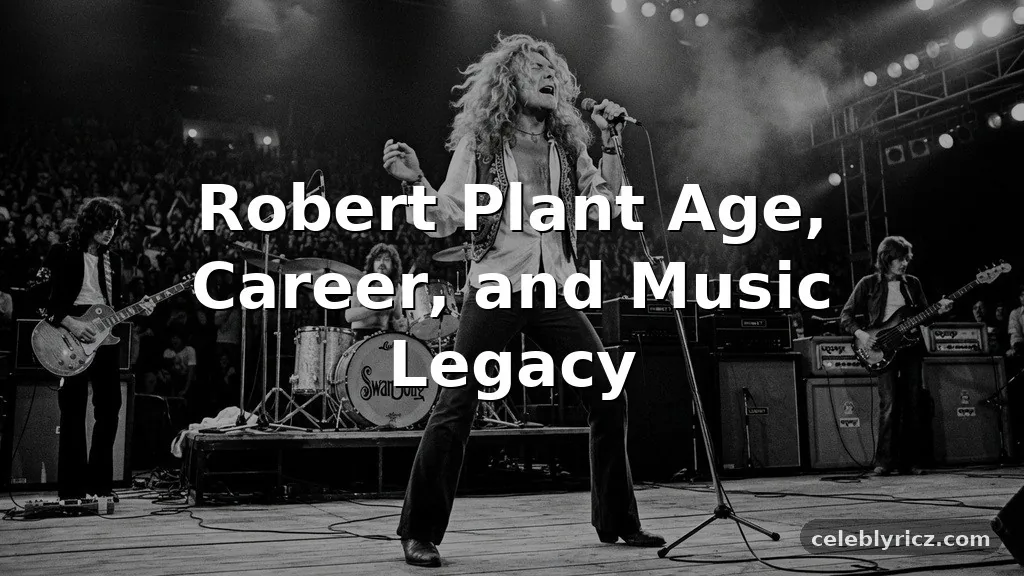

Robert Plant is 78 years old in 2026, and he remains the most restless legend in rock music. Born Robert Anthony Plant on August 20, 1948, in West Bromwich, England, he became immortal as the voice of Led Zeppelin — the “golden god” whose wail defined “Whole Lotta Love,” “Kashmir,” and “Stairway to Heaven.” But unlike most rock icons, he refused to spend the decades since as a nostalgia act.
This Robert Plant biography covers his age and English roots, the Led Zeppelin years, the adventurous solo career, the Grammy-winning Alison Krauss collaborations, the Saving Grace band and 2026 tour, his estimated net worth, and his personal life — including the tragedy that shaped him.
At 78, he is still moving forward. That is the whole story.
At a Glance
| Fact | Details |
|---|---|
| Full name | Robert Anthony Plant |
| Born | August 20, 1948, West Bromwich, England |
| Age in 2026 | 78 years old (Leo) |
| Height | 6 ft 1 in (1.86 m) |
| Known for | Lead singer, Led Zeppelin (1968–1980) |
| Solo hits | “Big Log,” “In the Mood,” “Ship of Fools” |
| Krauss albums | Raising Sand (2007), Raise the Roof (2021) |
| Grammys | Album of the Year 2009 (Raising Sand) + 5 more that night |
| Current band | Saving Grace (with Suzi Dian; album Sept 2025) |
| 2026 honor | Record Store Legend (3rd ever) |
| Net worth | Reported around $200 million (unverified) |
How Old Is Robert Plant?
Robert Plant was born on August 20, 1948, making him 78 years old in 2026 — he celebrated his 78th birthday in August, just weeks before the fall concert season. His Leo sign suits the legend: charismatic, proud, and born for the stage, yet with the lion’s late-career wisdom about when to roar and when to purr.
He has now spent more than six decades as a professional musician — a career that began in small Midlands clubs in the 1960s and continues on American stages in 2026. Few artists in history have sustained creative relevance across six decades.
West Bromwich Roots
Born in West Bromwich, Staffordshire, Plant grew up in England’s industrial Midlands, obsessed with American blues and rock and roll. Like so many British Invasion musicians, he learned the music of Black America — Howlin’ Wolf, Robert Johnson, Muddy Waters — and channeled it through an English sensibility into something entirely new.
By the late 1960s, he was singing in Midlands bands like the Band of Joy — developing the high-register wail and dramatic stage presence that would soon conquer the world. Then Jimmy Page came calling — and popular music changed forever.
Led Zeppelin: 1968–1980
In 1968, guitarist Jimmy Page recruited the 20-year-old Plant as the singer for his new band — and Led Zeppelin was born. What followed was one of the most dominant runs in music history: eight studio albums in eleven years, stadiums conquered on every continent, and a songbook — “Stairway to Heaven,” “Kashmir,” “Whole Lotta Love,” “Black Dog,” “Ramble On” — that became the foundation of hard rock.
Plant was more than a voice; he was the band’s lyricist and its visual icon — the bare-chested, lion-maned “golden god” who defined rock frontman charisma for all time. His blues phrasing, mythological lyrics, and octave-leaping vocals set the template every hard rock singer since has followed or rebelled against.
The band ended in 1980 after drummer John Bonham’s death. Plant has described those years as “like the weather” — unpredictable, raw, occasionally transcendent. He has consistently refused full reunions, believing Zeppelin was a moment, not a franchise.
The Solo Career: Refusing Nostalgia
Plant’s solo career began with Pictures at Eleven (1982) and established an immediate principle: no Zeppelin retreads. Hits like “Big Log,” “In the Mood,” and “Ship of Fools” built a parallel catalog, while side projects like The Honeydrippers (a 1950s rock-and-roll homage) showed his range.
Through the 1980s, 1990s, and 2000s, he kept exploring: the world-music textures of Fate of Nations, the Americana turn of Dreamland, the psychedelic folk of the Band of Joy and Sensational Space Shifters lineups. Each album was a new direction, each tour a new band. While peers cashed in on greatest-hits packages, Plant treated his past as raw material, not inventory.
As he told Mojo: “[To] do it for the sake of it was never what Zeppelin was about.” The quote is his artistic creed — curiosity over commerce, always.
The Honeydrippers Detour
In 1984, at the height of his 80s solo success, Plant did something characteristically perverse: he formed The Honeydrippers, a band devoted to 1950s rock and roll and R&B, and scored a hit with “Sea of Love.” For the voice of heavy metal’s founding band to tenderly croon a Phil Phillips oldie was either madness or genius — and the record’s success suggested the latter.
The detour revealed the depth of his musical roots: before Zeppelin, there was the kid who loved the music of his parents’ generation. The Honeydrippers were not a joke but a homecoming — and a preview of the roots-explorer he would fully become decades later with Krauss and Saving Grace.
Alison Krauss: The Grammy Triumph
The most celebrated chapter of Plant’s post-Zeppelin career came with bluegrass star Alison Krauss. Their 2007 collaboration Raising Sand — produced by T Bone Burnett — was a masterpiece of cross-genre alchemy, and at the 2009 Grammy Awards it won six awards including the coveted Album of the Year, one of the most honored records in Grammy history, a distinction few collaborations have ever achieved.
The pairing seemed unlikely — the rock god and the bluegrass angel — but their voices intertwined with eerie perfection. They reunited for Raise the Roof (2021), confirming the collaboration was no fluke. Like fellow veteran Dwight Yoakam, whose country career also spans decades of reinvention, Plant proved that great voices only deepen with age.
Saving Grace and the 2026 Tour
Since 2019, Plant’s primary vehicle has been Saving Grace, the folk-blues-gospel band featuring co-vocalist Suzi Dian, drummer Oli Jefferson, guitarist Tony Kelsey, banjo player Matt Worley, and cellist Barney Morse-Brown. The band released its self-titled debut album in September 2025 — Plant’s first solo album in eight years — and toured it through sold-out November shows.
The 2026 “Spring Fever” tour brought Saving Grace across America: kicking off March 14 in Albuquerque, passing through Dallas, Memphis, Louisville, Nashville, Philadelphia, and Red Bank, New Jersey, before wrapping April 7 at New York’s Cathedral of St. John the Divine. A South American leg (Argentina, Brazil) followed in May.
The setlists reflect Plant’s philosophy: mostly new material and folk reimaginings, with only occasional Zeppelin songs (“Black Dog,” “Gallows Pole”) transformed into haunting acoustic arrangements. As American Songwriter noted, fans hoping for a greatest-hits show may leave disappointed — but those open to the journey witness something rarer: a legend still discovering.
2026 Record Store Legend
In April 2026, Plant was named Record Store Day’s 2026 Record Store Legend — only the third artist ever to receive the honor, after Elton John (2017) and Johnny Marr (2025). He marked the honor by visiting Spillers Records in Cardiff, Wales — the world’s oldest record store, established in 1894 and still operating — and unveiling a commemorative plaque.
For Record Store Day (April 18), he released an exclusive vinyl EP, “Saving Grace: All That Glitters” — 3,500 copies through independent shops only, featuring folk arrangements of Gillian Welch and Bert Jansch songs. The honor recognized what the tour demonstrates: at 78, his appetite for musical discovery has not waned.
Personal Life: Love, Loss, and Family
Plant married Maureen Wilson in 1968; the marriage lasted until 1983. They had three children: Carmen, Karac, and Logan. In 1977, during Led Zeppelin’s American tour, five-year-old Karac died of a stomach illness — a tragedy that devastated Plant and shadows his biography to this day. He has rarely spoken about it publicly, but those close to him say it fundamentally changed him.
He later had a long relationship with Shirley Wilson (Maureen’s sister), with whom he has a son, Jesse. His current companion is widely reported to be Suzi Dian, his gifted Saving Grace co-vocalist — though both keep the personal details private, as Plant always has.
For all his stage flamboyance, Plant’s private life has been notably grounded: a longtime resident of the English Midlands, a devoted Wolverhampton Wanderers football supporter, and a man who chose roots over rock-star exile. Like fellow enduring vocalist Amy Lee, whose powerful voice defined her band’s identity, Plant’s instrument was always inseparable from the person — and the person chose home.
Net Worth
Robert Plant’s net worth is commonly reported at around $200 million, though the figure is unverified and should be treated as an estimate. The foundation is Led Zeppelin’s catalog — one of the best-selling in history, generating royalties for over fifty years — plus a substantial solo catalog, the Krauss albums, and decades of touring.
Unlike many rock fortunes built on lifestyle brands, Plant’s wealth is almost entirely musical: recordings, publishing, and live performance. Six decades of it.
The Voice: What Made Plant Revolutionary
Before Robert Plant, rock singers shouted. After him, they soared. His innovation was treating the voice as a lead instrument — not just delivering lyrics but bending notes, stretching syllables, and using his upper register as a textural weapon. The “Whole Lotta Love” breakdown, the “Immigrant Song” battle cry, the “Stairway” crescendo: these are not just singing but architecture, built from breath and nerve.
His phrasing drew from the blues masters he worshipped — the moans and hollers of Howlin’ Wolf, the ache of Robert Johnson — but electrified them through Marshall stacks and into arenas. He also brought a literary sensibility rare in hard rock: lyrics steeped in Tolkien, Celtic mythology, and English folk tradition, giving Zeppelin’s bombast an unexpected poetry.
The voice changed over the decades — the stratospheric highs of 1969 mellowed into the rich, weathered baritone-tenor of the Krauss years — but the musicality never left. If anything, the later voice is more expressive: less power, more meaning. The instrument aged; the musician deepened.
The 1980s and 1990s: Wilderness Years That Weren’t
The decades after Zeppelin are often mischaracterized as Plant’s wilderness years. They were anything but. The 1980s solo albums — Pictures at Eleven, The Principle of Moments, Shaken ‘n’ Stirred — produced genuine hits and established him as a viable solo artist, not a former band member trading on past glory.
The 1990s brought Fate of Nations and the Page and Plant reunion project (more below), while the 2000s saw the Americana exploration of Dreamland and Mighty ReArranger. Each decade added a layer: the 80s proved commercial viability, the 90s proved artistic restlessness, the 2000s proved roots mastery. The “wilderness” was actually a garden, carefully tended.
What these years proved, above all, was independence. Plant did not need Led Zeppelin — a statement few frontmen of his stature could honestly make. The solo catalog stands on its own, and the refusal to reunite permanently was its own kind of artistic declaration.
Page and Plant: The Unledded Era
In 1994, Plant reunited with Jimmy Page for MTV’s Unplugged — released as No Quarter: Jimmy Page and Robert Plant Unledded — revisiting Zeppelin songs with Moroccan and Egyptian orchestration. It was a triumph: respectful of the past without being imprisoned by it, and a massive commercial success.
The collaboration extended to the 1998 studio album Walking into Clarksdale and a world tour. But Plant eventually walked away again — the pull of new directions stronger than the comfort of the old partnership. Page wanted Zeppelin; Plant wanted tomorrow. The split was amicable but definitive, and it clarified Plant’s hierarchy of values: discovery over dynasty.
The Unledded project remains the gold standard for how legacy artists can revisit their past: reimagined, not replicated. It is the approach he has applied ever since — including to the Zeppelin songs that occasionally surface in Saving Grace sets.
The Reunion Question
Every few years, the question resurfaces: will Led Zeppelin reunite? The 2007 Ahmet Ertegun tribute concert at London’s O2 Arena — with Jason Bonham on drums — was the closest thing to an answer: a triumphant one-off that proved the magic remained and that Plant meant it when he said one night was enough.
He has been consistent for decades: Zeppelin was a moment in time, tied to youth, to Bonham, to a chemistry that cannot be recreated by act of will. “To do it for the sake of it was never what Zeppelin was about” is not just a quote but a philosophy — and the reason the O2 show’s legend has only grown. Scarcity preserved the sanctity.
Fans continue to hope; Plant continues to tour with Saving Grace instead. At 78, the answer is final: the future, not the past, gets his energy. The reunion that matters is the one between the artist and his curiosity, renewed nightly.
Influence: The Singers He Created
Robert Plant’s vocal DNA runs through generations of rock singers. The high-register hard rock frontman — from Steven Tyler to Axl Rose to Chris Cornell — descends directly from his template: the bare-chested wailer commanding the arena. Heavy metal’s entire vocal tradition owes him a debt it can never repay.
But his deeper influence is philosophical: the proof that a rock singer can age into artistry rather than nostalgia. His Krauss collaborations and Saving Grace work gave every aging rocker a blueprint — follow the curiosity, honor the voice you have now, refuse the oldies circuit. The singers who learned that lesson are still working; those who didn’t are playing casinos.
In the end, Plant’s greatest innovation might not be a note he sang but a path he walked: from golden god to roots explorer, from arena to record shop, from “Stairway to Heaven” to Spillers Records in Cardiff. The voice made him famous. The choices made him truly legendary.
Wolves, Home, and Staying Grounded
For all the global fame, Robert Plant never left home — spiritually, at least. He remains a devoted supporter of Wolverhampton Wanderers, his local football club, and has served as a vice-president of the club. He has been known to adjust tour schedules around important matches, a detail that endears him to fans more than any platinum record.
He lives in the English Midlands, not in rock-star exile in Los Angeles or the South of France. The choice is deliberate: the industrial landscape that formed him remains his anchor, the place where the golden god is just a local lad who made good. Bandmates and journalists describe a man without airs — curious, funny, and genuinely interested in other people’s music.
That groundedness is the secret ingredient of his longevity. Fame utterly destroyed many of his contemporaries; Plant survived it by never quite believing in it — or at least never moving to where it lives. The Midlands made him, the Midlands keeps him, and the music is the sturdy bridge between the two.
Frequently Asked Questions
How old is Robert Plant?
Robert Plant is 78 years old in 2026. He was born on August 20, 1948, in West Bromwich, England.
Is Robert Plant still touring?
Yes. In 2026 he toured the U.S. with his band Saving Grace on the “Spring Fever” tour (March–April), followed by South American dates in May.
Did Robert Plant win a Grammy with Alison Krauss?
Yes — their 2007 album Raising Sand won six Grammys in 2009, including Album of the Year. They reunited for Raise the Roof in 2021.
Why doesn’t Robert Plant play more Led Zeppelin songs?
He refuses to be a nostalgia act. His Saving Grace setlists focus on new material and folk reimaginings, with only occasional Zeppelin songs in acoustic arrangements.
What is Robert Plant’s net worth?
Commonly reported at around $200 million (unverified), built on Led Zeppelin royalties, his solo catalog, and decades of touring.
Conclusion
Robert Plant’s career is the great counterexample in rock history: the frontman who had everything — the voice, the looks, the catalog — and chose curiosity over comfort. He could have spent forty years playing “Stairway to Heaven” to stadiums. Instead he made Raising Sand, formed Saving Grace, and at 78 is still releasing folk EPs through independent record shops.
The 2026 Record Store Legend honor got it right: his appetite for discovery has not waned, and his refusal to become his own tribute act remains the most radical decision of his career. While contemporaries play the hits on endless farewell tours, Plant plays new songs in cathedrals — literally, in the case of St. John the Divine — to audiences who came for the legend and stayed for the music. The golden god grew up, and the grown-up turned out to be even more interesting. Long may he roam — and long may he keep surprising us.
Explore more on CelebLyricz.