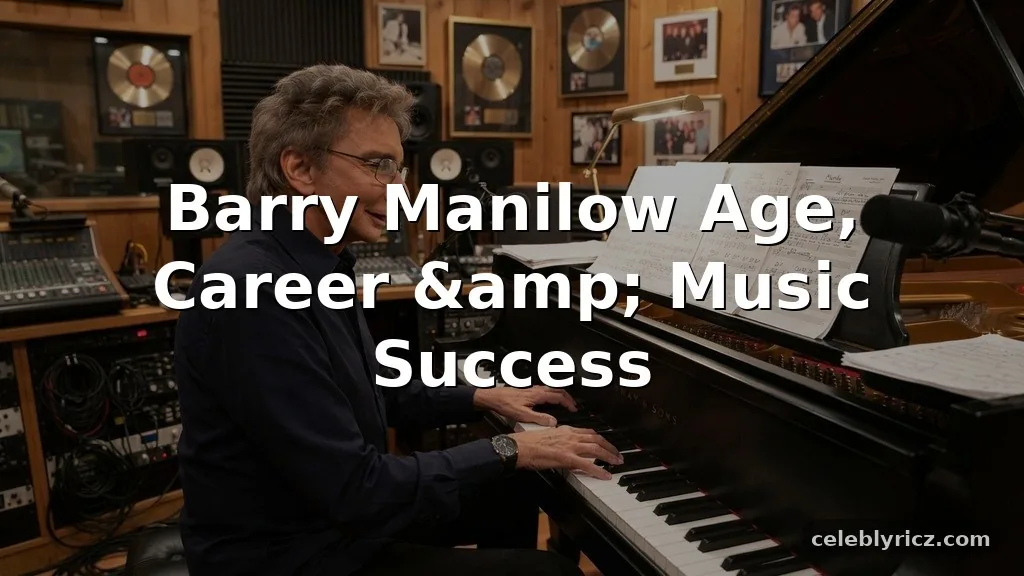

Barry Manilow has been making music for more than six decades, and at 83 years old he is still doing it — still singing “Mandy,” still packing the International Theater at the Westgate Las Vegas, and still adding to a career that has sold more than 85 million records worldwide. Few artists have survived as many eras of popular music as Manilow: the jingle-writing 1960s, the soft-rock 1970s, the MTV 1980s, the Vegas-residency 2000s, and the farewell-tour 2020s.
His age, career, and music success remain subjects of fascination because Manilow’s story is really several stories in one. He is the commercial jingle writer behind State Farm’s “Like a Good Neighbor.” He is the piano man who launched Bette Midler’s career. He is the balladeer behind “Mandy,” “I Write the Songs,” and “Copacabana (At the Copa)” — a man who once told the Guardian he doesn’t even consider himself a singer. And he is, by Celebrity Net Worth’s 2026 estimate, a $100 million man.
This guide covers the full picture: Barry Manilow’s age and early life, his journey from jingles to superstardom, his biggest hits and records, his legendary Las Vegas residency, his personal life and marriage to Garry Kief, his estimated net worth, his 2025–2026 health battle with lung cancer, and where his career stands today. Every fact is grounded in reported sources — estimates labeled as estimates, rumors left out.
Barry Manilow at a Glance
| Fact | Details |
|---|---|
| Full name | Barry Alan Pincus |
| Born | June 17, 1943, Brooklyn, New York |
| Age in 2026 | 83 years old |
| Profession | Singer, songwriter, arranger, producer, composer |
| Spouse | Garry Kief (married 2014) |
| Records sold | Over 85 million worldwide |
| No. 1 hits | 13 (reported) |
| Estimated net worth | $100 million (Celebrity Net Worth, 2026) |
| Signature songs | “Mandy,” “I Write the Songs,” “Copacabana (At the Copa),” “Can’t Smile Without You” |
| Current base | Las Vegas residency, Westgate International Theater |
Early Life: Brooklyn to Juilliard
Barry Manilow was born Barry Alan Pincus on June 17, 1943, in Brooklyn, New York, to Harold Pincus and Edna Manilow. His father left the family when Barry was two years old, and he eventually adopted his mother’s maiden name — Manilow — as his professional surname. He grew up in the Williamsburg section of Brooklyn, where his passion for music ignited early through the accordion and piano.
His talent was serious enough to take him to the New York College of Music and then to the Juilliard School of Music, two of the most prestigious music institutions in the country. Those years honed the compositional and arranging skills that would define his entire career. Manilow has always described himself first as a musician rather than a singer — in a May 2026 Guardian interview, at 82, he said plainly: “I don’t consider myself a singer; I consider myself a musician. If this wonderful part of my career hadn’t exploded the way it did, I would be playing piano in some Paris bar and I would be a happy guy.”
That self-image explains a great deal about his career. Manilow never chased the rock-star persona. He was a craftsman — an arranger, a melody writer, a pianist — who happened to have a voice that could sell millions of records. The craft came first; the fame was almost incidental.
The Jingle Years
Before the world knew his name, Barry Manilow was the anonymous genius behind some of the most famous commercial jingles in American advertising history. He wrote and composed jingles for State Farm (“Like a Good Neighbor”), McDonald’s, KFC, Band-Aid, and others — the kind of earworms that lodged in the national consciousness without anyone knowing who made them.
The famous detail: Manilow was paid just $500 for the State Farm theme and receives no residuals from it. The song has aired countless millions of times; he has never earned another cent. He has said he isn’t bitter about it — writing jingles, he claims, was the perfect training for a career in pop music. A jingle has to hook a listener in seconds, resolve cleanly, and be unforgettable. So does a hit single.
In 2026, that early chapter earned formal recognition: Manilow was inducted into the Advertising Hall of Fame, an honor he celebrated publicly while pausing parts of his farewell tour for health reasons. It was a fitting acknowledgment that his career began not on a stage but in the commercial trenches — and that the skills he learned there never left him.
Bette Midler: The Partnership That Changed Everything
Manilow signed to Columbia Records in the late 1960s but didn’t make a big splash as a solo artist in his first years at the label. His breakthrough came sideways — through another performer. He landed a gig playing piano for a young singer named Bette Midler, accompanied her on her Grammy-nominated 1973 album The Divine Miss M and her self-titled follow-up, and became her musical director, arranger, and co-producer.
The Midler partnership was transformative for both of them. Her bawdy, theatrical nightclub act needed a musical backbone with range and wit, and Manilow provided it — arranging, conducting, and shaping the sound that made her a star. For Manilow, the collaboration provided invaluable experience, exposure, and industry credibility. He learned how to build a show, how to work a room, and how a great performer connects with an audience.
It also put him in the room with the right people. The Midler years built the network — producers, executives, fellow musicians — that would soon make his own solo career possible. When his moment came, he was ready in a way that years of anonymous jingle-writing alone could never have made him.
“Mandy” and the Breakthrough
In 1974, everything changed. Manilow’s recording of “Mandy” — a ballad he hadn’t written (it was penned by Scott English and Richard Kerr) but made entirely his own — reached No. 1 on the Billboard Hot 100 in early 1975 and launched him into the mainstream. The song’s dramatic build, from quiet piano opening to soaring orchestral climax, was pure Manilow: emotional, theatrical, and impossible to ignore.
“Mandy” also led to his first big paycheck, and the story behind it is pure music-business legend. Manilow told Forbes in 2017 that the song’s royalties earned him his first $1 million — a check that record executive Clive Davis personally handed him before a convention in San Diego. The kicker: Manilow had bounced a check at his local Manhattan grocery store just to afford the trip to San Diego. He arrived broke and left a millionaire.
The Arista Records era, under Davis’s guidance, turned Manilow into one of the defining pop stars of the late 1970s. The hits came in waves, each bigger than the last, and each cementing a style — the big ballad, the dramatic arrangement, the emotional crescendo — that became instantly recognizable as his.
The Hit Parade: Manilow’s Biggest Songs
Barry Manilow’s catalog is one of the deepest in pop history: more than 30 studio albums, 13 reported No. 1 hits, 13 platinum and 6 multi-platinum albums. His signature style — heartfelt lyrics, lush arrangements, memorable melodies, powerful vocal delivery — made him the king of 1970s adult contemporary, a genre he essentially defined.
| Song | Year | Why it matters |
|---|---|---|
| “Mandy” | 1974 | First No. 1; the breakthrough that made him a star |
| “I Write the Songs” | 1975 | Grammy-winning anthem; became his signature statement |
| “Weekend in New England” | 1976 | Classic ballad; fan favorite for decades |
| “Looks Like We Made It” | 1976 | No. 1 hit; peak of his chart dominance |
| “Could It Be Magic” | 1975 | Chopin-inspired; later covered by Donna Summer and Take That |
| “Copacabana (At the Copa)” | 1978 | Grammy-winning disco epic; his most theatrical hit |
| “Can’t Smile Without You” | 1978 | Enduring wedding and radio staple |
“Copacabana (At the Copa)” deserves special mention. The song — a mini-musical about Lola the showgirl, Tony the bartender, and a nightclub tragedy — was unlike anything else on pop radio in 1978. It won a Grammy, became a global smash, and later inspired a stage musical and a television film. It proved Manilow could do more than ballads: he could do spectacle.
The critics were often brutal — Manilow told the Guardian in 2026 about “15 years of relentless, horrible reviews,” saying it was “as if I’d hurt somebody in their family.” But the fans, affectionately known as “Fanilows,” never wavered. Eighty-five million records sold is the kind of number that makes critical opinion irrelevant.
The Las Vegas Residency: More Shows Than Elvis
Barry Manilow’s second act may be even more impressive than his first. Beginning with a landmark one-year deal at the Las Vegas Hilton in 2004 — a $60 million contract that Billboard reported as the largest residency deal in Vegas history at the time, surpassing even Celine Dion’s first residency paycheck — Manilow became synonymous with the modern Vegas residency model.
In 2018, he began his long-running residency at the Westgate International Theater — the same room where Elvis Presley once performed — and eventually set up what has been described as a lifetime residency. Along the way, he surpassed Elvis Presley’s record of 636 performances at the venue, a milestone that says everything about his durability as a live performer. His Westgate dates were scheduled to extend through 2026.
The residency model suited him perfectly. Instead of grinding through endless tour buses at 80-plus, he could perform in one room, for devoted fans who traveled to him, with a full production built around his strengths. It turned Las Vegas into Manilow’s permanent home base — and made him one of the highest-earning live acts of his generation. Country legend Dwight Yoakam, another artist with a decades-long touring career, shows how veteran performers can sustain audiences across generations — but few have done it in one room the way Manilow has.
Personal Life: Garry Kief and Coming Out
For most of his career, Barry Manilow kept his personal life intensely private. That changed in 2014, when he married his longtime partner and manager, Garry Kief, in a private ceremony at their Palm Springs estate. The couple had been together for decades; Kief had managed Manilow’s career since the late 1970s.
In 2017, Manilow came out publicly as gay in a People magazine interview, confirming what many fans had long suspected. He explained that he had kept the relationship private partly out of concern that it might disappoint his fanbase — a fear that proved unfounded, as the announcement was met with widespread support.
The marriage to Kief is one of the longest-running partnerships in the music business, spanning both a personal relationship and a professional one. In an industry famous for short marriages and shorter management deals, the Manilow-Kief partnership — approaching five decades — is genuinely remarkable.
Barry Manilow’s Net Worth in 2026
Barry Manilow’s net worth in 2026 is estimated at $100 million, according to Celebrity Net Worth — a figure that includes estimated album sales, performance contracts, and his known real-estate holdings. (Some outlets, like NetWorthPost, have estimated closer to $80 million; as with all celebrity wealth figures, these are estimates, not audited disclosures.)
| Income source | Details |
|---|---|
| Record sales | 85M+ records sold; 13 platinum, 6 multi-platinum albums |
| Las Vegas residencies | $60M Hilton deal (2004, per Billboard); ongoing Westgate residency |
| Touring | Decades of arena tours, including the 2023 “Last Concerts” tour |
| Songwriting royalties | Catalog of hits; “Mandy” alone earned his first $1M |
| Real estate | Malibu properties (sold a villa for $5.45M in 2012); Vegas condo; Palm Springs estate |
Real estate has been a significant part of the picture. Manilow bought and sold several Malibu homes over the years — listing his first beach house for $2.71 million in 1994 and selling a later villa for $5.45 million in 2012, according to the Los Angeles Times. He has also owned properties in Las Vegas tied to his residencies, including a three-bedroom Park Towers condo listed at $2.2 million in 2015, plus the Palm Springs estate he shares with Kief.
The jingle years, ironically, contributed almost nothing financially — that $500 State Farm payment with no residuals remains one of music’s great “what if” stories. But everything after “Mandy” compounded: the records, the tours, the residencies, the catalog. Few careers in pop history have monetized longevity as effectively as Barry Manilow’s.
Health Battle: Lung Cancer and the 2026 Comeback
In December 2025, Barry Manilow announced that he had been diagnosed with stage 1 lung cancer. The discovery came almost by accident: he had visited his doctor for hip pain, and after two bouts of bronchitis, an MRI of his lungs was ordered — revealing a spot on his left lung. He underwent a lobectomy to remove one lobe of the lung, spending seven days in intensive care, and canceled his December and January shows.
The recovery was slow and public. In February 2026, his surgeon told him his lungs weren’t ready for 90-minute performances, and he postponed February, March, and April arena dates. But on March 3, 2026, he posted a video update confirming he was cancer-free and “getting stronger,” followed by a detailed People interview on March 24 about the full experience. On March 26, 2026, he returned to the stage at the Westgate Las Vegas for his first live performance since the diagnosis.
The comeback continued through the summer: a UK arena tour in June 2026 including London’s O2 Arena, the release of his 33rd studio album What a Time, and 29 shows across 68 days in the UK and US. But the pace took its toll — three August 2026 Westgate shows were canceled due to vocal and technical problems, and on August 25, Manilow announced a touring hiatus until October 8, 2026, saying the summer schedule had been “pushing a little too hard.” At 83, with a cancer-free diagnosis and a Vegas residency waiting, the question isn’t whether he’ll return — it’s whether he’ll pace himself when he does.
Legacy and Music Success
Barry Manilow’s legacy is secure by every commercial measure: 85 million records, dozens of chart-toppers, a Songwriters Hall of Fame induction (2002), a Grammy, and a Vegas record that beat Elvis. But his artistic legacy is more interesting than the numbers. He was a musician’s musician who became a pop star — an arranger and melodist in an era that increasingly valued image over craft.
His influence echoes in the modern pop ballad. The dramatic build, the key change, the orchestral swell — the architecture of the big emotional pop song owes an enormous debt to Manilow’s 1970s template. Contemporary pop balladeers like Alex Warren work in a landscape Manilow helped create, even if the production sounds nothing like 1978.
And then there’s the honesty. In that 2026 Guardian interview, Manilow was disarmingly frank about never feeling comfortable in the spotlight, about the cruelty of the critics, and about simply being a musician who got lucky — or, as he put it, a guy who would have been happy playing piano in a Paris bar. After 60-plus years, 85 million records, and more Vegas shows than Elvis, that humility might be the most Manilow thing of all.
Frequently Asked Questions
How old is Barry Manilow?
Barry Manilow was born on June 17, 1943, which makes him 83 years old in 2026. He was born Barry Alan Pincus in Brooklyn, New York.
What is Barry Manilow’s net worth?
Barry Manilow’s net worth is estimated at $100 million as of 2026, according to Celebrity Net Worth. The figure reflects his record sales, Las Vegas residency contracts, touring income, and real estate holdings.
What are Barry Manilow’s most famous songs?
His biggest hits include “Mandy” (1974), “I Write the Songs” (1975), “Looks Like We Made It” (1976), “Could It Be Magic” (1975), “Copacabana (At the Copa)” (1978), “Weekend in New England” (1976), and “Can’t Smile Without You” (1978).
Is Barry Manilow still performing in 2026?
Yes. After lung cancer surgery in late 2025, Manilow returned to his Westgate Las Vegas residency in March 2026, toured the UK in June 2026, and released his 33rd album. He announced a touring hiatus in August 2026 due to vocal strain, with a return planned for October 2026.
Who is Barry Manilow married to?
Barry Manilow is married to Garry Kief, his longtime partner and manager. They wed in a private ceremony at their Palm Springs estate in 2014. Manilow publicly came out as gay in a 2017 People interview.
Barry Manilow’s career is a masterclass in longevity. From $500 jingles to a $100 million fortune, from Bette Midler’s piano man to a Vegas record that beat Elvis, from “Mandy” to a 33rd studio album at 83 — he has outlasted critics, trends, and even a cancer diagnosis. His age is a number; his music success is a monument.
What endures is the craft. Long after the chart positions fade from memory, the melodies remain — the build of “Mandy,” the drama of “Copacabana,” the ache of “Weekend in New England.” Barry Manilow never set out to be a pop star; he set out to be a musician. He became both, and the songs will outlive us all.