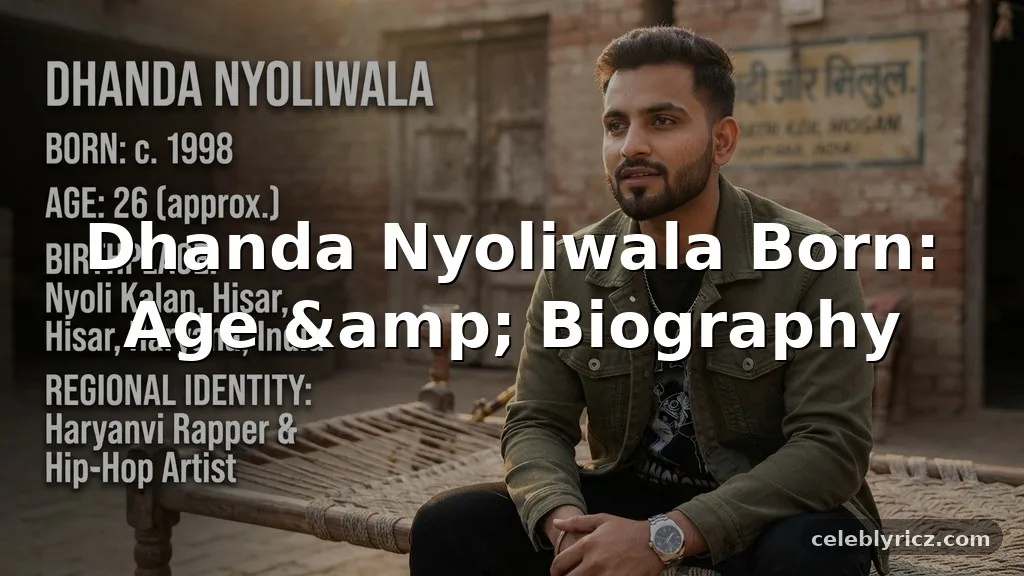

Dhanda Nyoliwala was born Parveen Dhanda on May 21, 1997, in the small village of Nyoli Kalan in Haryana’s Hisar district, India. As of 2026, he is 29 years old — and in those 29 years, he has traveled from a rural Haryanvi childhood to the Billboard charts, from national-level athletics to pioneering an entire musical genre.
His birth story matters because everything about Dhanda Nyoliwala — his stage name, his language, his sound, his identity — traces back to where and when he was born. “Nyoliwala” literally means “the one from Nyoli”: the village of his birth is tattooed on his artistic identity.
This biography traces Dhanda Nyoliwala’s life from birth through childhood, his athletic years, the move to Australia, and his rise as the global face of Haryanvi drill — with his age and life milestones mapped along the way.
Dhanda Nyoliwala: Birth and Age Facts
| Fact | Details |
|---|---|
| Birth name | Parveen Dhanda |
| Date of birth | May 21, 1997 (some sources say 1998) |
| Age (2026) | 29 years old |
| Birthplace | Nyoli Kalan, Hisar district, Haryana, India |
| Zodiac sign | Gemini |
| Nationality | Indian |
| Religion | Hinduism |
| Community | Jaat (Haryanvi) |
| Height | 5’8″ (173 cm) |
Born in 1997: The World Dhanda Nyoliwala Was Born Into
Dhanda Nyoliwala was born in 1997, a year that placed him at a fascinating generational crossroads. India was liberalizing economically, the internet was arriving, and rural Haryana stood on the cusp of enormous change. He would grow up bilingual in tradition and modernity — fluent in village life and, eventually, in global hip-hop.
Hisar district, his birthplace region, is deep Haryanvi heartland: agricultural, athletic, proud, and culturally distinct. The Haryana of 1997 was a place of wrestlers and farmers, of folk songs and fierce community identity. It was also a place largely invisible in India’s mainstream entertainment — a gap Dhanda would eventually fill. It is a land of wrestlers and soldiers, of folk singers and Olympians — a place where physical excellence and cultural pride are expectations, not aspirations. A child born here absorbs ambition with the air.
Being born in May makes him a Gemini — and fans of astrology might note the sign’s reputation for duality and communication. Dhanda’s art is nothing if not dual: village and world, Haryanvi and hip-hop, tradition and rebellion, all held in productive tension. Whether or not one credits the stars, the description fits uncannily — and his gift for rapid-fire Haryanvi wordplay is the communicative brilliance Geminis are said to possess.
The Birthplace: Nyoli Kalan, Hisar
Nyoli Kalan is a village in the Hisar district of Haryana — the kind of place where everyone knows everyone, where the Haryanvi dialect is spoken in its purest form, and where life revolves around agriculture, community, and sport. It is not a place anyone expected a global music star to emerge from.
That is precisely why Dhanda’s stage name matters. By calling himself “Nyoliwala” — the one from Nyoli — he turned his obscure birthplace into a brand, a badge, and a statement. Every time his name is announced on a stage in Toronto or Sydney, Nyoli Kalan travels with him.
The village gave him his two greatest assets: the Haryanvi language in its most authentic form, and the lived experience of rural life that makes his lyrics ring true. Birthplace is biography, and Dhanda’s biography is inseparable from Nyoli Kalan’s soil.
Childhood and Early Years (1997–2015)
Growing up in Nyoli Kalan in the late 1990s and 2000s, young Parveen Dhanda lived a classic Haryanvi childhood: local government school, outdoor games, community festivals, and immersion in the physical culture of Haryana. His father, a government school teacher, ensured education was valued alongside athletics.
By his teens, his athletic talent was evident. He gravitated toward javelin throw — a discipline demanding explosive power, precise technique, and mental focus. Haryana’s sports infrastructure, among India’s best, gave him coaching and competition. He rose to the national level, competing against India’s best young throwers.
These formative years built the competitor. The discipline of dawn training, the psychology of competition, the experience of winning and losing on a national stage — all of it forged a resilience and self-belief that would later sustain him through the much harder grind of the music industry.
The Athletic Years: National-Level Javelin Thrower
As a national-level javelin thrower, Dhanda Nyoliwala was a serious athlete — not a hobbyist. Javelin at the national level requires years of specialized training: strength conditioning, technique refinement, and the mental game of performing under pressure. He was, by all accounts, genuinely talented.
Why did he leave athletics? The full story has never been told in detail, but the pattern is familiar: Indian athletics offers glory but uncertain livelihoods, and a young man with growing creative ambitions may have seen a ceiling. What is clear is that he did not waste the athletic years — the discipline, physicality, and competitive fire transferred directly into his music career.
Listen to his delivery and you hear the athlete: the explosive energy, the controlled power, the refusal to show weakness. Watch him perform and you see it: the stamina, the command of space, the physical confidence. The javelin thrower became a rapper, but the competitor never left.
2018: The Move to Australia (Age 21)
At around 21, Dhanda made the life-altering decision to move to Queensland, Australia, for higher studies. For a young man from rural Haryana, this was an enormous leap — new country, new culture, new language environment, new everything.
The move was ostensibly about education, but it became about music. In Australia, Dhanda encountered hip-hop, drill, and trap production at a level of sophistication he had never experienced. Simultaneously, distance from home sharpened his Haryanvi identity — the classic immigrant-artist awakening.
Age 21 is when most people are still finding themselves. Dhanda found himself by losing himself in music — writing songs from 2019, committing to hip-hop by 2020, and fusing his mother tongue with the hardest beats on the planet.
2019–2021: The Musical Awakening (Ages 22–24)
Between ages 22 and 24, Dhanda underwent his artistic metamorphosis. He began writing songs in 2019, experimenting with Haryanvi lyrics over contemporary beats. By 2020, he had committed fully to hip-hop, developing the Haryanvi drill fusion that would become his signature.
Early tracks like “Afgan” and “First Haryanvi Drill” announced the new sound: trap and drill production carrying raw Haryanvi narratives. The response was immediate — listeners recognized something genuinely new, not an imitation but an invention.
These were the underground years: building a catalog, finding an audience, refining the craft. By 24, Dhanda had the sound, the voice, and the vision. He just needed the breakout.
2022: “Up To U” and Stardom (Age 25)
At 25, Dhanda Nyoliwala released “Up To U” — and everything changed. The track exploded past 75 million views, hit #1 on Spotify India and Shazam India, and made him the first Haryanvi artist on the Billboard Canada charts.
Twenty-five is a classic breakout age in music — old enough to have paid dues, young enough to capture the zeitgeist. Dhanda’s decade of preparation (athletics, migration, musical experimentation) converged in a single song that announced Haryanvi drill to the world.
The success was not just personal but historic: a regional-language rapper from a Hisar village had achieved what no one from his background had done before. The birthplace that once seemed like a limitation was now his superpower.
2023–2025: Consolidation and Global Hits (Ages 26–28)
The years from 26 to 28 saw Dhanda consolidate his position with a string of hits: “No Mercy,” “Yamaha,” “Ego Killer,” “Chora Baba Ka” with Raftaar, and above all “Russian Bandana” — which peaked at #6 in India in November 2024 and crossed 112 million Spotify streams.
He released the album Kohram (featuring “Not Guilty”), toured internationally across Australia, Canada, New Zealand, and India, and grew his Instagram following past 3 million. Each year brought new milestones, new collaborations, and new proof that Haryanvi drill was not a fad but a movement.
His collaboration “Boom Shaka” with KR$NA linked him to Indian hip-hop royalty — a passing of the torch moment between generations. By 28, Dhanda was no longer just a rapper but an institution: the founding father of a genre.
2026: Bollywood Debut and Beyond (Age 29)
At 29, Dhanda Nyoliwala made his Bollywood debut with “Do Numbari” for Mirzapur: The Movie — the first release under Excel Music, the new label from Excel Entertainment. Composed, written, and performed entirely by Dhanda, the track brought Haryanvi drill to mainstream Indian cinema.
He also released the Big Plans EP featuring “Zigane,” continuing his prolific output. At 29, he stands at the intersection of underground credibility and mainstream success — a rare position that few artists achieve.
What does the future hold? More film music, bigger tours, deeper catalog, and the ongoing project of building Haryanvi hip-hop into a permanent institution. At 29, his story is still in its early chapters.
Dhanda Nyoliwala’s Age in Context
At 29, Dhanda Nyoliwala is in the prime window for a hip-hop artist — experienced enough to command respect, young enough to evolve. Compare his trajectory to other genre pioneers: like KRSNA, whose Delhi underground years built a lasting legacy, Dhanda’s independent grind forged an artist who answers to no one.
His age also positions him as a bridge: old enough to remember pre-smartphone Haryana, young enough to be a digital native. That duality — the village childhood and the global career — is the engine of his art, and it is a product of exactly when he was born.
Artists who peak in their late twenties often enjoy the longest careers, because their success rests on craft rather than novelty. Dhanda’s foundation — a decade of athletics, migration, and musical experimentation before fame — suggests he is built for the long run, much like Lil Tony, whose early start gave him years to develop before breaking through.
Personal Life: What We Know
Dhanda Nyoliwala guards his personal life fiercely. What is known: born Parveen Dhanda, Hindu, from a Jaat family, son of a former government school teacher, former national-level javelin thrower, reportedly married to discus athlete Asha Saharan (wedding allegedly December 8, 2019, unconfirmed).
He has no confirmed children. His parents’ and siblings’ names remain private. His social media focuses on music, not lifestyle. In an industry of oversharing, his discretion is distinctive — and deeply Haryanvi, a culture that prizes dignity over display.
The Meaning Behind His Stage Name
“Dhanda Nyoliwala” is a name that tells a whole story. “Nyoliwala” — the one from Nyoli — is a declaration of origin worn as identity. In hip-hop, where stage names often project toughness or luxury, Dhanda chose geography: his village, his birthplace, his roots.
The choice was strategic as well as sentimental. In an industry full of artists hiding their small-town origins, Dhanda made his the centerpiece. The name is instantly distinctive, impossible to confuse, and deeply authentic — three qualities that marketing budgets cannot buy.
“Dhanda” itself, his chosen first name, carries street connotations in Haryanvi and Hindi — business, hustle, the grind. Together, the name reads as a mission statement: the hustler from Nyoli, taking the village to the world.
Family Background: The Teacher’s Household
Dhanda was born into a family that valued education: his father served as a teacher in a government school, a respected position in rural Haryana. Teachers’ families occupy a special place in village life — educated, disciplined, aspirational, and deeply embedded in the community.
Growing up in a teacher’s household meant structure: homework before play, respect for learning, and an understanding that effort compounds. Those lessons, absorbed in childhood, later powered both his athletic career and his musical grind. The discipline that made him a national-level athlete and then a prolific musician was seeded at home.
His Jaat heritage added another layer: the community’s pride in physical prowess, agricultural roots, and straightforward dealing. The combination — a teacher’s discipline and a Jaat’s fire — produced an artist who works relentlessly and speaks plainly.
Dhanda Nyoliwala: Life Timeline
- May 21, 1997: Born Parveen Dhanda in Nyoli Kalan, Hisar district, Haryana.
- Late 1990s–2000s: Childhood in Nyoli Kalan; local government schooling; immersion in Haryanvi language and culture.
- Early 2010s: Emerges as a javelin thrower; rises to national-level athletics.
- 2018 (age 21): Moves to Queensland, Australia, for higher studies.
- 2019 (age 22): Begins writing songs in Australia.
- 2020 (age 23): Commits fully to hip-hop; develops Haryanvi drill fusion; early tracks like “Afgan.”
- 2022 (age 25): Breakthrough with “Up To U” — 75M+ views, #1 Spotify/Shazam India, first Haryanvi artist on Billboard Canada.
- 2023–2024 (ages 26–27): Hits including “No Mercy,” “Chora Baba Ka” (ft. Raftaar); “Russian Bandana” peaks at #6 India, crosses 112M Spotify streams.
- 2025 (age 28): Album Kohram; international tours; “Boom Shaka” with KR$NA.
- 2026 (age 29): Big Plans EP (“Zigane”); Bollywood debut “Do Numbari” for Mirzapur: The Movie via Excel Music.
Why His Birth Story Resonates
Dhanda Nyoliwala’s birth story resonates because it inverts the usual celebrity narrative. He was not born into the industry, the city, or privilege — he was born in a small village most Indians could not find on a map, and through sheer talent and determination he made that village famous.
For millions of young people from small towns and villages, his life is proof of concept: your birthplace is not a ceiling but a foundation. The specificity of his story — Nyoli Kalan, Hisar, Haryana, May 21, 1997 — makes it real in a way that generic “follow your dreams” narratives never are.
And in an age of manufactured personas, the fact that his stage name is literally his birthplace is a quiet act of integrity. He did not reinvent himself to succeed; he introduced himself — where he was born, who he is — and the world came to him.
What His Age Means for His Career
At 29, Dhanda Nyoliwala sits in hip-hop’s sweet spot. The genre’s history shows that artists who break through in their mid-twenties on the strength of craft — rather than viral novelty — tend to enjoy the longest, most respected careers. Dhanda’s foundation is unusually deep: a decade of athletics, international migration, and musical experimentation preceded his fame.
His age also gives him authority with two audiences at once. To teenagers discovering Haryanvi drill, he is the pioneering elder — the originator. To industry veterans, he is the serious craftsman who paid dues and built a genre from nothing. Few artists command both kinds of respect simultaneously.
The next decade — his thirties — will likely define his legacy: the catalog deepens, the influence compounds, and the pioneer becomes the institution. If his twenties were about proving Haryanvi drill could exist, his thirties will be about proving it endures. Everything in his story so far suggests he is built for exactly that long game.
Frequently Asked Questions
When was Dhanda Nyoliwala born?
Dhanda Nyoliwala was born Parveen Dhanda on May 21, 1997, in Nyoli Kalan village, Hisar district, Haryana, India. Some sources list 1998, but 1997 is the most widely cited year.
How old is Dhanda Nyoliwala in 2026?
Dhanda Nyoliwala is 29 years old as of 2026. He was born on May 21, 1997, which makes him a Gemini.
Where was Dhanda Nyoliwala born?
Dhanda Nyoliwala was born in Nyoli Kalan, a village in the Hisar district of Haryana, India. His stage name “Nyoliwala” means “the one from Nyoli,” honoring his birthplace.
What did Dhanda Nyoliwala do before music?
Before music, Dhanda Nyoliwala was a national-level javelin thrower. He later moved to Queensland, Australia, in 2018 for higher studies, where he began writing songs in 2019 and shifted to hip-hop full-time by 2020.
What is Dhanda Nyoliwala’s biggest achievement?
Dhanda Nyoliwala’s biggest achievements include “Up To U” (75M+ views, #1 Spotify/Shazam India), “Russian Bandana” (112M+ Spotify streams), becoming the first Haryanvi artist on the Billboard Canada charts, pioneering Haryanvi drill, and his 2026 Bollywood debut with “Do Numbari” for Mirzapur: The Movie.
Dhanda Nyoliwala’s life — born May 21, 1997, in Nyoli Kalan; athlete, migrant, musician; 29 years old and already a genre pioneer with hundreds of millions of streams — is a testament to what happens when roots run deep and ambitions run high. From a Hisar village to the world stage, his journey is still unfolding.
The boy born Parveen Dhanda did not just become a rapper. He became proof that where you are born does not limit where you can go — it defines how far your voice can carry. And his voice, raised in Haryanvi, now carries across the world. From a May morning in Nyoli Kalan in 1997 to the global stage and Bollywood soundtracks in 2026, Dhanda Nyoliwala’s twenty-nine years are a masterclass in turning humble origins into an extraordinary destiny.
Explore more on CelebLyricz.