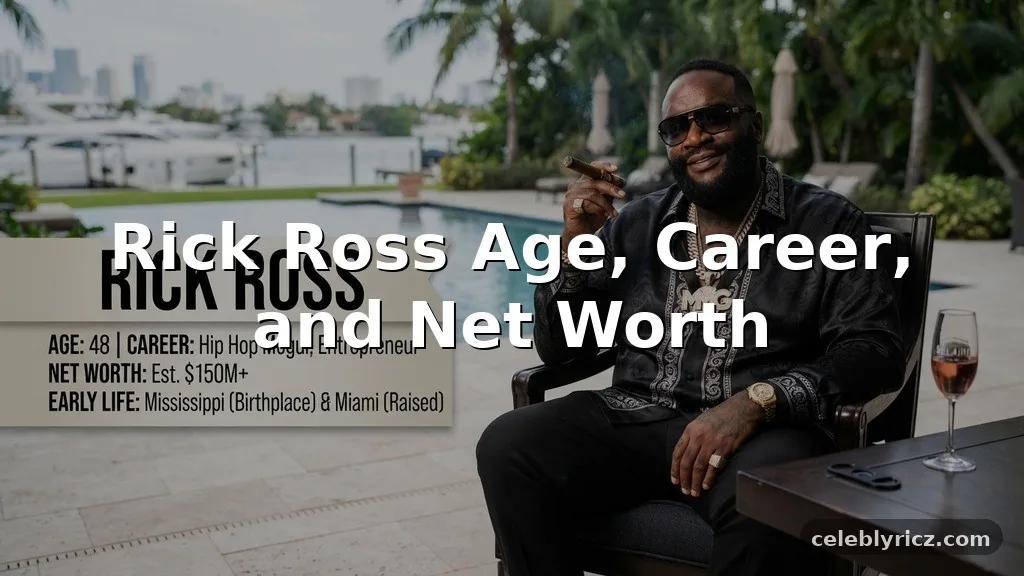

Rick Ross is 50 years old in 2026 — and two decades after “Hustlin'” turned a Miami rapper into a national phenomenon, the man born William Leonard Roberts II has built something bigger than a rap career. He’s built an empire. With an estimated net worth of around $150 million, a dozen studio albums, a record label, dozens of restaurant franchises, and some of the most famous real estate in hip-hop, Rick Ross is the living embodiment of his own philosophy: it’s not about how much you make, it’s about how much you keep.
Born January 28, 1976, in Clarksdale, Mississippi, and raised in Carol City, Florida, Ross broke through in 2006 with Port of Miami, a No. 1 debut that introduced his larger-than-life “Boss” persona. Since then, he’s released 12 studio albums (most recently Set in Stone in July 2026), founded Maybach Music Group, signed stars like Meek Mill and Wale, and converted rap earnings into Wingstop franchises, Checkers locations, spirits partnerships, and a 235-acre Georgia estate he calls the Promise Land.
This guide covers Rick Ross’s age and early life, his rise from Carol City to Def Jam, the Maybach Music empire, his business portfolio, the controversies (including the correctional-officer revelation and the Drake feud), his family, and the full breakdown of his estimated $150 million fortune.
Rick Ross at a Glance
| Fact | Details |
|---|---|
| Full name | William Leonard Roberts II |
| Born | January 28, 1976, Clarksdale, Mississippi |
| Age in 2026 | 50 (turned 50 in January 2026) |
| Raised | Carol City, Florida |
| Height | 5’11” (180 cm) |
| Profession | Rapper, record executive, entrepreneur |
| Breakthrough | Port of Miami (2006) |
| Label | Maybach Music Group (founder, 2009) |
| Studio albums | 12 (2006–2026) |
| Net worth (est.) | ~$150 million |
| Children | 4 |
Early Life: Clarksdale to Carol City
William Leonard Roberts II was born on January 28, 1976, in Clarksdale, Mississippi — the heart of Delta blues country. The family moved to Florida when he was young, and he grew up in Carol City, a working-class neighborhood in Miami-Dade County that has produced an extraordinary number of hip-hop artists. Carol City shaped everything: the drawl, the stories, the ambition.
As a teenager, Roberts was a football standout — a large, athletic kid who earned a football scholarship to Albany State University, a historically Black college in Georgia. He played there briefly before leaving, and what came next became one of the most controversial chapters of his biography: he worked as a correctional officer in Florida for about 18 months in the mid-1990s. That fact, exposed by The Smoking Gun in 2008, detonated his carefully constructed street persona — and his handling of the fallout became a case study in crisis management.
Carol City itself deserves context. The neighborhood produced not just Ross but a pipeline of Miami hip-hop talent, and its mix of poverty, pride, and musicality shaped his worldview. The young William Roberts absorbed it all — the street narratives, the church choirs, the bass-heavy car culture. When he later built the Boss persona, he wasn’t inventing from nothing; he was amplifying the loudest parts of where he came from, filtered through ambition. The football scholarship showed the discipline; Carol City supplied the stories.
Rather than collapse, Ross absorbed the blow and kept moving. He later acknowledged the job while insisting it didn’t define him — a working man taking a paycheck before the music paid. The controversy faded; the career didn’t. If anything, surviving the exposure proved the persona’s real foundation: not biography, but charisma, work ethic, and an unshakeable belief in the Boss character.
The Breakthrough: “Hustlin'” and Port of Miami
Before the fame, Roberts worked behind the scenes — ghostwriting and producing for local Miami acts, learning the business from the inside. He took his stage name from “Freeway” Ricky Ross, the infamous Los Angeles drug kingpin (a choice that later led to a lawsuit the real Ross lost on First Amendment grounds). The name fit the persona: grand, cinematic, larger than life.
In 2006, the single “Hustlin'” exploded — a hypnotic, minimalist anthem built on Ross’s gravelly delivery of “every day I’m hustlin’.” A bidding war erupted among major labels; Jay-Z’s Def Jam won, reportedly paying a premium. Port of Miami debuted at No. 1 on the Billboard 200, selling nearly 187,000 copies in its first week. At 30 years old — ancient by rap-debut standards — Rick Ross was an overnight sensation a decade in the making.
What followed was one of the most consistent album runs in modern hip-hop. Trilla (2008), Deeper Than Rap (2009), Teflon Don (2010), and God Forgives, I Don’t (2012) all reached the top of the charts. Six of his 12 albums have hit No. 1 on the Billboard 200. The sound — lush, orchestral, cinematic, built on soul samples and booming bass — became instantly recognizable. Ross wasn’t just releasing albums; he was building a sonic brand: luxury rap, aspirational and unapologetic.
Teflon Don is widely considered his masterpiece — the album where the Boss persona fully crystallized. “B.M.F. (Blowin’ Money Fast)” became a cultural catchphrase; “Aston Martin Music” with Drake and Chrisette Michele was a crossover smash. Critics who’d dismissed Ross as a one-hit wonder had to reckon with an artist operating at an elite level. God Forgives, I Don’t continued the run with first-week sales over 218,000, proving the audience wasn’t going anywhere. Across this era, Ross also became rap’s most in-demand guest feature — his verse could elevate anyone’s single, and he lent that Midas touch generously.
Studio albums
| Album | Year | Billboard 200 peak |
|---|---|---|
| Port of Miami | 2006 | #1 |
| Trilla | 2008 | #1 |
| Deeper Than Rap | 2009 | #1 |
| Teflon Don | 2010 | #2 |
| God Forgives, I Don’t | 2012 | #1 |
| Mastermind | 2014 | #1 |
| Hood Billionaire | 2014 | #6 |
| Black Market | 2015 | #6 |
| Rather You Than Me | 2017 | #3 |
| Port of Miami 2 | 2019 | #2 |
| Richer Than I Ever Been | 2021 | #22 |
| Set in Stone | 2026 | — |
Maybach Music Group: Building the Label
In 2009, Ross founded Maybach Music Group (MMG), distributed through Warner Bros. and later Atlantic/Epic. The move transformed him from artist to executive — and it worked. MMG’s early signings included Meek Mill and Wale, both of whom became stars under Ross’s mentorship. The label’s compilation albums (Self Made series) showcased the roster’s depth.
Meek Mill’s story illustrates the MMG model. Ross signed the young Philadelphia rapper, put him on the Self Made compilations, gave him the platform — and Meek became one of the biggest rappers of the 2010s. Wale, the D.C. poet-rapper, found his commercial breakthrough under the MMG umbrella. Ross’s genius as an executive was curation: he didn’t try to make artists in his image; he amplified what made them distinct, then wrapped them in the MMG luxury aesthetic. The label took a cut of everything — the classic mogul playbook, executed flawlessly.
MMG’s genius was branding: the Maybach name, the luxury aesthetic, the “MMG” tag — it all reinforced the Boss identity while generating revenue from other artists’ work. Ross proved he could spot talent, develop it, and profit from it. The label remains active, a cornerstone of his business identity and a significant contributor to his wealth.
The executive role also changed how the industry saw him. Rappers who build labels — Jay-Z with Roc-A-Fella, 50 Cent with G-Unit — graduate to a different tier of wealth and influence. Ross joined that tier. Rising Southern rapper BigXthaPlug represents the new generation navigating the same label landscape Ross helped reshape, while young artists like Lil Tony chase the kind of breakout Ross achieved with “Hustlin’.”
The Business Empire: Wingstop, Real Estate, and Spirits
Rick Ross’s business portfolio is the real story behind the $150 million. He’s been explicit about his philosophy: music is the marketing; ownership is the money. His investments include:
- Wingstop franchises — nearly 30 locations, one of his best-known and most profitable investments, generating millions in annual revenue.
- Checkers & Rally’s franchises — additional fast-food holdings diversifying the restaurant portfolio.
- The Promise Land — his 235-acre Fayetteville, Georgia estate, purchased in 2014 for $5.8 million from boxer Evander Holyfield; featuring a 109-room mansion, it’s become a cultural landmark (and filming location).
- Star Island mansion — a $37 million Miami waterfront estate purchased in cash in 2023, among the most expensive homes in hip-hop.
- Spirits partnerships — long-term equity and ambassador roles with Luc Belaire champagne and Bumbu rum.
- Maybach Air — his Gulfstream G550 private jet, valued near $19.5 million, branded as an extension of the empire.
- The Rick Ross Car & Bike Show — his annual Georgia car show, generating millions yearly and cementing his automotive-culture influence.
The strategy is textbook wealth-building: convert high but volatile music income into appreciating real estate and cash-flowing franchises. At 50, he’s described the shift explicitly — “at 50, the dream is infrastructure.” The Boss persona sells records; the portfolio builds generational wealth.
The real estate deserves a closer look, because it’s where the wealth is most visible. The Promise Land purchase in 2014 — $5.8 million for Evander Holyfield’s foreclosed 235-acre estate — was the steal of the decade; comparable Georgia land has appreciated enormously since. The property has hosted everything from music videos to his annual car show, making it an income-producing asset as well as a home. The Star Island purchase was the opposite play: $37 million cash for Miami’s most exclusive zip code, a trophy asset that also happens to sit on some of America’s most valuable residential land. And the $4.2 million acquisition of Meek Mill’s former Atlanta estate added another luxury property to a portfolio that’s now worth an estimated $50 million.
The car show, meanwhile, has become a cultural institution. The Rick Ross Car & Bike Show draws tens of thousands to Georgia annually, generating millions in revenue while reinforcing the automotive-luxury brand. It’s marketing that pays for itself — the Boss lifestyle as a ticketed event.
Controversies and Setbacks
Ross’s career hasn’t been controversy-free. The 2008 correctional-officer revelation challenged his authenticity. A 2015 arrest on assault and kidnapping charges (stemming from an incident with a groundskeeper at his Georgia estate) led to a 2017 no-contest plea to aggravated assault. Health scares — seizures in 2011 that forced emergency plane landings — prompted a dramatic weight-loss transformation and lifestyle overhaul.
The 2024 feud with Drake was the most high-profile rap beef of his later career, with Ross releasing the diss track “Champagne Moments” and trading shots across social media. Like most Ross controversies, it generated headlines without derailing the business. If anything, his ability to absorb scandal and keep building has become part of the legend: the Boss doesn’t flinch.
The Drake beef was fascinating because the two had been collaborators — “Aston Martin Music,” “Stay Schemin’,” years of mutual respect. When it fractured in 2024, Ross went at Drake with uncharacteristic personal venom, mocking everything from his appearance to his authenticity. The feud dominated hip-hop discourse for weeks, with Ross playing the instigator role to perfection. It reminded everyone that beneath the businessman is still a battle rapper who enjoys the sport — and that at 48, he could still command the culture’s attention at will.
Personal Life and Family
Ross is the father of four children: Toie (with Tia Kemp), William Roberts III, Berkeley, and Billion. He’s been open about fatherhood while keeping his children’s lives largely private. His relationships have occasionally made headlines, but he’s never married — the Boss persona extends to a bachelor lifestyle he’s never seemed eager to change.
What’s notable is how he’s woven fatherhood into the brand without exploiting it. His children appear at the car show, in social media moments, at the Promise Land — present but protected. He’s spoken about teaching them the business: not just the wealth, but the mechanics behind it. The infrastructure quote applies to them too. The goal isn’t just rich kids; it’s a family that understands ownership. Billion, the youngest, already has a name that sounds like a business plan.
His mother and family remain central to his life; the Promise Land estate functions as a family compound as much as a showpiece. He’s spoken about wanting to build wealth that outlasts him — the infrastructure quote again — and his children are the intended beneficiaries of the empire.
Rick Ross Net Worth: The $150 Million Breakdown
Rick Ross’s net worth is estimated at around $150 million as of 2026, with some trackers placing it as high as $180 million. The figure is an estimate — Ross has never released audited financials — but it’s grounded in visible assets and two decades of documented earnings.
| Asset / income stream | Estimated value |
|---|---|
| Music catalog, royalties & touring | ~$35 million |
| Maybach Music Group equity | ~$15–20 million |
| Real estate (Promise Land, Star Island, Atlanta) | ~$50 million |
| Wingstop & Checkers franchises | ~$30–40 million |
| Spirits partnerships (Belaire, Bumbu) | ~$10 million |
| Jet, cars & luxury assets | ~$20 million |
| Total estimated net worth | ~$150 million |
He’s earned over $90 million from music alone across his career, frequently appearing on highest-paid-rapper lists. But the fortune’s growth engine is the business portfolio — real estate appreciation, franchise cash flow, and brand equity. In 2026, he’s reportedly pursuing catalog acquisitions (including a reported $2 million offer for the G-Unit catalog) and expanding into African markets musically and commercially.
The G-Unit catalog bid is revealing. Buying a rival’s catalog — 50 Cent’s, no less, from the man who once mocked Ross’s correctional-officer past — would be both a financial investment and a symbolic victory lap. Music catalogs have become one of the hottest alternative assets in finance, with multiples soaring as streaming provides predictable cash flows. Whether the $2 million offer succeeds or not, the fact that Ross is shopping for catalogs shows how far the thinking has evolved: from making hits to owning them, from artist to asset manager.
2026: The 20th Anniversary Victory Lap
2026 marks 20 years since Port of Miami — and Ross is celebrating like a man with nothing to prove and everything to build. Set in Stone, his 12th studio album, arrived in July 2026. He’s headlining international dates (including the Hustle & Heritage concert in Harare, Zimbabwe), planning collaborations with African artists, and continuing to expand the business empire into tech and agriculture.
The Africa focus is the most interesting strategic move of his 50s. After headlining in Harare alongside Nigeria’s Omah Lay, Ross announced plans for a collaborative project with African artists and producers — and floated a dream collaboration uniting Bob Marley, Fela Kuti, and Burna Boy’s legacies. It’s both artistic curiosity and business calculation: Africa’s music markets are among the world’s fastest-growing, and Ross is positioning himself as a bridge between American hip-hop and the continent’s sounds. The hustle, as always, evolves.
At 50, Rick Ross occupies a unique position: respected OG, active hitmaker, serious businessman. Few rappers have sustained relevance across two decades while building wealth outside music. The Boss did both.
Frequently Asked Questions
How old is Rick Ross?
Rick Ross is 50 years old in 2026. He was born William Leonard Roberts II on January 28, 1976, in Clarksdale, Mississippi, and raised in Carol City, Florida.
What is Rick Ross’s net worth?
Rick Ross’s net worth is estimated at around $150 million as of 2026. His wealth comes from music earnings, Maybach Music Group, Wingstop and Checkers franchises, real estate including his Georgia Promise Land estate and Miami Star Island mansion, and spirits partnerships.
What is Rick Ross’s real name?
Rick Ross’s real name is William Leonard Roberts II. He took his stage name from “Freeway” Ricky Ross, the former Los Angeles drug kingpin — a choice that led to an unsuccessful lawsuit by the real Ross.
Was Rick Ross really a correctional officer?
Yes. In 2008, The Smoking Gun revealed that William Roberts worked as a Florida correctional officer for about 18 months in the mid-1990s. Ross acknowledged the job while maintaining it didn’t define him, and the controversy ultimately didn’t derail his career.
How many Wingstop locations does Rick Ross own?
Rick Ross owns nearly 30 Wingstop franchise locations, along with interests in Checkers & Rally’s restaurants. His franchise holdings are among his most profitable business investments.
Rick Ross’s story is the American dream in a Maybach: a correctional officer from Carol City who became a rap star, then a label boss, then a franchise mogul, then a real-estate baron. The $150 million isn’t the point — it’s the proof. Proof that the hustle works, that ownership beats wages, and that a persona built on belief can become a balance sheet.
At 50, with a 12th album fresh, a 20th anniversary to celebrate, and an empire still expanding, the Boss isn’t slowing down. He’s building infrastructure — the kind of wealth that outlasts hits, headlines, and even the man himself. Every day he’s hustlin’. The difference now is that the hustle owns Wingstops.
Explore more on CelebLyricz.