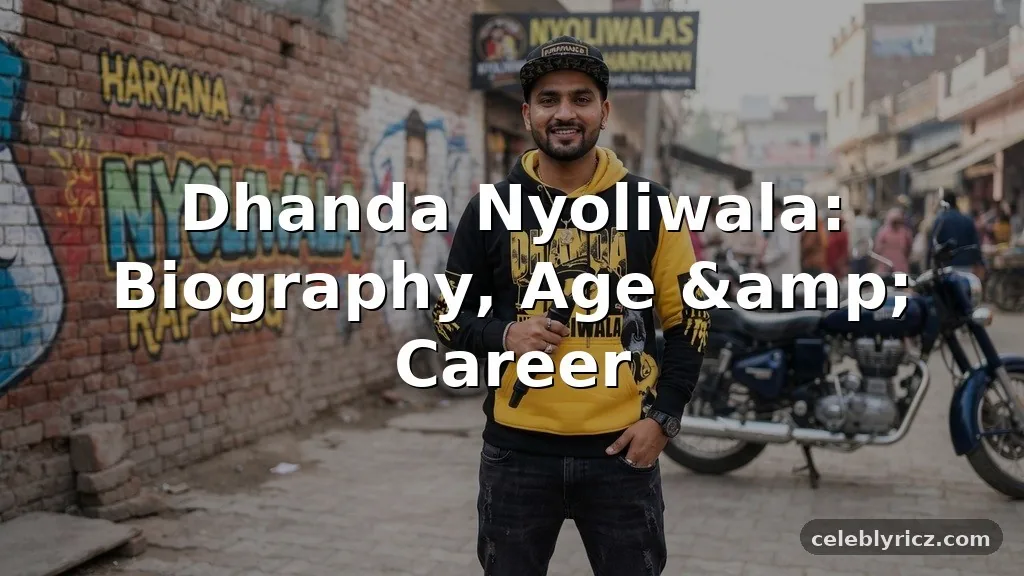

Dhanda Nyoliwala is the stage name of Parveen Dhanda, a Haryanvi rapper, singer, and lyricist who went from a village in Haryana to international stages — with a stop in Australia along the way. Searches for Dhanda Nyoliwala’s biography, age, and real name mix solid career facts with a fog of conflicting claims, so this guide separates what is documented from what is merely repeated. The commonly reported birth date is May 21, 1997, which would make him 29 years old in 2026, though sources disagree on the exact year.
What is not in dispute is his impact. Dhanda Nyoliwala pioneered a fearless fusion of Haryanvi folk language with modern trap production, broke out globally with the viral hit “Up To U” in 2022, and became one of the most-streamed regional Indian hip-hop artists in the world — all as an independent artist without major-label backing. Before music, he was a national-level athlete, competing in javelin throw and the 3000-metre steeplechase.
This biography covers Dhanda Nyoliwala’s age and real name, his early life and athletic career, his move to Australia, his musical breakthrough, his biggest songs, the “Vomit On Paper” controversy, his wife and family, his estimated net worth, and what he is doing now.
Dhanda Nyoliwala Age and Real Name: What We Know
Dhanda Nyoliwala’s real name is Parveen Dhanda. The “Nyoliwala” in his stage name comes from his home village — Nyoli Kalan (also spelled Nyoli Kala) in the Hisar district of Haryana, India. It is a classic hip-hop move: rep your roots so hard they become your brand.
His birth date is the murkiest basic fact about him. Most biography sources list May 21, 1997, which would make him 29 in 2026. Others claim May 21, 1998 (28 in 2026), and at least one source gives July 15, 1999 (27 in 2026). No official document has settled the question publicly. The May 21, 1997 date appears most frequently across independent sources, so it is the best-supported answer — but treat it as commonly reported rather than confirmed.
Dhanda Nyoliwala Quick Facts
| Fact | Detail |
|---|---|
| Real name | Parveen Dhanda |
| Stage name | Dhanda Nyoliwala |
| Date of birth | May 21, 1997 (most commonly reported; disputed) |
| Age in 2026 | 29 years old (if 1997 date is correct) |
| Birthplace | Nyoli Kalan, Hisar, Haryana, India |
| Current residence | Gold Coast, Queensland, Australia |
| Nationality | Indian |
| Religion | Hindu |
| Profession | Rapper, singer, lyricist, YouTuber |
| Athletic background | National-level javelin thrower; 3000m steeplechase |
| Marital status | Married |
| Wife | Asha Saharan |
| Breakout song | “Up To U” (2022) |
| Net worth (2026) | Estimated ₹6–8 crore (~$1M USD) |
Early Life: Village Roots in Haryana
Parveen Dhanda was born in Nyoli Kalan village, Hisar district, Haryana, and grew up in a typical Haryanvi agrarian household. His father worked as a government teacher, his mother is a homemaker, and he has a younger brother who has supported him throughout his journey. The family is described as grounded, with values of respect, hard work, and humility that Dhanda credits for keeping him steady through fame.
Village life became the raw material of his art. The dialect, the farmer struggles, the codes of loyalty and pride, the friction between tradition and modernity — all of it would later pour into his lyrics. Rather than hiding his rural roots when he found success, he built his entire brand identity around them, and that authenticity is exactly what connects him with millions of fans, from Haryana’s villages to the Indian diaspora in Canada and Australia.
The Athlete Years
Before he was a rapper, Parveen Dhanda was a serious athlete. He competed at the national level in javelin throw — as a left-handed thrower — and in the grueling 3000-metre steeplechase. His athletic peak is a matter of public record: on June 21, 2021, he won a bronze medal at the 4th Indian Grand Prix athletics meet at the Netaji Subhas National Institute of Sports in Patiala, completing the steeplechase in 9:24.86.
That achievement matters for understanding the artist. Elite athletics demands the same qualities his music career later required: discipline, pain tolerance, comfort with lonely training, and the ability to perform under pressure. The competitive mindset never left him — it just found a new arena. His journey from javelin medalist to rap star is one of the most unusual career pivots in Indian music, and it gives his “village to global” story a documented backbone that most rapper origin stories lack.
Move to Australia and Education
In 2018, Dhanda moved to Australia to pursue higher education, enrolling in Mechanical Engineering at the Queensland University of Technology. He lived across Queensland, Sydney, and Melbourne before settling on the Gold Coast, Queensland, where he is based today.
He ultimately left the engineering program to follow music — a decision that will sound familiar to anyone who knows the desi-immigrant-artist story. But the Australian years were formative in a different way: distance from home sharpened his sense of identity, and the multicultural hip-hop scenes of Australian cities exposed him to international rap styles that would fuse with his Haryanvi foundation. Some of his most interesting work comes from that collision — village dialect riding trap beats, with lyrical nods to Urdu poetry.
Musical Career: From “Afgan” to “Up To U”
The Beginnings (2019–2020)
Dhanda began writing songs in 2019 and fully transitioned into music by 2020, debuting with the Haryanvi track “Afgan.” The early releases built a grassroots following among Haryanvi youth and the diaspora, but he was still a regional artist with a distinctive sound searching for a breakout moment.
His style was already fully formed in its essentials: Haryanvi folk roots fused with modern trap production, lyrics drawn from village life and social commentary, and influences ranging from Urdu poets Jaun Elia and Hafeez Jalandhari to international rappers like Dutchavelli and Hopsin. He rapped about farmers’ struggles, caste dynamics, youth frustration, and political corruption — subjects mainstream Indian hip-hop often avoided.
The Breakthrough: “Up To U” (2022)
Everything changed in 2022 with “Up To U.” The track, which Dhanda reportedly wrote impromptu during a car ride and infused with the poetic spirit of Jaun Elia, went massively viral — amassing over 75 million views on YouTube and propelling him from regional favorite to global desi hip-hop star.
“Up To U” worked because it was undeniable: a hypnotic flow, quotable bars, and a sound that felt both deeply Haryanvi and completely current. It opened doors that had been closed to Haryanvi rap, and it remains his signature song — the one that plays when his name comes up in any conversation about Indian hip-hop’s regional wave.
Major Songs and Collaborations
Since the breakthrough, Dhanda has released a string of successful singles that cemented his position:
- “Ego Killer” — one of his most acclaimed tracks, a statement of artistic intent
- “No Mercy” — hard-hitting single showcasing his aggressive delivery
- “Unstoppable” — anthemic track that became a fan favorite
- “Chora Baba Ka” — collaboration with Raftaar, one of Indian hip-hop’s biggest names, bridging the Haryanvi scene with the mainstream
- “Block” — earlier foundational track that helped build his presence
He also made history as the first Haryanvi rapper to collaborate with English-speaking artists, helping carry Haryanvi rap to a genuinely global audience. His music streams on Spotify, Apple Music, and YouTube, where he commands 1.71 million+ subscribers, alongside 3.7 million Instagram followers — numbers that put him among the most-followed independent regional artists in India.
International Tours
Dhanda has performed internationally across Australia, Canada, New Zealand, and India, playing to sold-out crowds of diaspora fans who see in him a voice for their own in-between identity — rooted in the village, living in the world. His live shows are known for high energy and crowd connection, the athlete’s stamina serving him well on stage.
His rise parallels the broader explosion of regional Indian hip-hop, where artists like KR$NA, who similarly built a career on lyrical depth outside the mainstream, and BigXthaPlug, another rapper who turned regional identity into a national brand, have shown that authenticity scales. For more on his physical presence and stage persona, see our profile of Dhanda Nyoliwala’s age and biography.
The “Vomit On Paper” Controversy (2024)
In 2024, Dhanda’s track “Vomit On Paper” sparked a major religious controversy. The song’s lyrics and music video — which featured imagery resembling Pandit Dhirendra Krishna Shastri (Baba Bageshwar) and showed disrespect toward a saffron-clad figure — were widely perceived as insulting religious sentiments and challenging religious authority.
The backlash was intense, with critics accusing him of deliberately provoking Hindu religious feelings for attention. Supporters framed it as artistic expression and social commentary — consistent with his long-standing willingness to confront power in his lyrics. The episode illustrated the double edge of his outspoken style: the same fearlessness that made him a voice for the voiceless could also ignite firestorms when aimed at revered figures.
The controversy did not derail his career, but it marked him as a genuinely polarizing figure rather than just an entertainer — an artist whose work carries real social weight, for better and worse.
Dhanda Nyoliwala Net Worth in 2026
Dhanda Nyoliwala’s net worth in 2026 is estimated at ₹6–8 crore INR (roughly $700,000 to $1 million USD), with annual earnings estimated at ₹3–4 crore. These are estimates, not disclosed figures — but they are remarkable for an independent Haryanvi rapper without major-label backing.
His income streams reflect the modern independent artist’s playbook:
- Music streaming royalties from Spotify, Apple Music, and YouTube — his catalog generates steady global streams
- Live shows and international tours across Australia, Canada, New Zealand, and India
- YouTube ad revenue from 1.71M+ subscribers and tens of millions of views
- Brand deals and sponsorships targeting his young, diaspora-heavy audience
- Collaborations with mainstream artists like Raftaar, expanding his commercial reach
The self-made nature of the wealth is central to his brand. No label advance, no Bollywood playback machine — just direct audience connection converted into income. It is the same independent-creator economics that has reshaped music globally, executed from a village in Hisar via the Gold Coast.
Dhanda Nyoliwala Wife and Family Life
Dhanda Nyoliwala is married to Asha Saharan (also reported as Asha Dhanda). She is herself reported to be a national-level athlete — sources variously describe her as a discus throw champion or a kabaddi player, so the specific discipline is uncertain, but her athletic background is consistently reported. The couple lives together on the Gold Coast, Australia, and they have no publicly reported children.
The marriage of two athletes-turned-public-figures is a fitting coda to his story: discipline recognizes discipline. His family — the teacher father, the homemaker mother, the supportive younger brother — remains the grounding force he credits publicly, and the Jat community values he raps about are, by all accounts, the values he lives by.
What Is Dhanda Nyoliwala Doing Now?
As of 2026, Dhanda Nyoliwala continues to release music, tour internationally, and grow his digital audience from his Gold Coast base. He remains one of the most-streamed Indian regional hip-hop artists on Spotify globally, and his influence on the Haryanvi scene is foundational — a generation of younger rappers now works in the lane he carved.
The open questions are artistic rather than commercial: will he push further into international collaborations? Will his social commentary sharpen or soften with success? Whatever comes next, his place is secure as the artist who proved Haryanvi rap could go global without diluting itself — village dialect, farmer pride, and all.
What Dhanda Nyoliwala Raps About: Lyrical Themes
Dhanda Nyoliwala’s lyrics are the core of his appeal — and the reason his music travels beyond pure entertainment into social commentary. Several themes recur across his catalog:
Village Pride and Rural Identity
His most consistent subject is the village itself: the dialect, the fields, the community codes of Haryana’s Jat belt. Where mainstream Indian pop treats rural life as either a joke or a postcard, Dhanda treats it as a complete world with its own dignity, conflicts, and philosophy. Lines about farming, village loyalty, and rural masculinity are delivered not as nostalgia but as present-tense identity.
Farmers’ Struggles and Social Commentary
He raps directly about farmers’ hardships, youth unemployment, political corruption, and caste dynamics — subjects that carry real risk in India’s public discourse. This willingness to name power is part of what separates him from party-rap peers. His Urdu poetry influences, particularly the spirit of Jaun Elia — the poet of defiance and melancholy — surface in his more reflective bars, giving his social commentary a literary weight unusual in the genre.
Self-Belief and the Outsider’s Hustle
Tracks like “Ego Killer” and “Unstoppable” are anthems of self-belief from someone who had to prove himself twice — first as an athlete, then as a rapper in a language the industry ignored. The confidence in his delivery is earned, not performed, and young listeners in small towns hear their own ambitions in it.
Spiritual and Philosophical Undercurrents
Beneath the aggression, his lyrics often carry philosophical and spiritual questioning — about fate, struggle, and what a man owes his roots. It is this layering — street energy over folk soul over poetic reflection — that critics point to when explaining why his music rewards repeat listening in a way disposable viral rap does not.
The Haryanvi Hip-Hop Scene He Helped Create
Before Dhanda Nyoliwala’s breakthrough, Haryanvi music’s national profile rested largely on folk-pop and the occasional crossover hit. Regional rap existed, but it lacked a figure who could prove the language worked at global hip-hop standards. Dhanda became that proof.
His success triggered a visible wave: younger Haryanvi rappers now cite him as the reason they believed the dialect could carry a rap career, producers began building trap beats around Haryanvi flows, and the diaspora audience — particularly in Canada and Australia — became a real market rather than an afterthought. He essentially created the commercial template: authentic dialect, international production quality, direct-to-audience distribution, and touring the diaspora circuit.
The Raftaar collaboration on “Chora Baba Ka” was symbolically important — the mainstream acknowledging the regional pioneer rather than the other way around. And his distinction as the first Haryanvi rapper to work with English-speaking artists pointed the scene outward, toward a future where Haryanvi rap features on global playlists as a matter of course.
Awards, Records, and Recognition
Dhanda Nyoliwala’s recognition comes less from formal award shows — regional independent artists are routinely overlooked by mainstream Indian music awards — and more from verifiable milestones:
- Bronze medal, 4th Indian Grand Prix athletics (June 21, 2021, Patiala) — 3000m steeplechase in 9:24.86, a documented national-level athletic achievement
- 75M+ YouTube views on “Up To U” — one of the most-viewed Haryanvi rap tracks ever
- 1.71M+ YouTube subscribers and 3.7M Instagram followers as an independent artist
- First Haryanvi rapper to collaborate with English-speaking artists
- Sold-out international shows across Australia, Canada, New Zealand, and India
- Among the most-streamed Indian regional hip-hop artists on Spotify globally
These are the metrics that matter in the streaming era — audience numbers that no committee can grant or withhold. For an artist from Nyoli Kalan with no label machinery, they represent a genuinely historic run.
Frequently Asked Questions
What is Dhanda Nyoliwala’s real name?
Dhanda Nyoliwala’s real name is Parveen Dhanda. “Nyoliwala” comes from his home village of Nyoli Kalan in the Hisar district of Haryana, India. He adopted the stage name as a tribute to his roots.
How old is Dhanda Nyoliwala?
Dhanda Nyoliwala’s age is most commonly reported as 29 in 2026, based on a birth date of May 21, 1997. However, sources disagree — some give May 21, 1998, and one gives July 15, 1999. The 1997 date appears most frequently but has not been officially confirmed.
What is Dhanda Nyoliwala’s net worth?
Dhanda Nyoliwala’s net worth in 2026 is estimated at ₹6–8 crore INR (roughly $700,000 to $1 million USD), with estimated annual earnings of ₹3–4 crore. He built this wealth independently, without major-label backing, through streaming, touring, YouTube, and brand deals.
Who is Dhanda Nyoliwala’s wife?
Dhanda Nyoliwala is married to Asha Saharan, who is reported to be a national-level athlete. The couple lives on the Gold Coast in Queensland, Australia. Specific details about her sporting discipline vary between sources.
What was the “Vomit On Paper” controversy?
In 2024, Dhanda Nyoliwala’s song “Vomit On Paper” sparked a religious controversy when its lyrics and video — featuring imagery resembling spiritual leader Dhirendra Krishna Shastri (Baba Bageshwar) — were perceived as insulting Hindu religious sentiments. The backlash made him a polarizing figure but did not end his career.
Dhanda Nyoliwala’s story — from Parveen Dhanda the javelin thrower to the voice of Haryanvi hip-hop — is the rare artist biography where every chapter actually happened the hard way. National athletics, an engineering dropout in Australia, a viral car-ride freestyle, and a global audience built without a label: it is a village-to-global arc with the receipts to prove it.
At 29 (by the most common account), with a catalog of anthems, a loyal worldwide fanbase, and a willingness to say what others won’t, Dhanda Nyoliwala has already changed what regional Indian music can be. The dialect he refused to abandon became his superpower — and the world is still catching up to what Nyoli Kalan already knew.