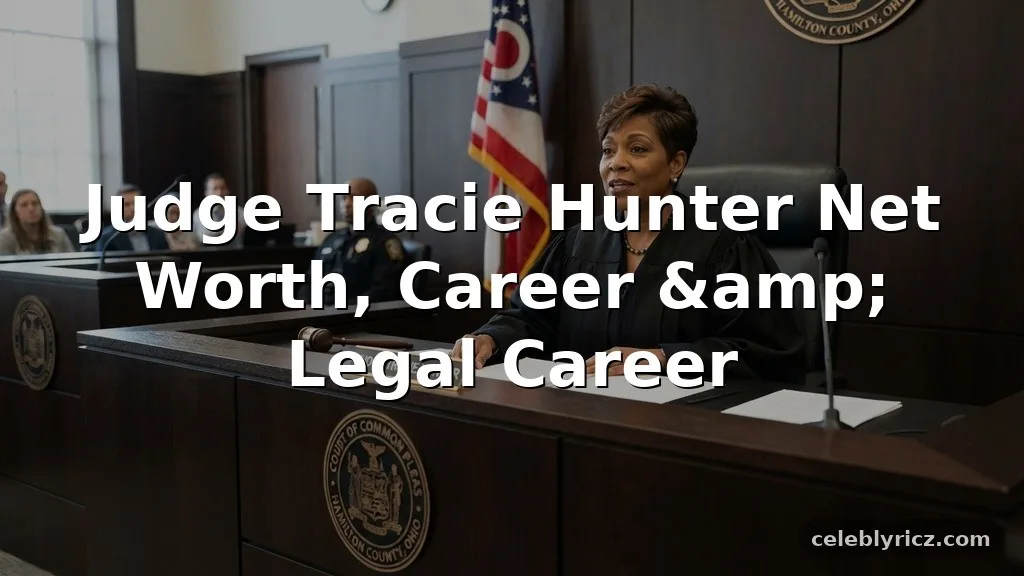

Judge Tracie Hunter’s net worth, career, and legal downfall remain subjects of intense public interest in Cincinnati and beyond. Elected to Ohio’s Hamilton County Juvenile Court in 2010 — the first African American to hold that judgeship — her rise ended in a felony conviction, a jail sentence, and one of the longest-running legal sagas in Ohio history. Her exact wealth has never been reliably disclosed; the public record is about the case, not the money.
This profile covers Tracie Hunter’s age and Cincinnati roots, her legal career before the bench, the disputed 2010 election, the 2013–2014 prosecution over confidential documents given to her brother, the conviction and jail time, the years of appeals, her law license suspension, and where she stands in 2026.
It is a story about judicial power, family loyalty, and a legal battle that refused to end.
At a Glance
| Fact | Details |
|---|---|
| Full name | Tracie Hunter |
| Born | 1966, Cincinnati, Ohio |
| Age in 2026 | 60 years old |
| Education | J.D., University of Cincinnati College of Law (1992) |
| Position | Hamilton County Juvenile Court Judge (2012–2014) |
| Historic first | First African American juvenile court judge in Hamilton County |
| Conviction | Unlawful interest in a public contract (felony), Oct 2014 |
| Sentence | 6 months jail (served ~75 days in 2019) |
| Law license | Indefinitely suspended by Ohio Supreme Court |
| Net worth | Not publicly disclosed; no reliable estimate exists |
Early Life and Legal Career
Tracie Hunter was born in 1966 in Cincinnati, Ohio — the city whose legal and political establishment she would spend a decade battling — making her 60 years old in 2026. She earned her Juris Doctorate from the University of Cincinnati College of Law in 1992, entering the legal profession with a focus on society’s most vulnerable.
After law school, she worked as a legal advocate for abused and neglected children — representing the system’s most vulnerable participants in the cases few lawyers wanted — and as a contract attorney with a public defender’s office — the kind of ground-level legal work that builds both courtroom skills and community credibility. She also served as general manager of WCVG-AM, an urban gospel radio station, giving her a public profile in Cincinnati’s Black community beyond the courtroom.
The WCVG-AM Years
Her tenure as general manager of WCVG-AM, an urban gospel radio station, is often overlooked but was crucial to her rise. The role gave her a voice in Cincinnati’s Black community — literally — and a platform for discussing the issues she cared about: youth, justice, family. It also taught her media skills that served her throughout the legal saga: how to frame a narrative, how to speak to an audience, how to stay on message under pressure.
When the prosecution came, those skills mattered. Hunter was never just a defendant; she was a communicator, and the radio years had trained her for the public-relations war that ran alongside the legal one.
That combination — children’s advocacy law plus community media presence — made her a natural candidate when she decided to run for judge. She understood both the legal system and the people it served.
The Disputed 2010 Election
Hunter ran for Hamilton County Juvenile Court in November 2010. On election night, she appeared to have lost to opponent John Williams by about 2,800 votes. But then it emerged that certain provisional ballots had not been counted because they were cast in the wrong precinct — and the Board of Elections’ handling of those ballots looked arbitrary.
Hunter filed a federal lawsuit, and after more than a year of litigation over which provisional ballots should count, she was declared the winner by just 74 votes. She took the bench in 2012 as the first African American juvenile court judge in Hamilton County history — a milestone celebrated across Cincinnati.
The election fight foreshadowed everything that followed: Hunter as a legal combatant willing to take on institutions, and institutions willing to fight back just as hard. Like the high-profile legal battles covered by national journalists such as Kaitlan Collins, her case would become a media story as much as a legal one.
The 2010 Election Fight in Detail
The battle for the juvenile court seat deserves its own chapter, because it established the pattern of Hunter’s career: institutions versus Tracie Hunter, fought in courtrooms, decided by narrow margins. On election night 2010, John Williams led by roughly 2,800 votes — a comfortable margin that should have ended the race.
But the provisional ballots told a different story. Ohio law requires such ballots to be cast in the correct precinct, and hundreds had been cast in the wrong ones — many by voters given incorrect information by poll workers. The Board of Elections decided to count some but not others, a distinction Hunter’s legal team attacked as arbitrary and unconstitutional.
The federal lawsuit that followed lasted over a year, with the Sixth Circuit and federal district court weighing in on Ohio’s provisional-ballot regime. When the dust settled, enough ballots were counted to flip the result: Hunter won by 74 votes out of tens of thousands cast. It was one of the closest judicial elections in Ohio history — and a victory that made her enemies before she ever took the bench.
The Case Against Her: What Happened
In July 2013, Hunter’s brother, Stephen Hunter — employed as a corrections officer at the Hamilton County Juvenile Court’s Youth Center — was alleged to have hit a youth residing at the center. The Youth Center superintendent recommended he be fired and scheduled a termination hearing.
On the evening Stephen Hunter learned of the hearing, then-Judge Hunter emailed all Youth Center employees about safety concerns and scheduled a closed-door meeting with corrections officers. She then emailed the superintendent requesting documents related to the Youth Center — including documents the superintendent would not normally provide to someone not directly involved in the investigation.
Once the documents were provided, she gave them to her brother. Stephen Hunter offered the documents to his attorney before the termination hearing; the attorney refused some of them, calling it “unethical” to accept them and suggesting an ethics report to the Supreme Court might be required. Stephen Hunter was eventually fired.
Based on her role in her brother’s case, a Hamilton County grand jury indicted Judge Hunter. In January 2014, the Ohio Supreme Court suspended her from the bench pending the outcome of eight felony counts — including tampering with records, forgery, and theft in office.
The 2014 Conviction
In October 2014, a jury found Hunter guilty of a single count: violation of Ohio Revised Code 2921.42(A)(1) — having an unlawful interest in a public contract — a fourth-degree felony. She was acquitted or the jury deadlocked on the other charges. The sentence: six months in jail, court costs, and one year of probation.
The conviction centered on her use of judicial authority to intervene in her brother’s employment matter — providing him confidential documents related to his termination proceeding. Prosecutors framed it as a judge misusing her office for family; her supporters framed it as a selective prosecution of a reform-minded Black judge who challenged the system.
Years of Appeals
What followed was one of Ohio’s longest legal odysseys. The Ohio Supreme Court stayed her sentence pending appeal; the First District Court of Appeals affirmed the conviction on January 15, 2016; on May 18, 2016, the Ohio Supreme Court declined to accept jurisdiction for further review.
Hunter then turned to federal court, filing a habeas corpus petition. U.S. District Judge Timothy Black stayed her sentence pending review — keeping her out of jail for years while the federal case wound through the system. She even returned to federal court over voting rights after the Board of Elections canceled her registration based on the felony conviction, winning a ruling that she was eligible to vote.
The case became a cause célèbre in some circles and a symbol of judicial accountability in others. Few Ohio legal stories have generated as much sustained attention — or as many court filings.
The 2019 Jail Sentence
In July 2019, after the federal stays lifted, Hamilton County Common Pleas Judge Patrick Dinkelacker ordered Hunter to begin serving her sentence: six months minus one day. The courtroom scene was dramatic — Hunter went limp, and sheriff’s deputies dragged her from the courtroom as demonstrators protested. She later explained she had extensive injuries from an accident, including a metal rod in her back limiting her mobility, and said she had blacked out amid the commotion.
She ultimately served about 75 days of the six-month term before release. In interviews afterward, she described mistreatment by guards — cruel language, constant cell searches, denied showers — allegations that added another chapter to an already extraordinary saga.
Law License Suspended
The conviction’s professional consequences extended beyond jail. In April 2023, the Ohio Board of Professional Conduct recommended that Hunter’s law license be suspended indefinitely, and the Ohio Supreme Court imposed the indefinite suspension. For a woman whose identity was built on the law — advocate, judge, officer of the court — the loss of her license was arguably the heaviest blow.
She has continued fighting for reinstatement, but as of 2026, the suspension stands. The path back to practicing law for a convicted felon is steep in any state; in Ohio, with her case’s profile, it is steeper still.
Where Is Tracie Hunter Now (2026)?
As of 2026, Tracie Hunter remains in legal combat mode. In May 2026, a judge denied her request to file a post-conviction petition — another door closed. But in September 2026, she made headlines again by filing affidavits alleging criminal offenses by Ohio Supreme Court justices, including claims about a 2017 email in which a justice requested an internship for his son at the Hamilton County Prosecutor’s Office.
A special prosecutor was assigned to review her allegations against the justices. An attorney for the justices called her claims “baseless,” saying she was “simply bitter because of her prosecution and conviction for violating Ohio law.” The review was pending as of late 2026 — yet another front in a war that has now lasted over a decade.
She remains a polarizing figure in Cincinnati: to supporters, a crusading judge railroaded by a hostile system; to critics, a convicted felon who abused judicial power and refuses to accept the verdict. The truth, as with most such cases, likely contains elements of both narratives.
Net Worth: What Is Known
Judge Tracie Hunter’s net worth has never been reliably disclosed, and no credible estimate exists in public sources. Unlike celebrities or elected officials with financial disclosure requirements that draw media coverage, her finances have not been the subject of verified reporting.
What can be said: her earning years as a judge ended with her 2014 suspension; her law license is indefinitely suspended, eliminating legal practice income; and the decade-plus of litigation undoubtedly consumed significant resources. Any figure attached to her name online should be treated as speculation, not fact. The documented story here is the legal saga, not the money.
The Trial: Eight Counts, One Conviction
The 2014 trial was the culmination of a prosecution that had begun with eight felony counts — a sweeping indictment that included tampering with records, forgery, and theft in office. The state’s theory was broad: that Hunter had systematically misused her judicial office. The jury’s verdict was narrow: guilty on one count, unlawful interest in a public contract.
That single-count conviction is one of the most debated aspects of the case. Supporters argue it proves the prosecution overreached — eight counts filed, one sustained, suggesting a case built more on zeal than evidence. Prosecutors counter that the one count captured the essential misconduct: a judge using her position to benefit her brother’s employment case.
The sentencing reflected the ambiguity. Six months in jail for a fourth-degree felony, plus court costs and probation — significant, but far from the maximum exposure of the original indictment. Former Judge Norbert Nadel imposed the sentence at the end of 2014, setting off the appeals marathon.
Supporters vs. Critics: Two Narratives
Few Ohio cases have split public opinion like Hunter’s. The supporters’ narrative: a reform-minded Black judge, the first African American on the juvenile bench, targeted by a hostile establishment for challenging how the system treated Black youth and their families. In this telling, the prosecution was selective — the kind of case that would never have been brought against a white judge in similar circumstances. Her courtroom dragging in 2019 became, for supporters, a symbol of that hostility.
The critics’ narrative: a judge who broke clear ethical rules, using her office to funnel confidential documents to her brother’s lawyer in a personnel matter. In this telling, the conviction was accountability working as designed — no one, not even a judge, is above the law. Her refusal to accept the verdict, critics say, compounds the original misconduct.
The polarization made her case a staple of public debate — the kind of controversy that fuels commentary across media, from cable news to independent commentators like Myron Gaines who built audiences dissecting divisive public figures. Whatever one’s view, the case became bigger than its facts: a referendum on race, power, and justice in Hamilton County.
The Habeas Years: Federal Court
After Ohio’s courts affirmed the conviction, Hunter’s last resort was federal habeas corpus — the mechanism by which federal courts review state convictions for constitutional violations. U.S. District Judge Timothy Black stayed her sentence pending review, a decision that kept her free for years while the federal litigation played out.
The habeas fight was technically complex, involving questions about the state courts’ handling of her claims and the deference federal courts owe state verdicts. For Hunter, it was also a strategic masterstroke: every year of delay was a year of freedom, a year to build the public case for her innocence, a year in which the political context could shift.
When the stays finally lifted in 2019, the bill came due all at once: the courtroom, the dragging, the jail cell. The habeas years had postponed the inevitable, not prevented it — but they had also kept her story alive, ensuring that when the sentence was finally served, the whole country was watching.
The $17,275 Question
Among the lesser-known details of the case: Hunter was ordered to pay $17,275 in court costs as part of her sentence — a figure that became its own subplot when an intermediary delivered a final check for the costs she owed during the 2019 proceedings, after which her probation was terminated. In a saga of constitutional questions and courtroom drama, the mundane matter of court costs served as a reminder that the legal system always collects its due, whatever the headlines say.
Frequently Asked Questions
What did Judge Tracie Hunter do?
As a Hamilton County Juvenile Court judge, she gave confidential Youth Center documents to her brother, a corrections officer facing termination for allegedly striking a juvenile detainee. She was convicted in 2014 of unlawful interest in a public contract, a fourth-degree felony.
How long did Tracie Hunter serve in jail?
She was sentenced to six months in 2014 but served about 75 days in 2019 after years of appeals and stays, before being released.
Is Tracie Hunter still a judge?
No. She was suspended in January 2014 after indictment, and her felony conviction ended her judicial career. Her law license was later indefinitely suspended.
Where is Tracie Hunter now?
As of 2026, she is out of jail and continues to challenge her conviction — including 2026 filings alleging misconduct by Ohio Supreme Court justices, under review by a special prosecutor.
What is Judge Tracie Hunter’s net worth?
Her net worth has never been reliably disclosed and no credible estimate exists. Her judicial career ended in 2014 and her law license is suspended.
Conclusion
Tracie Hunter’s story is one of the most dramatic in modern Ohio legal history: a children’s advocate who became a history-making judge, then a convicted felon who spent 75 days in jail and lost her law license — and who, more than a decade later, is still fighting. Whether viewed as a crusader wronged by the system or a judge who broke the rules for family, her case raises enduring questions about power, race, and accountability in the judiciary.
As of 2026, the saga continues — new filings, new allegations, new reviews, and a special prosecutor examining her claims against sitting justices. The May 2026 denial of her post-conviction petition closed one door; the September 2026 allegations opened another. For observers, the question is no longer whether the case will end but what form its next chapter will take.
For Tracie Hunter, the gavel fell long ago, but the case never really closed. It may be the defining truth of her career: she does not stop fighting, whatever the odds — and whatever the cost.Explore more on CelebLyricz.