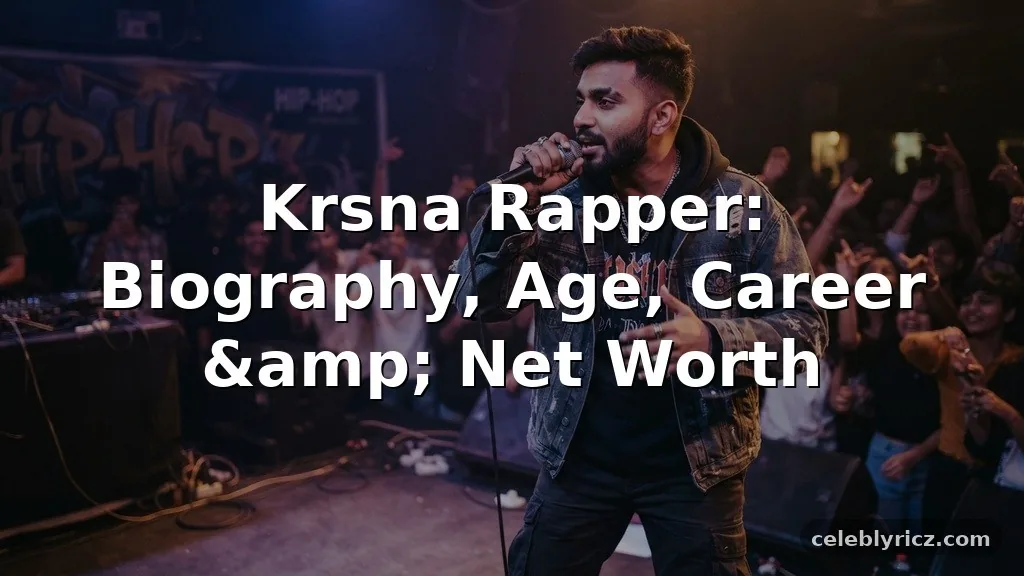

KRSNA — the rapper formerly known as Young Prozpekt, born Krishna Kaul — is widely regarded as one of the founding fathers of Indian hip-hop. Long before desi hip-hop had record labels, streaming playlists, or Bollywood co-signs, he was writing dense, technically sharp verses in New Delhi and uploading them to MySpace, helping to prove that rap in Hindi and English could find an audience in India. His 2010 breakout “Kaisa Mera Desh” became one of the first Indian hip-hop songs to go viral on YouTube, and he has been a central figure in the scene ever since.
Over a career spanning nearly two decades, KRSNA has moved from underground battle-rap circles to a Universal Music deal, from an all-English debut album to Hindi anthems like “Vyanjan” and “Seedha Makeover,” and from local cyphers to collaborations with international heavyweights such as Royce da 5’9″ and Jay Park. As a partner in Raftaar’s Kalamkaar label, he has also helped shape the next generation of Indian rappers. His journey mirrors the rise of desi hip-hop itself — from dismissed subculture to mainstream force.
This in-depth KRSNA rapper biography covers everything fans want to know: his age and real name, his childhood between New Delhi and London, his career from Young Prozpekt to KR$NA, his most famous songs and the Emiway Bantai rap feud, his estimated net worth, and his personal life. As with many independent artists, exact figures for his wealth are unverified — but the publicly reported estimates place the KRSNA rapper net worth figure in the range of ₹5–10 crore.
KRSNA at a Glance
| Fact | Details |
|---|---|
| Real name | Krishna Kaul |
| Stage names | KRSNA, KR$NA (formerly Young Prozpekt / Prozpekt) |
| Date of birth | October 4, 1989 |
| Age in 2026 | 36, turning 37 in October |
| Birthplace | New Delhi, India |
| Height | 5 ft 10 in (178 cm) |
| Nationality | Indian (Kashmiri Pandit family) |
| Parents | Anil Kaul (father), Sumita Kaul (mother) |
| Sibling | Sister: Kashish Kaul |
| Profession | Rapper, songwriter, record producer |
| Languages | Hindi and English |
| Labels | Universal Music, Kalamkaar (partner), Mass Appeal India association |
| Breakthrough song | “Kaisa Mera Desh” (2010) |
| Debut album | Sellout (May 2014) |
| Marital status | Unmarried; keeps personal life private |
| Estimated net worth (2026) | ₹5–10 crore (roughly $600,000–$1.2 million) |
Early Life and Education
Krishna Kaul was born on October 4, 1989, in New Delhi into a Kashmiri Pandit family. His father, Anil Kaul, and mother, Sumita Kaul, raised him alongside his sister Kashish Kaul. During his childhood, the family relocated to South London for personal reasons, and it was there — far from home — that a young Krishna first encountered hip-hop culture in its natural habitat.
London in the 2000s was a tough environment for an outsider. Kaul has described witnessing gang violence and struggling to fit in as an Indian kid in South London schools. At just 14 years old, he turned to rap as a way to connect with the people and culture around him, writing lyrics and joining competitive rap battles. Hip-hop gave him both an identity and a voice — and he never put the pen down.
The family returned to India in 2003, and Kaul completed his schooling in New Delhi before graduating from Hansraj College, Delhi University. He later pursued post-graduate studies at St. Xavier’s College. His education, combined with his bicultural upbringing, gave his writing a distinctive edge: Indian themes delivered with the technical precision of Western battle rap.
Career Beginnings: The Young Prozpekt Era
Back in Delhi, Kaul began writing and recording songs in 2006 under the name Young Prozpekt, posting tracks on his MySpace page. By 2008, he had built a small but devoted following in New Delhi’s underground scene and had even collaborated with artists from the United States and Canada — remarkable for an Indian rapper in the pre-streaming era. His early style was technically dense and confrontational, heavily influenced by the battle-rap tradition he had absorbed in London.
Those underground years were crucial. While Bollywood and pop dominated Indian music, a tiny hip-hop community was forming in basements, college festivals, and online forums. Kaul — alongside a handful of other pioneers — was building the foundation of what would become desi hip-hop, one verse at a time.
Breakthrough: “Kaisa Mera Desh” (2010)
The turning point came in 2010 with “Kaisa Mera Desh” (“What Has My Country Become”). The track — a sharp, socially conscious commentary on the state of the nation — became one of the first Indian hip-hop songs to go viral on YouTube, at one point ranking among the most-watched videos in India. Overnight, Krishna Kaul went from underground prospect to the face of a movement.
“Kaisa Mera Desh” mattered for reasons beyond its views. It proved that Indian audiences would embrace homegrown rap with serious lyrical content, and it established Kaul’s signature mode: the thinking person’s rapper, unafraid to address politics, society, and personal struggle. The song remains his most culturally significant release and the track most associated with his name.
Universal Music Deal and the “Sellout” Album
After a string of underground releases, Kaul signed a record deal with Universal Music in 2013 and officially changed his stage name from Prozpekt to KR$NA (stylized with a dollar sign, later also written as KRSNA). In May 2014, he released his debut album Sellout — an all-English effort on a major label, a bold choice in a market where Hindi film music ruled.
The album’s lead single “Last Night” peaked at number 5 on the VH1 music charts in India, and Kaul became the first hip-hop artist in India to mount a five-city album tour with a live band. It was a landmark moment for the genre. However, the title track’s music video failed to make a major impact amid shrinking label marketing budgets, and after the album cycle, Kaul stepped back for a two-year hiatus to regroup creatively.
Comeback and the Kalamkaar Era
“Vyanjan” and the Hindi Turn (2016)
Kaul returned in 2016 with “Vyanjan” — a Hindi-language tour de force built around intricate wordplay (the title means “consonant,” and the track is a masterclass in Hindi lyricism). The song reintroduced him to a new generation of listeners and marked a decisive shift toward Hindi rap, where his technical skills could shine brightest. Fans and critics alike hailed it as proof that complex, lyrically ambitious Hindi rap could thrive commercially. From that point on, there was no stopping him: a steady run of singles, features, and videos kept him at the center of the desi hip-hop conversation, and “Vyanjan” remains a staple of his live performances.
Partnering with Kalamkaar
Around this period, KRSNA became a partner in Kalamkaar, the hip-hop label co-founded by Raftaar — one of the biggest names in Indian rap. The partnership gave him a institutional home and a platform to mentor emerging talent. Working alongside Raftaar placed him at the heart of the industry’s power structure, and Kalamkaar releases became some of the most anticipated drops in Indian hip-hop.
The Emiway Bantai Feud
In 2019, KRSNA became embroiled in one of Indian hip-hop’s most famous beefs — a back-and-forth with Mumbai rapper Emiway Bantai that began over claims about who truly represented India on the global stage. The feud escalated through a series of diss tracks, with KRSNA’s “Seedha Makeover” and “Maharani” standing as highlights of his battle-rap arsenal. Love it or hate it, the beef was a watershed moment: it drew massive attention to desi hip-hop and showcased KRSNA’s pen at its most lethal.
KRSNA Discography Highlights
| Release | Year | Type | Notes |
|---|---|---|---|
| “Kaisa Mera Desh” | 2010 | Single | Breakthrough viral hit; among the first Indian hip-hop songs on YouTube |
| Sellout | 2014 | Album | Debut studio album on Universal Music; all-English; “Last Night” hit #5 on VH1 India |
| “Vyanjan” | 2016 | Single | Career-redefining Hindi comeback built on intricate wordplay |
| “Seedha Makeover” | 2019 | Diss track | Key salvo in the Emiway Bantai rap feud |
| “Maharani” | 2019 | Single | Fan-favorite from the beef era; showcases battle-rap precision |
| “No Cap” | 2020s | Single | Streaming-era hit reinforcing his mainstream presence |
| “Roll Up” | 2020s | Single | High-energy anthem popular in live sets |
| “Lil Bunty” | 2020s | Single | Character-driven storytelling track |
| “Machayenge 4” | 2020s | Single | Collaboration continuing the popular “Machayenge” series |
| Still Here | 2020s | Album | Later full-length project reflecting his veteran status |
| “I Guess” | 2020s | Single | Official music video crossed 57 million YouTube views |
The discography tells the story of an artist who adapted without surrendering. The English-language ambition of Sellout gave way to the Hindi mastery of “Vyanjan” and beyond — a pivot that mirrored the audience’s own journey. Where early desi hip-hop fans consumed mostly Western rap, today’s listeners proudly claim Hindi lyricism, and KRSNA’s catalog is the bridge between those two eras.
International Collaborations and Recent Work
What separates KRSNA from many of his peers is his genuine international footprint. He has collaborated with American rap veterans Royce da 5’9″ and KXNG Crooked, linked up with Hi-Rez, and worked with Asian stars including Jay Park and Japanese rapper Awich. These are not vanity features — they are co-signs from respected figures in global hip-hop, earned through sheer lyrical ability.
His association with Mass Appeal India — the Indian arm of Nas’s Mass Appeal label — further cemented his international credibility. In 2023, he won the Radio City Freedom Award for Best Indie Collaboration with Brodha V, adding an industry honor to his underground credentials. His later albums, including Still Here, and singles like “No Cap,” “Roll Up,” “Lil Bunty,” and “Machayenge 4” have kept his catalog fresh, while the “I Guess” music video alone has crossed 57 million YouTube views.
He even made a cameo as himself in the 2019 Bollywood film Gully Boy — the Ranveer Singh starrer that brought Indian hip-hop to the mainstream — a fitting acknowledgment of his pioneer status. With over 1.7 million Instagram followers and 2.3 million YouTube subscribers, his audience spans both the underground faithful and the mainstream curious. For readers tracking the broader Indian rap scene, our profile of Dhanda Nyoliwala’s height, age, and biography covers another fast-rising voice in the same movement.
Awards and Recognition
Underground credibility rarely comes with trophies, but KRSNA’s industry recognition has grown with his profile. His most notable honor is the Radio City Freedom Award for Best Indie Collaboration (2023), won alongside Brodha V — a peer widely considered the most technically gifted rapper in South India. The award was significant because it represented the independent music establishment acknowledging what the streets had known for years.
Beyond formal awards, his recognition comes in forms that matter more in hip-hop: co-signs from American rap veterans, a cameo in Gully Boy, a partnership in one of India’s premier rap labels, and the simple fact that younger rappers cite him as the reason they picked up a pen. In a genre built on respect, KRSNA has it in abundance — from fans, from peers, and from the international artists who have shared tracks with him.
KRSNA Rapper Net Worth and Income Sources
Estimates of the KRSNA rapper net worth figure vary, as is typical for independent artists who do not publish their finances. Most Indian entertainment outlets place it between ₹5 crore and ₹10 crore (roughly $600,000 to $1.2 million USD), while a few international biography sites claim figures as high as $3 million. The truth likely sits within the domestic range — substantial for an independent hip-hop artist in India, but modest compared to Bollywood playback stars.
His income comes from the standard mix of a working rapper’s revenue streams, diversified across recordings, performances, and business interests built over two decades in the industry. Music streaming royalties from a deep catalog — including evergreen tracks like “Kaisa Mera Desh” and “Vyanjan” — provide steady passive income. Live performances and college-festival shows across India form the backbone of his earnings, as touring typically pays best for hip-hop artists. YouTube ad revenue from 2.3 million subscribers, brand collaborations (including a partnership with TaylorMade), and his equity role at Kalamkaar add further layers.
What the numbers don’t capture is influence. As one of the earliest Indian rappers and a mentor to younger artists, KRSNA’s real wealth is arguably his position in the culture — a two-decade career that survived underground obscurity, major-label politics, and genre explosions. Our companion piece on KRSNA’s net worth and career breaks down his earnings trajectory in more detail.
Personal Life
KRSNA is unmarried and famously private about his personal life. Unlike many celebrities, he rarely discusses relationships in interviews and keeps his social media focused on music. His parents, Anil Kaul and Sumita Kaul, and his sister Kashish Kaul stay out of the spotlight. He has described himself as introspective, and those who know his music hear it: his lyrics are confessional and philosophical rather than tabloid-friendly.
Outside music, he is known as a golf enthusiast and an occasional social drinker — a low-key lifestyle that matches his artistic persona. He is also active in mentoring younger artists, often sharing studio wisdom with the new signees and collaborators who pass through the Kalamkaar ecosystem. He splits his time between Delhi and his work commitments, remaining deeply connected to the city where his journey began. His Kashmiri Pandit heritage occasionally surfaces in his writing, adding another layer to an already complex artistic identity.
Style and Legacy in Desi Hip-Hop
KRSNA’s rapping style is defined by technical precision: multisyllabic rhyme schemes, internal rhymes, and concept-driven songwriting that rewards close listening. While much of mainstream desi hip-hop leans toward party anthems, his catalog balances bravado with introspection — tracks about his father’s expectations, his London childhood, and the state of the nation sit alongside battle-ready diss records.
That duality — London-bred technique meeting Delhi-rooted storytelling — is his true signature. Few rappers anywhere move as fluidly between English and Hindi, between personal confession and social commentary, between underground purism and mainstream ambition. It is why his music rewards repeat listening: every verse contains layers that casual fans miss and devoted ones quote back at concerts.
His legacy is secure regardless of what comes next. He was rapping in India before it was cool, before it was profitable, and before anyone was watching — and he is still here, still sharp, still setting the lyrical bar. Every young Indian rapper writing complex Hindi verses today is, knowingly or not, walking a path that Krishna Kaul helped clear.
Through Kalamkaar, that influence is now institutional. As a label partner, KRSNA helps decide which new voices get studio time, marketing muscle, and a platform — a remarkable full-circle moment for someone who started by uploading tracks to MySpace with no industry support at all. The gatekeeper was once locked out; now he holds the keys, and he has used them to open doors for others.
Frequently Asked Questions
What is KRSNA’s real name?
KRSNA’s real name is Krishna Kaul. He previously performed under the stage names Young Prozpekt and Prozpekt before adopting KR$NA/KRSNA in 2013.
How old is KRSNA the rapper?
KRSNA is 36 years old, turning 37 in October 2026. He was born Krishna Kaul on October 4, 1989, in New Delhi, India.
What is KRSNA’s net worth?
KRSNA’s net worth is estimated between ₹5 crore and ₹10 crore (roughly $600,000 to $1.2 million USD) as of 2026, according to Indian entertainment outlets. Some international sites claim up to $3 million. All figures are unverified estimates.
What is KRSNA’s most famous song?
KRSNA’s most famous song is “Kaisa Mera Desh” (2010), one of the first Indian hip-hop tracks to go viral on YouTube. Other popular songs include “Vyanjan,” “Seedha Makeover,” “Maharani,” “No Cap,” and “Roll Up.”
Is KRSNA married?
No, KRSNA is unmarried as of 2026 and keeps his personal life private. He rarely discusses relationships publicly and focuses his public image on his music.
Conclusion
From a 14-year-old writing rhymes in South London to a pioneer of Indian hip-hop, Krishna Kaul’s journey as KRSNA is one of the great underground-to-mainstream stories in Asian music. His estimated net worth of ₹5–10 crore reflects nearly two decades of independent grinding — viral breakthroughs, a major-label album, a career-redefining comeback, international collaborations, and a label partnership that shapes the genre’s future. He never chased trends; instead, he outlasted them, proving that authenticity and craft can sustain a career long after hype fades.
What defines KRSNA is not a single hit but consistency of craft. In a scene that often rewards virality over lyricism, he remains the rapper other rappers respect — the technician, the pioneer, the pen. Whether he is trading verses with American legends or mentoring the next wave through Kalamkaar, his influence on desi hip-hop is permanent. At 36, with his best years potentially still ahead, the boy from Delhi who found his voice in London has become the voice of a generation — and the blueprint for every desi rapper who dreams of turning raw talent into a lasting career.