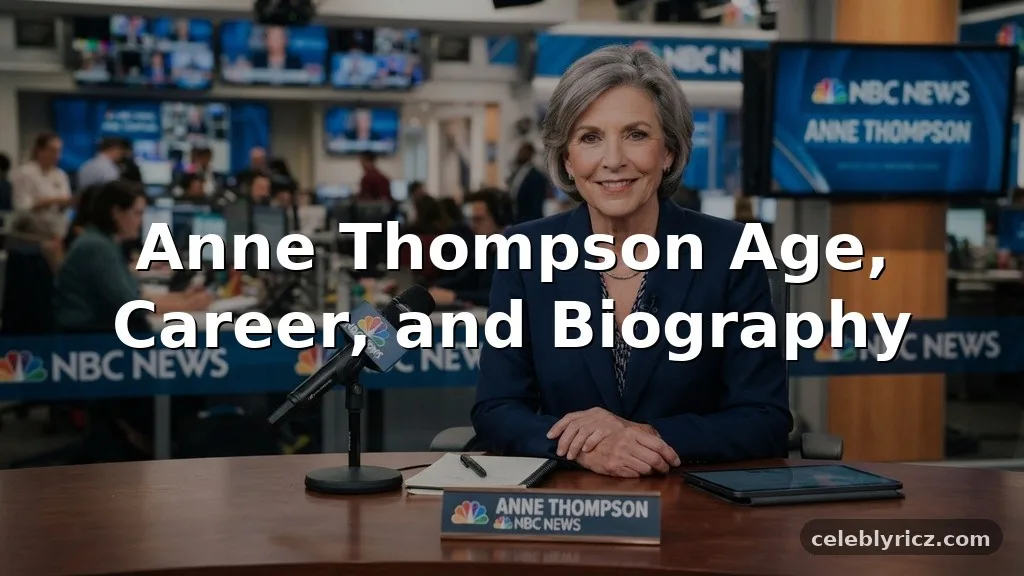

Anne Thompson age is widely reported as 72 — the NBC News veteran is said to have been born in 1954, though NBC has never officially confirmed her exact date of birth. What is beyond dispute is her stature: as NBC News’ Chief Environmental Affairs Correspondent, Thompson has spent nearly three decades at the network covering the stories that define eras — from the 2008 financial crisis to the BP oil spill to three papal transitions.
A two-time Gerald Loeb Award winner honored with seven Emmy Awards and the Audubon Society’s prestigious Rachel Carson Award, Thompson’s remarkable career arcs from humble local newsrooms in South Bend, St. Louis, and Detroit all the way to the highest levels of American network journalism — and she earned every step of the climb. She has reported on economics, the environment, and the Catholic Church with a rigor and reliability that made her one of American television news’ most trusted specialists — the correspondent producers call when the story is too important to get wrong.
Here is her full story: her age and background, her education at Notre Dame, her climb through local news, her NBC career, her awards, and her personal life as of 2026.
Anne Thompson Quick Facts
| Fact | Details |
|---|---|
| Full name | Anne Thompson |
| Birth year | Widely reported as 1954 (exact date not officially confirmed) |
| Age | Reported as 72 years old (as of 2026) |
| Birthplace | New York City, USA (raised partly in Europe) |
| Nationality | American |
| Education | International School of Brussels; University of Notre Dame (BA, American Studies) |
| Profession | Television journalist |
| Current role | Chief Environmental Affairs Correspondent, NBC News |
| Network tenure | NBC News since 1997 |
| Awards | 2 Gerald Loeb Awards, 7 Emmy Awards, Rachel Carson Award (2017) |
| Beats | Environment, climate, Catholic Church/Vatican, economics |
Anne Thompson Age: Reported as 72
Anne Thompson’s age is widely reported as 72, with most biographical sources listing her birth year as 1954 (some specify August 10). However, NBC News has never published her date of birth, and Thompson herself has not discussed it in verified interviews — so the precise date should be treated as reported rather than confirmed.
What the professional timeline confirms: she graduated from Notre Dame in 1979 and began television news the very same year, a trajectory that aligns squarely with a mid-1950s birth and roughly 47 years in the business by 2026. A Leo by the August account, she belongs to the generation of journalists who learned the craft in local newsrooms before cable news transformed the industry.
Early Life and Education
Thompson was born in New York City and raised partly in Europe — an international upbringing that gave her a broader perspective than most American journalists. She attended the International School of Brussels in Belgium before returning to the United States for college.
At the University of Notre Dame in Indiana, she earned a Bachelor of Arts in American Studies, graduating in 1979. Her connection to Notre Dame endured: in 2010, she served on the university’s Board of Trustees. The American Studies background — an interdisciplinary immersion in history, culture, politics, and institutions — proved ideal preparation for a journalist who would go on to cover the American economy, the global environment, and the Vatican: three beats that each demand understanding how large systems shape human lives.
Local News Years: 1979–1997
Thompson’s career began the way great journalism careers used to: in local news. From 1979 to 1983, she was a general assignment reporter at WNDU-TV in South Bend, Indiana — learning to cover everything, on deadline, with minimal resources.
From 1983 to 1986, she served as a consumer reporter at KSDK-TV, the NBC affiliate in St. Louis, Missouri — advocacy journalism that taught her to translate complex issues for viewers. Then came eleven years at WDIV-TV, the NBC affiliate in Detroit, Michigan (1986–1997), where she matured into a seasoned reporter; her seven Emmy Awards include work from this period, notably coverage of stories like the Jessica DeBoer custody battle.
Eighteen years in local news built an unshakeable foundation: source development across three distinct American cities, deadline discipline forged under daily broadcast pressure, and the rare ability to make genuinely complicated stories clear without condescension. When NBC News called in 1997, she was ready.
NBC News: National Correspondent to Chief (1997–Present)
Thompson joined NBC News in 1997 as a national correspondent — the culmination of eighteen years of local-news grinding — and her rise through the network’s ranks was swift precisely because she arrived fully formed. From March 2005 to April 2007, she served as Chief Financial Correspondent — covering the economic impact of Hurricane Katrina, the Martha Stewart trials, and the gathering storm of the financial crisis. Her business reporting earned two Gerald Loeb Awards: the 2004 Television Short Form award for “The Jobless Recovery” and the 2006 Television Deadline award for “The Katrina Effect.”
In April 2007, she became Chief Environmental Affairs Correspondent — the role that defined her legacy. Her reports appear across every NBC News platform: NBC Nightly News with its tens of millions of viewers, the Today show, MSNBC’s cable audience, NBC News Now’s streaming viewers, and NBCNews.com’s digital readership — a multi-platform reach that makes her one of the most-watched environmental journalists in the world.
Landmark Coverage
Thompson’s environmental reporting includes some of the decade’s biggest stories:
- The 2010 BP oil spill in the Gulf of Mexico — investigative coverage that earned her the 2017 Rachel Carson Award from the Audubon Society.
- Climate change and extreme weather — sustained reporting on the defining environmental story of the era.
- The 2008 financial crisis — leading NBC’s coverage as Chief Financial Correspondent.
- Hurricane Katrina’s aftermath — economic and human impact reporting.
Her parallel role as NBC’s Vatican correspondent — a beat she has held alongside her environmental duties for years — is equally distinguished: she has covered three papal transitions, including Pope Benedict XVI and Pope Francis — a beat requiring theological literacy, diplomatic sensitivity, and the trust of one of the world’s most secretive institutions.
Her career parallels other top broadcast journalists who rose through rigor and specialization — correspondents like Kaitlan Collins, who similarly built reputations on relentless, substantive reporting.
Awards and Recognition
- Two Gerald Loeb Awards for business journalism (2004, 2006) — the field’s highest honor.
- Seven Emmy Awards across her local and network career.
- 2017 Rachel Carson Award from the Audubon Society for environmental investigative journalism.
- Notre Dame Board of Trustees (2010) — institutional recognition from her alma mater.
The Loeb Awards deserve emphasis: business journalism’s Pulitzer equivalent, won twice, for stories (“The Jobless Recovery,” “The Katrina Effect”) that explained economic catastrophe to ordinary viewers. That explanatory gift — making the complex clear without dumbing it down — is Thompson’s signature.
Reporting Style and Reputation
Colleagues describe Thompson as the model of the specialist correspondent: deeply sourced, meticulously prepared, and allergic to sensationalism. Her environmental reporting avoids both alarmism and complacency — a difficult balance in climate coverage — earning trust across the political spectrum.
Her Vatican coverage demonstrates the same qualities applied differently: patience with opaque institutions, respect for belief, and the ability to explain ancient rituals to modern audiences. Covering three papacies requires a rare combination of knowledge and discretion.
In an era of hot takes, Thompson’s cool competence stands out. She reports; she doesn’t perform. That old-school discipline — honed across eighteen years of local news — is increasingly rare and increasingly valuable.
Personal Life
Thompson keeps her personal life private. There is no publicly confirmed spouse — some sources describe her as single, others offer no information, and no credible outlet has reported a marriage. She has not publicly discussed children or family details.
This privacy is entirely consistent with her professional persona across four decades: the story is the work, never the worker — a discipline that has kept her credible while more self-promotional colleagues flamed out. In nearly three decades on national television, she has never made herself the story — a discipline that itself commands respect.
Note: NBC’s Anne Thompson is often confused with Anne Thompson of IndieWire, the film journalist and Editor-at-Large — a different person entirely. The NBC correspondent covers environment and the Vatican; the IndieWire writer covers cinema.
Net Worth and Salary
Thompson’s net worth is estimated at around $1 million, with her NBC correspondent salary estimated near $300,000 — though neither figure is officially confirmed, as NBC does not disclose correspondent pay. Her wealth reflects a long salaried career: eighteen years in local news followed by nearly three decades at the network.
Unlike celebrity journalists with book deals, speaking empires, and primetime opinion shows, Thompson’s earnings come from journalism itself — the steady, substantial compensation of a top network correspondent. Fellow broadcast figures who built wealth through television careers, like Pat McAfee, show the range of the industry’s economics; Thompson represents its journalistic core.
The BP Oil Spill: Career-Defining Coverage
The 2010 Deepwater Horizon disaster — the largest marine oil spill in history — was Anne Thompson’s signature story as environmental correspondent. For months, she reported from the Gulf Coast as oil gushed from the seafloor: the failed containment efforts, the ecological devastation, the fishing communities destroyed, and BP’s evolving accountability.
Her coverage stood out for its investigative depth. While much spill reporting focused on the spectacle — the live “spillcam,” the political theater — Thompson dug into the systemic failures: regulatory capture, safety shortcuts, and the industry practices that made disaster inevitable. That rigor earned her the 2017 Rachel Carson Award from the Audubon Society, named for the author of Silent Spring — placing Thompson in the lineage of America’s great environmental journalists.
The spill coverage also demonstrated her range: she could report the science (dispersants, dead zones, marsh ecology), the economics (fisheries, tourism, claims), and the human cost — often in the same segment. Few correspondents command all three registers.
The Vatican Beat: Three Papacies
Covering the Catholic Church for American television is one of journalism’s most specialized assignments — and Thompson has done it across three papal transitions. The beat demands what she uniquely offers: substantive knowledge, institutional patience, and the ability to explain 2,000 years of tradition to a secular audience in two minutes.
Her Vatican coverage included Pope Benedict XVI’s historic resignation in 2013 — the first papal abdication in 600 years — and the election of Pope Francis, with all its theological and geopolitical implications. More recently, she covered Francis’s death and the election of his successor. Each transition is part conclave politics, part theology, part global diplomacy — and Thompson navigated all three dimensions.
The assignment reveals NBC’s trust in her: the Vatican beat goes to correspondents who won’t embarrass the network with shallow or disrespectful coverage. Thompson’s eighteen years of local-news discipline — get it right, respect your subjects — made her the natural choice.
The Financial Crisis Years
Before the environment, there was economics. As Chief Financial Correspondent (2005–2007), Thompson covered the American economy at its most fragile: the housing bubble’s inflation, Hurricane Katrina’s economic devastation, and the early tremors of the 2008 collapse.
Her Loeb-winning work — “The Jobless Recovery” (2004) and “The Katrina Effect” (2006) — exemplified her gift: taking abstract economic forces and showing their human consequences. The “jobless recovery” concept — GDP growing while employment stagnated — was wonky until Thompson put faces on it. “The Katrina Effect” traced how a hurricane reshaped regional and national economics.
When the financial crisis hit in 2008, her expertise made her NBC’s authoritative voice on the story — explaining credit default swaps and mortgage-backed securities to viewers who’d never heard the terms. The transition from financial to environmental correspondent in 2007 looks, in retrospect, like a natural evolution: both beats are about systems, consequences, and the long term.
Detroit Years: The Making of a Correspondent
Eleven years at WDIV-TV in Detroit (1986–1997) deserve emphasis — it’s where Thompson became Thompson. Detroit in those years was America’s hardest news town: deindustrialization, the crack epidemic, political corruption, racial tension, and resilient communities fighting back. A general assignment reporter there covered everything, and Thompson covered it all.
Her seven Emmys include Detroit-era work — the kind of stories that win local Emmys: investigations that change policy, human dramas that reveal systems. The Jessica DeBoer custody battle, which drew national attention, showcased her ability to handle legally complex, emotionally fraught stories with fairness.
Detroit taught her what Brussels and Notre Dame couldn’t: how America actually works at street level. When she later explained the BP spill’s impact on Gulf fishing families or Katrina’s economic wreckage, she was drawing on a decade of listening to people in crisis. The empathy was earned, not performed.
Journalism in the Thompson Era
Thompson’s career spans journalism’s most turbulent transformation: she started when three networks dominated, local news was profitable, and “the media” meant newspapers and broadcasts. She adapted through cable news, the internet, social media, and streaming — without ever becoming a creature of any of them.
Her model — deep beat expertise, institutional trust, explanatory clarity — is increasingly rare in an industry that rewards speed and personality. But it’s also increasingly valuable: as information environments fragment, audiences gravitate to correspondents they trust. Thompson’s four decades of credibility are a moat no algorithm can cross.
Young journalists studying her career should note the unglamorous secret: eighteen years of local news before the network. There are no shortcuts to the authority she carries — only reps, only deadlines, only the slow accumulation of knowledge and trust.
Anne Thompson’s Environmental Reporting Beat
Thompson’s current role as NBC News’ chief environmental affairs correspondent puts her at the center of one of journalism’s toughest assignments. Climate and energy stories do not break and resolve in a day; they develop over decades. Thompson has built her approach around staying with them, returning to the same communities and the same data year after year.
She reported extensively from the Gulf Coast in the aftermath of the 2010 BP oil spill, covering both the ecological fallout and the economic strain on fishing families. Her dispatches from that period are characteristic of her style: patient, fact-driven, and centered on the people living the story rather than the politics around it.
Thompson has also covered international climate summits and the growing toll of extreme weather on American towns, from hurricanes to wildfires. She has a reputation for translating complex scientific findings into clear broadcast reporting without flattening the nuance. Producers trust her with the stories that require homework, and she does it.
Within NBC, she has become the correspondent other reporters consult when an environmental angle needs grounding. That kind of institutional authority is earned slowly, and it explains why her byline still carries weight after four decades in the business. Few correspondents have covered the environment beat with such consistency.
Frequently Asked Questions
How old is Anne Thompson from NBC News?
Anne Thompson’s age is widely reported as 72, with most sources listing her birth year as 1954. However, NBC News has never officially confirmed her exact date of birth, so the precise date should be treated as reported rather than verified.
What does Anne Thompson do at NBC News?
Anne Thompson is NBC News’ Chief Environmental Affairs Correspondent, covering climate change, environmental issues, and economics. She also serves as NBC’s lead Vatican correspondent, having covered three papal transitions.
What awards has Anne Thompson won?
Anne Thompson has won two Gerald Loeb Awards for business journalism (2004, 2006), seven Emmy Awards, and the 2017 Rachel Carson Award from the Audubon Society for her investigative reporting on the BP oil spill and climate change.
Is Anne Thompson married?
There is no publicly confirmed spouse. Anne Thompson keeps her personal life private, and no credible outlet has reported a marriage.
Is NBC’s Anne Thompson the same as IndieWire’s Anne Thompson?
No. NBC’s Anne Thompson is a television correspondent covering environment and the Vatican. IndieWire’s Anne Thompson is a separate film journalist and Editor-at-Large. They share a name but are different people.
Conclusion
Anne Thompson’s career is a testament to journalism’s highest values: eighteen years in local newsrooms, nearly three decades at NBC, two Loeb Awards, seven Emmys, and coverage of the stories — financial collapse, environmental catastrophe, papal transitions — that defined generations. Whether she is 72 or otherwise, the record of her work needs no embellishment.
In an industry increasingly driven by personality, performance, and partisan heat, Thompson remains a reporter’s reporter in the classic mold: deeply sourced, relentlessly serious, and devoted above all to making complex stories clear for the viewers she serves. Her legacy is the work itself — four decades of it, from South Bend general assignment to the Vatican press corps — and the work speaks volumes that no biography could amplify.
Explore more on CelebLyricz.